Jessie Buckley

  • I’m Thinking of Ending Things (2020)

    (Netflix Streaming, September 2021) I have seldom felt as strong an impulse to bail on a film as I did through the fifth-to-fifteenth minutes of I’m Thinking of Ending Things. Here I was, stuck in the exasperating mind of a young woman who is herself stuck in a car with her current but soon-to-be ex-boyfriend. “I’m thinking of ending things,” she endlessly ruminates and repeats, berating herself for coming along as she contemplates — nay, looks forward—to ending their six-week relationship that feels shorter than the film already. The monologue goes on and on in what feels like a straight adaptation of a stream-of-consciousness prose narrative straight to the screen. Fortunately, the film has other creepy weirdnesses in store once past that rebarbative opening — This being a film from iconoclastic writer-director auteur Charlie Kaufman, the surrealism and off-putting material keeps piling up until viewers realize that I’m Thinking of Ending Things is not interested in narrative as much as formal experimentation. Narrators change, perspectives shift, genres blur into each other, strange stuff happens and we just keep going to the next thing. There’s an explanation of sorts, but no one will be blamed if they just don’t want to play Kaufman’s games. There are a few interesting moments and plenty of pop-culture quotes (including swatches of repurposed dialogue) and I’m rather happy with Jesse Plemons’ persona-busting performance. I also liked Jessie Buckley even if her character is exasperating—but that goes for much of the film as a whole. It’s not particularly deep experimental cinema, but it’s not interested by conventional storytelling either, so you’re either along for the ride or you check out—and I’m Thinking of Ending Things is a ride that starts out slow enough to send less-patient viewers heading for the exits.
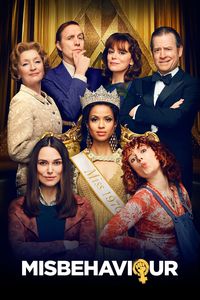
  • Misbehaviour (2020)

    Misbehaviour (2020)

    (On Cable TV, April 2021) The grrl-empowerment drama is a well-established genre by now, and Misbehaviour seems to be following in the steps of half a dozen examples of the form, perhaps most closely the recent Battle of the Sexes. You can check off the elements: a historical recreation a few decades past highlighting unbelievable sexism, plucky heroines banding together to fight the patriarchy, potshots at the institutions’ refusal to move forward, one hissable patriarch as an antagonist, queer characters, lighthearted tone, all savvily wrapped in well-executed crowd-pleasing style. It’s now common because it’s fun, mind you: you can’t be against the message of the film, and the underdog narrative always plays well even if it feels increasingly calculated. Misbehaviour does a little bit than most entries in the subgenre by being slightly more ambivalent about its message than a rote regurgitation of feminist talking points. Largely taking place in 1970 London, it tells us about the protests that targeted the Miss World contest held at the time, featuring a few activists going against none other than emcee legend Bob Hope, who comes to personify the worst aspects of the patriarchal agenda—hero of a generation, villain of the next. Our protagonists, anchored by Kiera Knightley (even though Jessie Buckley has a more striking role), aren’t the only ones with progressive credentials, however, as a very interesting subplot featuring Gugu Mbatha-Raw ends up establishing. Progressivity and diversity are multidimensional movements that have the good luck of all sharing white men as antagonists, and part of what makes Misbehaviour more interesting is in opposing different views about the Miss World contest, and what happens when the contest ends up scoring a victory for diversity even within the confines of the structure that our (white) protagonists are contesting. That kind of complementary complexity is something that reflects real-world tensions within the progressive communities, and something I’d like to see a bit more rather than simplistic underdog fairy-tales. As a result, Misbehaviour does get better as it goes on, and then becomes much better once it hits its final moments. The style is meant to be easily accessible, and the viewing experience reflects that: it’s an easy film to watch and to like even when it plays close to the obvious formula. Despite the film’s hit-job, I still like Bob Hope — but then again, I can pass as a patriarch if I need to.