Joan Bennett

  • Maybe it’s Love aka Eleven Men and a Girl (1930)

    Maybe it’s Love aka Eleven Men and a Girl (1930)

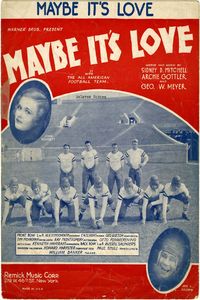
    (On Cable TV, May 2021) In the pantheon of largely forgotten comic actors, I have an unaccountable fondness for Joe E. Brown, he of the impossibly wide mouth, expressive face and gentle-giant demeanour. He gives Maybe it’s Love a significant head-start that the rest of the film doesn’t deserve. A dull college football comedy, it focuses on the underhanded means through which an underdog college builds a strong football team to take on their perennial opponents — namely, sending a lovely girl to entice great football players into enrolling. Brown plays an older player, while Joan Bennett plays the seductress. (Meanwhile, real football players play the recruits, and they are clearly not actors.)  At 73 minutes, Maybe it’s Love flies by, although it’s not always swift to deliver the laughs. The slightly risqué implications of the premise clearly hail from a freer Pre-Code era, while the portrayal of college football circa 1930 is good for a light anthropology lesson (or maybe another instance of something that hasn’t changed in American society — speaking of which, the heroine is a bookish girl who becomes instantly attractive by taking off her glasses). Brown is all right but not used to his full potential, and that pretty much goes for the rest of the film as well. The inherent naughtiness of the premise is really underplayed, and many comic opportunities are reduced to their barest (bearest?) essentials. I can think of many worse movies, but even by the standards of 1930, Maybe it’s Love isn’t all that good.

  • Scarlett Street (1945)

    Scarlett Street (1945)

    (On Cable TV, February 2020) I do like Scarlett Street quite a bit, but I have a feeling I would have liked it even more if I had seen it not so shortly after 1944’s The Woman in the Window, of which it’s practically a remake with the same director, stars and themes. Here too, Edward G. Robinson plays a middle-aged man whose artistic impulses lead him to meet a dangerous woman (again; Joan Bennett) who asks him for a murderous favour that eventually takes everything from him. But if you’re not aware of The Woman in the Window, then Scarlett Street does play a bit better. It’s a steady slide from one slightly greedy action to a worse one, and things just keep escalating for our poor protagonist, who thought he could just indulge himself without anyone knowing. The hand of fate weighs heavily, and director Fritz Lang films it all in shadowy style. One thing that Scarlett Street does better than its predecessor, however, is not blink at the last moment—in true noir fashion, there’s no waking up from the nightmare that comes from corruption. You’d be hard-pressed to find many better early noirs, and both Robinson and Bennett are used to great effect here. I’m nearly sure that seeing this again in a few years, without first watching its predecessor, will make it even more effective.

  • The Woman in the Window (1944)

    The Woman in the Window (1944)

    (On Cable TV, June 2019) There are two distinct sections in classic noir film The Woman in the Window. The first takes up most of the film and is an exemplar of the form. The second is the film’s final two minutes, and it destroys what we think of a noir movie. I’m eager to discuss it in spoilerriffic details, but first we’ll have a few general comments about the film’s bulk. (Any readers unfamiliar with the film are advised to go see it—no, really, it’s worth a look—before proceeding any further.)  Edward G. Robinson reinvented himself in the role of a meek professor finding himself in the middle of a terrible situation, forced to kill the lover of the woman he just met, and then arrange a coverup that goes awry. Joan Bennett is quite good as the titular woman, beguiling enough (wow, that see-through blouse!) that she can lead men to murder and deception. Dan Duryea is the third highlight of the film, playing a would-be blackmailer who cranks the tension even higher. Director Fritz Lang brings some moviemaking savvy to the film, but the result seems uncomfortable with the implicit dark humour of the screenplay as ironies mount and surround the protagonist. For much of its duration, The Woman in the Window is pitch-perfect noir as our meek protagonist simply finds himself at the wrong place and the wrong time, and keeps making desperate decisions that run against his better judgment and make the situation worse. It all leads to a climactic sequence in which he swallows enough pills to bring down a horse … and wakes up at the beginning of the film, having imagined it all. Do note that there are enough clues and foreshadowing here and there to make the ending somewhat organic and premeditated rather than tacked on: our protagonists openly muses about degrees of murder in the opening segment, then talks about the siren call of adventure with his friends before falling into slumber. The problem with the film may be one of anticipated codes: What we know of noir as it developed after 1944 is that its protagonists don’t get an easy way out: they suffer the whims of a capricious universe that sends temptations, mobsters and femmes fatales their way, and even having a solid moral compass may not be enough to save them from ruin. Still, there is a feeling that the happy ending is not deserved, that it cheapens the dramatic buildup, that it runs counter to the very foundations of noir. Whether it’s good or not is immaterial—although film historians will be quick to point out that the film was a commercial success and that its immediate remake, Scarlett Street (released a year later and featuring the same director, stars, plot) with a far more unforgiving ending, isn’t as remembered as the original. Few stories, all mediums combined, ever try to attempt the “it was all a dream” stunt for good reasons, and The Woman in the Window is a study in why.