Joan Fontaine

  • Jane Eyre (1943)

    Jane Eyre (1943)

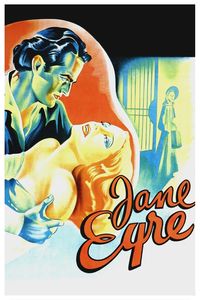
    (On Cable TV, February 2021) For anyone even remotely knowledgeable about gothic romances, Jane Eyre is the ur-example for the form — with its likable governess becoming entangled in a romance with the mysterious owner of a large estate, and a crazy woman locked in the cellar. This version of the much-adapted Charlotte Bronte novel does have a truly impressive cast and crew — a script featuring contributions from Aldous Huxley and John Houseman, Joan Fontaine in the titular role and, perhaps best of all, Orson Welles (who also produced) as the mysterious Edward Rochester. The film plays up its sombre era of abandoned children, cruel orphanages and mysterious manors halfway between Dickensian social criticism and film noir visual melodrama. The result is curiously enjoyable, although now in a self-aware register that wallows in the overdone style of the piece. Welles is credibly menacing here, already channelling the scene-chewing nature of many of his later performances. It’s a period drama of a far more mysterious nature than many of the literary adaptations of the time, and it fits remarkably well will the mini-wave of domestic thrillers of the mid-1940s. As usual with stories adapted so frequently to the screen, the 1943 version of Jane Eyre is more remarkable for the cast and crew assembled for the occasion, as a snapshot of what Hollywood could do with the source material at the time than for the innate qualities of the story itself.
  • A Damsel in Distress (1937)

    A Damsel in Distress (1937)

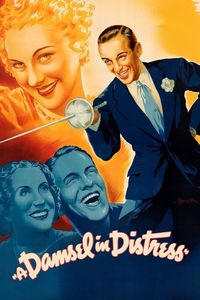
    (On Cable TV, October 2020) One of the lesser Fred Astaire musicals of the 1930s, A Damsel in Distress takes us to England, where Astaire plays (as usual) a renowned entertainer trying to find love. He eventually finds it in the character of an English lady, although not without the complications that usually follow such narratives. The cast does offer some interest, with Joan Fontaine at the female lead, and comic characters played by none other than George Burns and Gracie Allen, the later being progressively funnier as a squeaky-voiced airhead. There’s the usual number and variety of dance numbers from Astaire, and while there’s nothing truly anthology-worthy here, two or three sequences still work really well: “Stiff Upper Lip” leads to a showpiece funhouse dance number, while “Nice Work If You Can Get It” leads to an Astaire drum solo played with a variety of appendages. Nearly everything about the film is perfunctory by Astaire’s high standards—Fontaine is not a particularly good dancer, the comedy is slight (aside from Burns and Allen) and the premise is a bit dull compared to other movies of the era. Those who keep a wearied eye on Astaire’s romantic persona (boiled down to “no means try again later”) will note an explicit statement of the persistence credo late in the film, where a character calls out Astaire for being too passive and to Go Get It. Modern audiences will groan at that moment—what works for Astaire would mean a restraining order and social media denunciations in real life twenty-first century. Still, A Damsel in Distress itself is not too bad, even though it is frankly one of the more easily disposable of Astaire’s black-and-white films.

  • Ivanhoe (1952)

    Ivanhoe (1952)

    (On Cable TV, November 2019) Technicolor-era historical Hollywood adventures don’t get any more exemplary than Ivanhoe, what with a 19th-century novel being loosely adapted into a Technicolor swashbuckler. It has more than its share of issues, especially from a contemporary perspective, but it also has quite a bit of charm. Robert Taylor and Joan Fontaine may star as the lead couple, but modern viewers may be forgiven for only having eyes for Elizabeth Taylor in an early yet striking supporting role. George Sanders is also up to his usual standards playing a villain. Otherwise, the rest of the film is a succession of sex appeal, sword fights, medieval jousts, and arena combat as a climactic bow. Ivanhoe is not to be trusted as a historical document, but it’s not a bad way to spend nearly two hours—the film is easy to take in, the hero is interesting (even a bit devious in his combat style), Taylor is luminous and it all builds to an effective action sequence in a film that has a few of them. As a competent Hollywood rendition of medieval adventure, Ivanhoe was nominated for three Academy Awards back then (including Best Picture) and you can see why it was both a commercial and critical success. This less-usual take on the Robin Hood legend is quite intentional, and it prefigures other films in that vein.

  • Gunga Din (1939)

    Gunga Din (1939)

    (On Cable TV, August 2019) As a straight white male, I’ve grown increasingly conscious of my own privilege in exploring Hollywood movie history—which was overwhelmingly built by and for straight white men, with the result that they are now best appreciated by straight white men (but maybe not the kind of straight white men who enjoy watching older movies). These issues are impossible to ignore while watching films like Gunga Din, deliberately set in an environment where colonialism is celebrated. Adapted by Rudyard Kipling stories, it’s an adventure film featuring three British soldiers somewhere around the edges of the British Raj, sent to repair communications but soon embroiled in the revival of a murderous cult intent on causing harm to the empire. (The histrionics of the antagonist get so shrill by the end of his speech to the heroes that I half-expected him to conclude with “ … and then I will molest your moms and kick your dogs.”)  Cary Grant, Victor McLaglen and Douglas Fairbanks Jr. are the three likable male leads, with Sam Jaffe playing the titular Gunga Din as a native water carrier who would like nothing more than to fight for the empire. (He gets his wishes, suffers for it and it sent off with the ultimate colonial compliment—”he was a good soldier.”)  Joan Fontaine pops up as one of the soldiers’ fiancée, leading to some curious hijinks in which the two other soldiers do everything they can to sabotage his impending marriage. It all leads to some really good action scenes, suspense sequences and a grand spirit of adventure against overwhelming odds. And that’s the kind of film that Gunga Din is: at once a terrific adventure story in the old-fashioned mould, and yet a disquieting grab-bag of very outdated ideas focusing on the straight white male as the centre of the universe: Boys will be boys (yucky girls had better not disrupt anything), and non-whites are to be killed unless they’re willing to help whites kill other non-whites. Modern viewers will find the end result to be a steady whiplash of contradictions, any enjoyment of the film’s high points constantly being undercut by heave-inducing Victorian values. Even my own privilege failed me throughout Gunga Din: Despite my best intentions and proven capacity at ignoring the bad stuff to focus on the good wasn’t enough to get me to like the result. If I end up recommending Gunga Din in any circumstance, it will be to show how terrible these movies could be.

  • Rebecca (1940)

    Rebecca (1940)

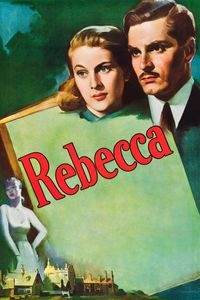
    (On DVD, September 2018) For all of his famed ability at creating and sustaining suspense, Alfred Hitchcock could have a surprisingly romantic streak at times, and few of his movies manage to combine both traits as intriguingly as in Rebecca, perhaps one of the best depiction of the Gothic romance sub-sub-genre ever put on-screen, adapted from Daphne Du Maurier’s still well-known novel. The mystery here is intensely personal, as the new wife of a rich man has trouble measuring up to the example set by her predecessor, the mistress of a vast estate who clearly still has her fans in the household help. Against the lonely and oppressive backdrop of a house far too big for its inhabitants, the heroine starts wondering who’s not out to murder her. It escalates into a fiery climax, but the point of the film, after a sunny romantic first act, is the heroine looking over her shoulder, discovering deeper secrets about her new husband and his house, and sparring with a standoffish housekeeper. Rebecca is noteworthy in Hitchcock’s oeuvre in a few respect: it was his first Hollywood project after emigrating from Great Britain; it was produced/dictated by the legendary producer David O. Selznick and it’s the only Hitchcock film to win the Best Picture Academy Award. Both Joan Fontaine and Laurence Olivier are quite good as the leads, but it’s Judith Anderson who has the best role as the ever-faithful Mrs. Danvers. Otherwise, Rebecca is still good fun to watch, not quite noir but definitely Gothic enough to be visually interesting on top of Hitchcock’s usually skillful direction.

  • Suspicion (1941)

    Suspicion (1941)

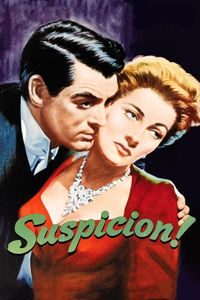
    (On Cable TV, May 2018) Great casting can make or break a movie, but I’m still not too sure what it does to Alfred Hitchcock’s Suspicion. Casting Cary Grant as a suave, sophisticated, easily charming man who ends up hiding an inglorious past to his wife seems like a slam-dunk: By that point in his career, Grant had developed a screen persona ideally suited to this kind of role. But the sword cuts both ways, given how audiences weren’t (and still aren’t) so willing to accept Grant as a purely evil character. Hence the ending that explains a few things and allows viewers to walk away satisfied and reassured in Grant’s persona. It’s a relief of an ending, but is it the most appropriate one? I still don’t know. The novel on which the film is based took a far more ambiguous approach to the same material, keeping up the eponymous suspicion through which the heroine (Joan Fontaine; rather good) comes to regard her new husband. Still, Suspicion remains a joy to watch. Hitchcock had achieved an unusual mastery of balance between comedy and suspense at that stage of his career, and the film’s domestic-paranoia theme would dovetail with a number of similar thrillers throughout the 1940s. The lack of a dark ending may stop the film from reaching its ultimate potential, but I’m not sure I’d change it. After all, I do like my Cary Grant suave, debonair and (ultimately) on the side of the angels even if he’s been a little devil along the way.