Joe Dante

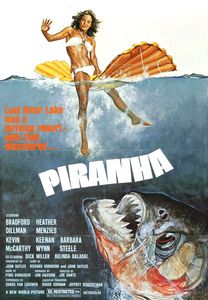
  • Piranha (1978)

    Piranha (1978)

    (In French, On Cable TV, January 2021) In retrospect, I really shouldn’t be surprised that the original 1978 Piranha reminded me so much of its detestable 2010s remake. Isn’t that the point of it? But there’s a crucial difference in how the original, for all of its terribly dated visuals, muddy cinematography and primitive special effects, actually benefits from its limitations. Not feeling forced to show everyone being graphically dismembered, this film does have the sometimes-amusing spirit of a classic monster movie, with the horror being tolerable rather than ultraviolent. It only barely qualifies as a horror/comedy considering how often women and children are the targets of the hungry piranhas. Director Joe Dante directs a John Sayles script with some skill, and the results of both filmmakers’ efforts are apparent: the justification for the monstrous piranhas is hallway witty, while the direction steadily cribs from 1970s disaster films and, most obviously, 1975’s Jaws. Alas, Piranha does remain a bloodbath of a monster film, so my liking for the result remains limited—but it’s a bit better than I expected.

  • Innerspace (1987)

    Innerspace (1987)

    (Second Viewing, In French, On TV, October 2020) I first saw Innerspace on VHS at the end of the 1980s, and it was a lot to take in: A scientist, reduced to microscopic size, and being injected into the body of someone else? Wow, those special effects! Of course, I didn’t know about Fantastic Voyage at the time, and it was easier to be amazed in a pre-CGI age. Still, revisiting this amiable Science Fiction comedy remains quite a bit of fun today: Under Joe Dante’s deft direction, the film breezily switches between SF, thriller, romance and comedy (a lot of comedy) as a daredevil test pilot (Dennis Quaid) is injected inside a meek hypochondriac (Martin Short) and a rival organization causes trouble for everyone. What’s more fun than expected here is how the film doesn’t just take the ludicrous premise from Fantastic Voyage, but doubles down on the preposterousness of it all. It’s not enough for an entire exploration craft to be shrunk down and somehow injected—no, in this film the pilot can tap into the optic nerve to see what’s going on, link to the ear to give instructions to the body’s owner, and control his host’s face muscles to impersonate someone else. Sure, why not? Nothing makes scientific sense, but it makes for a full four-quadrant thrill ride—with even some wonder thrown in at the sight of a fetus. Even with such heady concepts, Innerspace never quite loses touch with recognizable reality, as many stunts and comic sequences squarely depend on Short’s physical comedy and the growth of the characters. (Amusingly, Quaid and Meg Ryan met on this film by playing boyfriend-girlfriend, and later married.) The Oscar-winning special effects generally remain convincing today, and even thirty years later, it’s clear that Innerspace still has no equivalent. It’s still well worth a watch, or a re-watch.

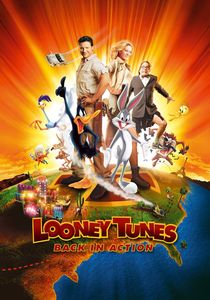
  • Looney Tunes: Back in Action (2003)

    Looney Tunes: Back in Action (2003)

    (On TV, September 2020) I somehow missed Looney Tunes: Back in Action when it was first released in theatres (it had the misfortune of coming out in November, a month where I wrote rather than watched: looking at the release schedule, I probably saw Master and Commander: The Far Side of the World that week), and I still can’t believe I waited so long before catching up. I’ve always had a fond spot for Bugs Bunny and his friends, so seeing them in a feature film was like unearthing a time capsule prepared just for me. The one thing that distinguishes Looney Tunes: Back in Action from most of the movies is the sheer pedal-to-the-metal pacing of the jokes—barely five seconds go by without some kind of gag, and the anarchic humour comes with an added dimension of metatextual movie humour. Highlights include a reference-crammed visit to ‘Area 52,’ closely followed by the technical marvel of a painting-hopping sequence set inside Le Louvre. Brendan Fraser does well in the lead role, with some decent assistance from Timothy Dalton (playing off the Bond archetype) and an ensemble cast of supporting players. I’m not so happy with Jenna Elfman (wow, remember her?), who’s used more like a clothes rack for a suspiciously high number of outfit changes rather than an actress with comic timing (although that Paris outfit—whew). The animated characters do better, but then again, they could be redrawn until perfection. Yet, for all the nice things I can say about its pinwheel of gags, Back in Action isn’t quite what it could have been. Director Joe Dante has spoken cryptically about being heavily constrained during production, which is probably inevitable considering the special effects requirements and the characters being one of Warner Bros’ crown jewels. Still, there’s a stiffness, rarely technical but nonetheless perceptible, that stops the action from being as involving as it should be—some annoying characters are given too much time (yes you, Steve Martin) and some sequences don’t play as well as they should. Still, I liked much the result, and would have liked to see it upon release… even there’s some value into discovering something so long after.

  • The Howling (1981)

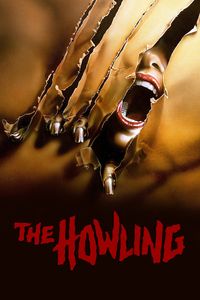
    The Howling (1981)

    (Youtube Streaming, August 2020) There is a lot of interesting stuff in werewolf dark comedy horror film The Howling – but I’m not too sure it all adds up to a better-than-interesting movie. There is a lot to like, for instance, in the blend of influences that end up in the script as a TV reporter, traumatized by an experience with a serial killer, is sent to a rehabilitation “colony” where she encounters werewolves. It’s not your average plot premise, and the blend of TV journalism with somewhat dubious new age therapy both feels very specific to the early 1980s and still provocative today. Add to that a typically clever directing job by Joe Dante, working from a script rewrite by John Sayles to add dark humour to the proceedings, and The Howling is a lot more than your average horror film. Then, perhaps most of all, there are the practical special effects all culminating into a lengthy werewolf transformation scene that’s both impressive (for its time) and a bit of a showing-off. The opening sequence is gripping, the closing scene is a nice attempt at collapsing the masquerade, and in-between we’ve got unpredictable moments all over the place. All of this should make The Howling much better than it is – but in the end it still feels like a disappointment. Much of this has to do with a scattershot approach that’s not as disciplined as it should be. The links between the serial killer that dominates the film’s first few minutes and the werewolf film that it becomes are preposterous. The pacing of the film is all over the place, and arguably shoots itself in the foot by having a mid-film transformation sequence far more impressive than the climax. Dramatic tension varies widely with great moments stranded in the middle of long stretches of nothing. While The Howling has a frank post-New Hollywood approach to the links between werewolves and animalistic erotic desire, it ultimately doesn’t do much with that (compare/contrast with The Hunger if you will). The actors do well without doing exceptionally well (maybe they were cowed by the special effects) and the direction is flashy without being sustained. In other words, The Howling does not amount to more than the sum of its parts, and, in fact, suffers when some parts subtract from the total. I still think it’s worth a look for fans of 1980s horror as one of the most daring takes on familiar material, but it doesn’t wrap it all up satisfyingly.

  • The Twilight Zone: The Movie (1984)

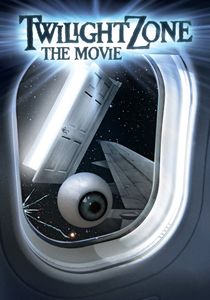
    The Twilight Zone: The Movie (1984)

    (Second Viewing, In French, On TV, April 2019) There’s no use soft-pedalling it: The Twilight Zone: The Movie is an uneven anthology of stories inspired by the classic TV show, but it remains far more noteworthy for an on-set accident that killed Vic Morrow and two child actors, an accident that required changing much of the film’s first segment and considerably soured the films’ production—not to mention its critical reception. The behind-the-scenes drama is fascinating (there’s an entire book about it) but what’s on-screen is not quite as interesting. The opening sequence is cute but overlong. John Landis’ first segment, the one that led to the shooting deaths, is left as a trite morality tale—and while I think that unrepentant racists getting a taste of their own bigotry is wholesome entertainment, the segment feels like obviousness piled upon obviousness. The second segment, directed by Steven Spielberg, is far too cute and unsurprising to be interesting. Things do get quite a bit better with Joe Dante’s take on the omnipotent kid trope, with stylish directing (making the most out of the visual effects of the time) and an overall feeling of dread that makes the segment work even if we know about the twist well beforehand. But the best is kept for the end: the well-known (and much-parodied) remake of “Nightmare at 20,000 feet,” a typically intense George Miller production featuring John Lithgow as a terrified airplane passenger who glimpses something frightening on the airplane wing. That segment is a little marvel of tight editing, impressionistic direction (including bulging eyeballs in a split-second moment), Lithgow’s great acting and good execution rather than a striking premise. Those last two segments do much to erase the bland impression left by the first two stories, but the overall feeling left by The Twilight Zone: The Movie is very uneven, and a waste of solid premises made even worse by its cost in human lives. I actually remembered a few things from seeing this film when I was a teen, but my current disappointment with the film is newly renewed.

  • The ’burbs (1989)

    The ’burbs (1989)

    (Second viewing, On TV, March 2017) I was wary of revisiting The ’burbs: what if it didn’t measure up to my good memories? Fortunately, I shouldn’t have worried: As a comedy, it’s still as increasingly anarchic as I recalled, and the film has aged relatively well largely due to director Joe Dante’s off-beat genre sensibilities. Baby-faced Tom Hanks stars as a driven suburban man daring himself to spend a week at home doing nothing. But his holiday soon turns to real work as he starts obsessing over his neighbours and, egged on by friends, suspecting them of the worst crimes. Set entirely in a quiet cul-de-sac, The ’burbs still has a few things to say about the hidden depths of suburbia, dangerous obsessions and the unknowability of neighbours. It’s also increasingly funny as actions become steadily more extreme—by the time a house blows up in the middle of the climax, it’s clear that the movie has gone as far as it could go. Corey Feldman (as a fascinated teenager treating the whole thing like a reality-TV show), Bruce Dern (as a crazed survivalist), Carrie Fisher (as a voice of exasperated reason) and Henry Gibson (deliciously evil) are also remarkable in supporting roles. The “burbs may take a while to heat up, but it quickly goes to a boil and remains just as funny today.

  • Gremlins (1984)

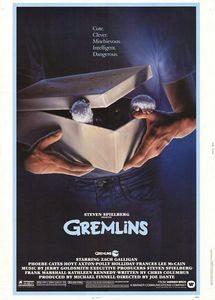
    Gremlins (1984)

    (On Cable TV, October 2016) I’ve been revisiting a lot of eighties classics lately, and this often means watching movies again for the first time in twenty-plus years. Not Gremlins, though: while I remember a lot of the film’s marketing (including the three “rules” of gremlins care and feeding), I had unexplainably managed to miss watching the film until now. I say “unexplainably” because Gremlins ends up being right up my alleyway and a quasi-classic after only one viewing. The anarchic mixture of horror and comedy rarely lets up once the film gets going midway through, and the second half is a gag-every-ten-seconds experience. Director Joe Dante successfully helms a film embarrassingly dense in practical effects, comic cues, dark humour and unbridled chaos. Despite the often sadistic humour (which helped usher in the PG-13 rating), it’s a lot of fun as a spectacle even if much of the connective tissue is dumb or irritating. The kitchen fight sequence is particularly good, making an action heroine out of an ordinary mom. Gremlins is compelling to watch (and I say this on some authority as I’m going through the often dull eighties greatest hits) and I’m now actively looking into watching Gremlins 2.

  • The Hole (2009)

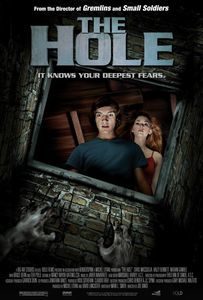
    The Hole (2009)

    (On Cable TV, June 2014) Just about the only noteworthy thing about The Hole is that it’s directed by Joe Dante, a veteran whose influence in the eighties and early nineties has faded to nothingness ever since. His professionalism certainly shows through this minor production: Despite an imperfect script and a family-friendly focus, horror film The Hole is handled professionally, has a pleasant rhythm and doesn’t let late-script disappointment get the better of its presentation. The 3D motif feels silly on the small flat screen, but the direction is clean and polished throughout. The story of three teenagers who discover a bottomless hole in their basement reflecting their deepest fears, The Hole is decidedly a horror film for young teenage audiences: it’s barely gory, low-key in its scare sequences and plays off childhood fears more than deep-set adult trauma. Nonetheless, the quality of the production holds it aloft even if the script doesn’t quite manage to hold together: not only does it spend its time on the symptoms of the hole rather than its root, it squanders some promising leads when it devolves to fairly standard “confront your deepest fears” messaging, along with a suddenly-bizarre finale that literalizes too many metaphors with sub-standard special effects. Chris Massoglia is a bit dull in the lead role, whereas Haley Bennett easily steals her scenes with a bubbly girl-next-door portrayal (although, typically, later script revelations contradict her early-movie reactions). There is, frustratingly, a lot of untapped potential in the initial set-up that is nowhere nearly fulfilled by the rest of the film. Still, it’s handled fairly well, can be watched without too much trouble and generally holds interest until the end. As far as horror movies go, it’s not too bad, and considering the wretched horror films aimed at younger teenagers, The Hole eventually ends up feeling like a welcome throwback to the kind of movies that Joe Dante himself was directing in the eighties.