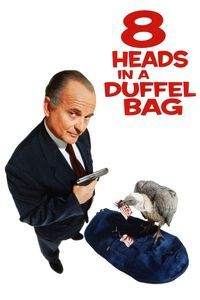
Joe Pesci

  • 8 Heads in a Duffel Bag (1997)

    8 Heads in a Duffel Bag (1997)

    (On TV, March 2021) As I’ve written elsewhere, many of the late-1990s criminal comedies made in the wake of Pulp Fiction’s success have aged more gracefully than you may have expected from their reviews at the time. Reviewers on the theatrical beat at the time quickly overdosed on those movies, and their reaction was harsher than modern viewers may have now that the fad has died. A fresher not-so-jaded perspective may help appreciate those films to their best value, and 8 Heads in a Duffel Bag is one of those films. While admittedly an awkward mixture of silly comedy and hitman crime, this is a film that, as can be gathered from its very title, plays loose and fast with severed heads as a comic device. The story has to do with a spectacularly irritating assassin getting mixed-up in a family vacation in Mexico, with the titular duffel bag getting picked up by strangers, not to mention the narrative trajectory of the seven heads. Joe Pesci plays the assassin and never misses an occasion to advertise how truly detestable his character is, even from the opening moments aboard a plane where he displays behaviour that would get him kicked out these days. It continues in that vein for the entire film, with the heads going from one character to the other, Pesci torturing other characters in amusing fashion (such as banging together two stethoscopes), the protagonist’s mother (the very attractive Dyann Cannon) shrieking on a near-continuous basis and a rather happy ending at the end of it. 8 Heads in a Duffel Bag is still not, to be clear, a great movie even with more than twenty years’ worth of insight: It’s inconsistently amusing, doesn’t give much to do to its protagonist, doesn’t give a comeuppance to its antagonist and often struggles in keeping things going at the same rate. But it’s entertaining enough to be worth a nostalgic look — not quite the bomb that contemporary reviews suggested, but somewhere closer to the average for the post-Pulp Fiction imitators.

  • The Irishman (2019)

    The Irishman (2019)

    (Netflix Streaming, December 2020) To anyone closely keeping track of Martin Scorsese’s career, The Irishman arrives as a clear late-career entry – the kind of film that plays as much as a narrative as a reflection of the films previously made under his direction. At first glance, it does look like many of Scorsese’s celebrated crime epics: a multi-decade odyssey through the murky world of east-coast union corruption, organized crime and veteran hitmen. It features Robert de Niro, Al Pacino and Joe Pesci, with special effects technology used to portray them from the 1950s to the 2000s. It has flashes of Scorsese’s directing style at its most vivid, with individual sequences playing like virtuoso riffs on the content of the film: There’s a particularly good sequence midway through in which a hitman ponders his choices for an upcoming hit, prepares and executes it despite not exactly going to plan. But, at the same time, The Irishman does play like a pre-retirement capstone, as the director deals heavily in themes that make more sense from an older filmmaker’s perspective. There is a moment where the narration sends nearly every single character to death or retirement, and you’re sure that this is the end of the film. But there are still thirty minutes and an unresolved framing device to go, and that’s when The Irishman strikes out in its own territory – telling us about the uneasy retirement of an accomplished hitman, the estrangement from his family, the gradual disappearance of his friends and the inevitable press of time, transforming a stone-cold killer in a frail old man liable to be taken out by even the slightest health problem. That’s what transforms The Irishman into something special, and something that befits Scorsese’s evolving filmography: he’s not putting together Mean Streets anymore. Of course, there’s a price to pay for such a substantial epilogue: the film is very long and feels even longer as the years go by and we dig ourselves out of no less than two framing devices and various flashbacks. There are a lot of characters to follow, and the way the film fits in history, often in oblique detail, is meant to be interpreted by those who have a decent grasp of post-WW2 American history, and specifically everything about Jimmy Hoffa. Some will argue that The Irishman would have done best as a miniseries, and, curiously enough, I only half-agree with that statement: Scorsese makes movies, not episodes of a TV show, and while that’s a distinction increasingly irrelevant to anyone but purists, it’s still a significant difference in matters of filmography. I enjoyed it, but I was really wishing for faster pacing at times. Still, The Irishman is an important milestone in Scorsese’s ongoing work: while we may wish for him to keep working forever, it does feel like the kind of work that can stand as a capstone.