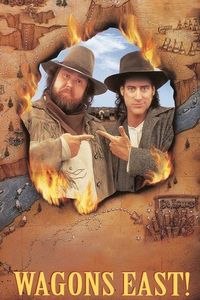
(On Cable TV, July 2021) If the silly comedy Wagons East is known for anything, it’s for being John Candy’s last film (he died toward the end of the production) and for being one of the worst-reviewed films of 1994. While I won’t necessarily disagree with the documented notion that it’s a bad film, I will take a contrarian stance and claim that the result is perhaps a bit more interesting than most would recognize. The premise, while built for laughs, does have something intriguing — the film spends its opening minutes showing the misery of late-nineteenth-century life on the American western frontier, with coarseness and violence being the currency of the land. One by one, our motley crew of characters comes to realize how badly the reality of western life has fallen short of their expectations and, before long, they realize that there’s only one real solution: go back east. This rejection of the western myth is not particularly common in American cinema, and it’s that thematic thread that kept me interested in the film despite its pratfalls, dumb jokes, offensive stereotypes and lowest-common denominator humour. There’s a powerful thematic engine at the core of Wagons East that’s let down by the clownish execution, but it’s there nonetheless. It’s interesting to see, for instance, that the characters rejecting the frontier to go back to the civilized east are largely characters that are portrayed as modern — civilized, urbane, peaceful and not constrained to heteronormativity. Of course, Wagons East (being a John Candy film) doesn’t push that notion all that further: the level of the jokes goes down significantly, and so the gay character is played ad nauseam as campy even during his moment of triumph as a sharpshooter. Even then, it’s also interesting to see another marginalized group not treated so badly — despite the caricatural approach to the Native American characters, they’re ultimately portrayed (again, for laughs, but still) as reasonable and practical. Wagons East may be more interesting than you’d expect, but that, of course, doesn’t really excuse its juvenile comedy, Candy’s mugging for the camera (although he’s quite effective at it) or its disjointed episodic structure. But unlike many Candy vehicles, there’s a great premise begging for better execution here — something that could have become, in other hands and with other actors, a mordant take on the western genre.