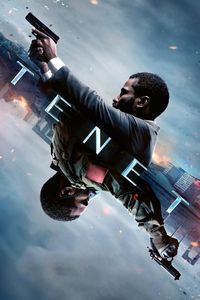
Tenet (2020)
(Video on-Demand, January 2021) I’m favourably predisposed toward anything from writer-director Christopher Nolan, but it’s not an uncritical stance, especially when Tenet doesn’t quite manage to meet its own objectives. It’s certainly, unmistakably a Nolan film: You can quickly recognize his thematic preoccupation with time, his love for spy thrillers, his willingness to play with narrative structure and the thematic winks toward filmmaking. You can once again experience the cool palette of colours, the crisp cinematography, the bombastic score and many of his usual favourite actors. (The theatrical experience of watching Tenet was reportedly marred by inappropriate sound mixing, but that doesn’t seem to be the case on home video—and I watch movies with subtitles anyway.) But Nolan can be too clever for his own good, and Tenet’s gimmick—reversing the time flow—is intriguing at first, then nonsensical in its details, then fascinating again when it leads to big novel action sequences, then incomprehensible again when you start asking questions. Tenet hovers perilously on the edge of disbelief, sometimes retreating to the unquestioning safety of a slam-bang action sequence, at other times hampered by its own confusion. I did love much of the first half-hour for the way it sets up a high-octane modern spy thriller, as if James Bond dove in Science Fiction and reinvigorated its formula. John David Washington makes for a good action hero, and while I’m already steadily growing more favourable to Robert Pattinson, this is the film that reassured me that he’s going to age into a great career. Elizabeth Debicki improves the longer the film goes on, ultimately getting up to Widows-level shenanigans late in the third act. Michael Caine has a terrific one-scene cameo, and Dimple Kapadia is also quite intriguing in a strong supporting role. Still, the star here is Nolan, as he builds an ambitious film that goes back and forth in its temporal narrative and delivers impressive showpieces. Fans of time-travel movies will learn to recognize the usual touches of the genre—Tenet is a film that benefits from a second watch, or reading a thorough analysis of it shortly after first viewing. The action sequence at the middle of the film is easily better than the too-chaotic conclusion that mars the third act—I recognize what Nolan was trying to do, but much of it simply appears confusing for confusion’s sake—or worse for visuals that don’t fit into the overall logic of the film. Compared to the luminous clarity of Inception, Tenet feels undercooked, leading viewers to ask questions about plausibility that are not to the film’s benefit. I still had a good time watching it, but I can’t help but remain unsatisfied by the result—it’s 75% of a great movie, and while that’s far preferable to most contemporary thrillers, it falls short of what Nolan usually delivers.
