John F. Kennedy

  • PT 109 (1963)

    PT 109 (1963)

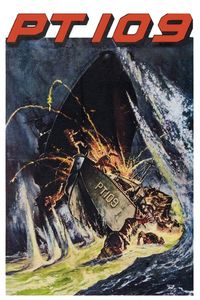
    (On Cable TV, March 2020) Twenty-first century viewers may be forgiven for not knowing that future president John F. Kennedy spent much of World War II captaining his own PT boat, even performing heroics when it was sunk by the Japanese and his crew needed to be rescued. But I can guarantee you that few Americans of voting age in 1960 did not know that story—it was an integral part of the JFK mythos, the young good-looking politician who had proven his mettle during WW2. PT 109 is a semi-hagiographic war film dramatizing those 1943 events, with Cliff Robertson playing the young and heroic president-to-be. JFK is said to have influenced the production of the film, although he insisted that the film remain historical and not without a few criticisms of his early actions. War movie enthusiasts may balk at this focus on a specific individual, but fortunately, PT 109 has more on its mind: it manages to deliver a credible depiction of a team of men during wartime. You can certainly compare it to the 1945 John Wayne PT boat movie They Were Expendable, except that this one is in colour, benefits from fifteen years’ worth of filmmaking improvements, already knows how WW2 will turn out (hence a looser tone), and is shot in colour. While not a great movie, PT 109 is reasonably interesting despite too long of a running time and not quite as heavy on hagiography as it could have been.

  • JFK (1991)

    JFK (1991)

    (On DVD, May 2017) As someone who’s almost viciously opposed to conspiracy theories, I’m about as far as you can imagine from being someone predisposed to like JFK. As a self-conscious “counter-myth” to the official conclusion that Lee Harvey Oswald killed Kennedy, JFK multiplies outlandish claims and plot in order to present a messy version of history in which powerful interests conspired to kill a sitting president. From a substance perspective, JFK often feels like a big ball of nonsense, spitting in all directions and actively introducing bad ideas in the discourse. But the big surprise is that despite all of this, I really liked the movie. It is, in many ways, a triumph of execution. Much of it has to do with its hyperactive style of editing, which feels very modern even twenty-five years later. It’s even more remarkable in that contrarily to much of the rapid-fire digital editing since then, JFK’s editing makes sense both from a content and container perspective: it’s often used to fake documentary proof, distinguish between periods, introduce flashbacks (sometimes even flashbacks within flashbacks) and peer into the characters’ minds … and it almost always makes sense. Acting credentials as solid, with a solid Kevin Costner in the lead, and various supporting roles played by such surprising names as Kevin Bacon, Tommy Lee Jones (in a very atypical role), Donald Sutherland, Gary Oldman and many others who are not always instantly recognizable in their roles. It all culminates in a barnstormer of a speech that will leave even conspiracy-skeptics cheering for truth and untainted democracy. For a three-hour film, JFK flies by and impresses even as a propaganda piece. It’s kind of amazing, actually, that such a piece of firebrand cinema would be so closely associated with major studio Warner Brothers. The years have been kind to JFK, even though its theory seems increasingly dubious (twenty-five years later, and no deathbed confessions…), its craft seems just as solid now as ever … and perhaps a bit less disorienting as it must have been then.