John Hurt

  • Owning Mahowny (2003)

    Owning Mahowny (2003)

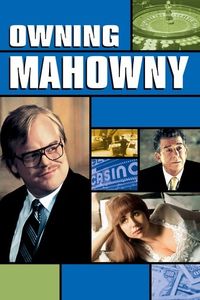
    (On TV, July 2021) I’m not always fond of Canadian Content (CanCon) restrictions on Canadian Cable TV channels requiring them to show a certain percentage of Canadian material if they want to keep their broadcast licenses. It certainly makes for a convenient scapegoat whenever a terrible made-in-Canada movie gets in regular rotation for a while. Of course, the pleasant flip-side of this is that CanCon often helps in keeping good but obscure Canadian movies in play long after they would have otherwise been forgotten. Seeing Owning Mahowny pop up regularly on schedules eighteen years after its release, for instance, is one of those cases where CanCon isn’t so bad. Based on a true piece of Canadiana, it’s the story of a bank vice-president who figures out a way to tap into his company’s funds in order to cover his gambling debts, only to see this “temporary” charade deepen, as he’s unable to cover his losses. Along the way, it clearly becomes a case study in a gambling addiction, as the protagonist goes bigger and bigger (becoming a “whale” for competing casinos) without quite getting any satisfaction out of it. Philip Seymour Hoffman is typically excellent in the lead role, consistently underplaying things in a way that becomes a statement by itself. Minnie Driver doesn’t get much to do as “the girlfriend” (aka the voice of reason), although seeing her in dirty-blonde straight hair with bangs is interesting in itself. John Hurt is delightful as a very amused casino manager trying to learn more about the player with deep pockets showing up in his establishment. Still, this is Hoffman’s show, and he shines brighter than the muddy 1980s-style cinematography attempting a period look. Fortunately, the film is progressively compelling: Hoffman’s character is clearly stuck in a spiral of lies and deception and there’s a perverse pleasure in seeing how far he’ll go in trying to cover up his growing debts. Among Owning Mahowny’s most interesting choices is a sequence that, in any other gambling film, would be about the flash and fun of being treated like a high-roller. Here, however, the entire thing feels like a pain for the protagonist, who would rather go on with the business of playing than being lavished with attention. Some decent screenwriting gives weight to even the minor characters and structural scenes — it makes for an absorbing film even when it doesn’t necessarily start out like one. Owning Mahowny is definitely worth a look if you’re even slightly interested by gambling movies, white-collar crime thrillers or character studies. So: score one more for CanCon victories in further exposing a home-made success.

  • Children of a Lesser God (1986)

    Children of a Lesser God (1986)

    (On Cable TV, October 2019) I’m not entirely convinced that romance has anything new to tell us, but sometimes it’s all in the context and that’s where Children of a Lesser God succeeds brilliantly. Romantic dramas about mismatched lovers trying to work out their differences are a dime a dozen, but even thirty-five years later the setting of this film still stands out: taking place at a school for deaf children, it follows a young energetic teacher as he meets his students and develops feelings for the antisocial janitor, an attractive alumnus of the school who refuses to talk out of past trauma. Setting can be a character of its own, and the fascination exerted by Children of a Lesser God quickly develops from learning about an entirely different world set alongside our own. As our guide in this world, John Hurt has the ingrate task of explaining to hearing audiences what’s going on (through his constant audible translation of signed language), even during intensely intimate moments. Opposite him, however, is the formidable Marlee Matlin, who steals the entire film in a ferocious, layered, compelling performance. Far from being merely a love interest, she plays a fully formed character defined by far many other things than her deafness. She deservedly walked away with an Oscar for her role, and it’s easy to see why even today: this is a performance that, for many, still redefines the frame that we use to evaluate good acting. In between the subject matter and Maltin’s performance, it’s easy to see why Children of a Lesser God remains a striking film even today.

  • Gorky Park (1983)

    Gorky Park (1983)

    (On Cable TV, May 2019) It’s clear that we will never quite experience Gorky Park like Western audiences perceived it back in 1983 (or in reading the original thriller novel by Martin Cruz Smith two years earlier). 1983, after all, is the year where the world narrowly avoided nuclear war between the USA and the Soviet Union, in the middle of Reagan’s first term and the years before Gorbachev’s détente. Back then, the idea of a crime thriller set deep behind enemy lines was novel and interesting by default—how would familiar genre elements work under the Soviet regime? Now, of course, the number of Hollywood movies shot and set in Russia has exploded, so we’ll never quite see Gorky Park with the same extra-narrative interest as audiences upon its release. But what’s left today is a decent thriller—not spectacular, not terrible, but engrossing enough in its depiction of a multiple murder whose investigation quickly goes to the top, with side glances at an espionage subplot. The synth music occasionally feels modern and then almost immediately dated. John Hurt is not bad in the lead role, as a disgraced police officer getting embroiled in intrigue. After a remarkable first half-hour, Gorky Park then loses steam the longer it does on, ending with the expected shootout knee-deep in the snow. The romantic story is a bit dull, especially compared to the rich atmosphere—Gorky Park may not have been shot in Moscow, but it presents a credible approximation of it. One lingering question remains, though: Did it accurately present Moscow at the twilight of the Cold War, or is it a Westernized idea of it, complete with the blatant pot shots at the regime in place? It’s left to interpretation, although the solid nature of the film isn’t up for discussion.

  • Nineteen Eighty-Four (1984)

    Nineteen Eighty-Four (1984)

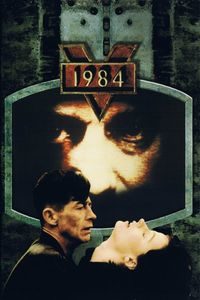
    (On Cable TV, November 2017) I remember reading George Orwell’s Nineteen Eighty-Four during high school and being bleakly depressed for the rest of the day. I’m pretty sure we saw clips of the movie in class, but not the entire film. As it turns out, Nineteen Eighty-Four itself is just about the most straightforward adaptation that anyone could have made of the novel. The high points are all there (even down to the device of having the protagonist keep a diary as a way to insert voiceover narration), the atmosphere is bleakly industrial and the film, at times, seems to have emerged straight from the dreary post-war years in Britain, all bathed in dusty grays and dirty browns. It is also powerfully depressing to a degree that I had almost forgotten: By the time the film discusses removing fundamental biological imperatives as a way to further control the masses, we’re way past most of the nicest dystopias out there. (In fact, Nineteen Eighty-Four makes most post-apocalyptic stories look positively cheerful in comparison.)  John Hurt is both bland and good as protagonist Winston Smith—Richard Burton is more lively as voice-of-authority O’Brien. Writer/director Michael Radford did an exceptional job putting Orwell’s genre-defining vision on-screen. But, as faithful as the film can be to the novel, it’s also limited by that faithfulness. Having seen Brazil, I know which bleak dystopia I prefer.

  • The Elephant Man (1980)

    The Elephant Man (1980)

    (On Cable TV, October 2017) My rule of thumb for David Lynch is that the more conventional his movies get, the better I like them. (The Straight Story and The Elephant Man would suggest that some sentimentality also helps, but Dune doesn’t really fit in that pattern.)  In any case, The Elephant Man is only grotesque on the surface, as a horribly deformed man (John Hurt, justifiably unrecognizable) is taken in by a benevolent doctor (a very young Anthony Hopkins, looking unusually dashing with a black beard), revealing his sensitive nature to Victorian-era London even as some people can’t see past appearances. There is a strong sympathy here for the marginal protagonist of the story, and it’s that sympathy that carries through the movie even as the lead character gets kidnapped, abused, insulted and wounded. It ends beautifully (if tragically), which wasn’t a given considering the dour nature of the humans in the story. The Elephant Man isn’t perfect: there’s quite a bit of manipulation in hiding the protagonist’s true nature for a long time before the end of the first act, and it’s best not to dig too deep in the real events that inspired the film. On the other hand, it’s a more effective Lynch film because it is grounded more strongly in reality, which doesn’t preclude some pointed questions about human nature and motives. The re-creation of Victorian London is evocative, and the direction has its moments of interest. While I’m not going to pretend that I liked the film more than I did, it does come as an antidote to my recent viewing of Eraserhead, and I couldn’t be more grateful.