John Steinbeck

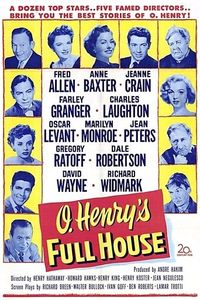
  • O. Henry’s Full House (1952)

    O. Henry’s Full House (1952)

    (On Cable TV, December 2021) Although far less famous now, O. Henry (a pseudonym of William Sydney Porte) was a steady fixture of English textbooks throughout the twentieth century, his deeply ironic short stories being the kinds of things teachers could use as examples of literary devices that students would enjoy reading. (“The Gift of the Magi,” in particular, still has some power.) The flip-side of that popularity is that some of his stories have now fallen into easy cliché, so a film adaptation of five of his best-known tales does often seem far more conventional than intended. O. Henry’s Full House does have a few other things running for it, though: It features none other than John Steinbeck as host, telling us about Henry and introducing each of the five segments. There’s also the matter of casting, with such notables as Marilyn Monroe, Charles Laughton, Oscar Levant… and Richard Widmark reprising his character from Kiss of Death. There are also some surprisingly good credentials behind the camera as well, with Howard Hugues directing one segment co-written by Ben Hecht. Still, the overall impact of the stories is good without being great: Since Henry’s narratives are often built around an ironic surprise ending, it doesn’t take long to learn to accurately guess where the segments are going. (And that’s not counting the cases where we already know how the stories will end.)  Still, the execution is not bad, and everything can be watched rather easily. For English literature fans, O. Henry’s Full House is an intriguing film not just for the Henry adaptations, but also for Steinbeck’s only movie appearance.

  • Viva Zapata! (1952)

    Viva Zapata! (1952)

    (On TV, September 2020) The best reason to watch Viva Zapata is for Marlon Brando, and Marlon Brando is probably the best reason not to watch the film as well. Of course, that statement will hinge a lot on how you feel about Brando playing a Mexican revolutionary through a mixture of a stereotypical accent and quite a bit of mumbling. I pretty much loathed it (in keeping with a surprisingly large chunk of Brando’s filmography), and that’s probably where my review should stop. Alas, there’s more to it. Directed by Elia Kazan, featuring an Academy Award-winning supporting performance by Anthony Quinn and a screenplay by John Steinbeck (plus Daryl F. Zanuck producing), Viva Zapata is no lightweight fly-by-night production: It was intended as a prestige film, and the two things preventing the film from being recognized as an epic 1950s film are its restrained length (less than two hours) and black-and-white cinematography. It surely plays fast and loose with the historical facts—Zapata here is presented as a populist folk hero, illiterate (which wasn’t true) and utterly unremarkable from a political point of view. Worst of all is the somewhat tepid pacing and lack of sustained interest. At least Quinn is reasonably authentic. As for the rest of Viva Zapata—well, can you stand two hours of Brando mumbling? Some think that’s the best thing ever; others will want to claw their way to the exit.

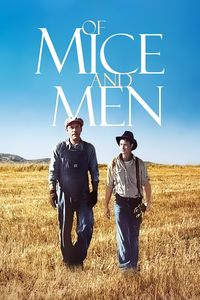
  • Of Mice and Men (1992)

    Of Mice and Men (1992)

    (In French, On TV, April 2020) Generations of American high school students know all about John Steinbeck’s Of Mice and Men, with its heavy mixture of depression-era vagrants, uncontrolled force, tough choices and titular mouse. As such, there’s a ready-made public for an adaptation, whether it’s to revisit a classic about which a substantial proportion of all Americans had to write an essay about, or post-1992 classrooms that might as well watch the film rather than read the novella. There had already been one movie version of the story in 1939, so this one had an opportunity to upgrade the craft of the film adaptation while remaining faithful to the text. Under director Gary Sinise (who also plays the quick-witted one of the duo), this take on Of Mice and Men succeeds at keeping much of the Steinbeck text while updating the classic film: the visuals carry some sort of gentle nostalgia for a less-complex time, the images are what we would expect of a period film, and both Sinise and John Malkovich (who plays the strong-but-slow one) are good in their roles. The controversial casting here is Malkovich, who’s far from being the image of the bulky and physically imposing character… but makes up for it in innocent menace. In many ways, Sinise’s Of Mice and Men is the ideal case for literary adaptation: It doesn’t deviate much from the original text, sumptuously executes the story, delivers on cinematic aspects—and in doing so, manages to reach even those who aren’t primed to like the story through the curricular circumstances of how they encountered it.

  • Of Mice and Men (1939)

    Of Mice and Men (1939)

    (On Cable TV, September 2019) In some ways, there’s very little to say about the 1939 adaptation of John Steinbeck’s Of Mice and Men—It’s a solid drama, an adaptation tailored to the big screen (in altering some plot elements for easier consumption) and an actor’s showcase as well. It’s very much like the novel you likely read in high school. One of the advantages of the film adaptation is how it depicts the migrant worker life in the 1930s, adding another layer of interest to the story of its two protagonists. Burgess Meredith has the lead role as George, but Lon Chaney Jr. has probably his finest dramatic role as the hulking Lennie. Competently shot in black-and-white and with admirable restraint when it comes to the depiction of its most violent moments, Of Mice and Men hasn’t aged all that much—it’s firmly set in the 1930s and has become a period piece along the way. It’s one more piece of evidence for 1939 as one of the finest years for cinema, and an engrossing film in its own right.

  • The Grapes of Wrath (1940)

    The Grapes of Wrath (1940)

    (On TV, March 2018) Do American movies ever get as angry as does The Grapes of Wrath? Squarely taking on injustice in Dustbowl-Depression era, the film follows a family forced away from their Oklahoma fame and led to seek work in California fields. It really doesn’t go well for most of the movie, as the “Okies” family encounters death and capitalist exploitation at every turn, only reaching satisfaction of sorts in the hands of a decent government program. While definitely softened from the original Steinbeck novel (including reordering episodes around to provide a good ending), The Grapes of Wrath is still a scathing denunciation of the free market in a time of need. It’s almost continuously infuriating as the protagonist family gets knocked down again—fortunately, the stirring ending manages to make things a bit better, delivering a memorable speech about the resiliency of the people (and the importance of being there to right wrongs) as an epilogue. Visually, the black-and-white quality of the film’s images reinforces the poverty of their surroundings, washing out any colour in a muddle of despair. Still, director John Ford knew what he was doing, and the film is still powerful even today. Consider that The Grapes of Wrath was a major production by a big studio … why is it that movies never get as angry as this one, even at a time when social disparities are ripe for criticism?