John Wayne

  • Rio Lobo (1970)

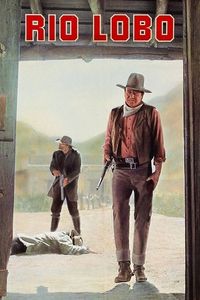
    Rio Lobo (1970)

    (On Cable TV, October 2021) The obvious attraction in watching Rio Lobo is that this is the last film from legendary director Howard Hawks, who career spanned the 1920s to the 1970s and produced more than a dozen good-to-classic films along the way. Alas, this is not much of a swan song: saddled with an undistinguished plot that echoes previous Hawks “defend the town” westerns, Rio Lobo is further hampered by John Wayne strutting around in self-satisfied fashion, a remarkable lack of humour, not-so-striking female characters and a noticeable lack of whatever made previous Hawks films so compelling. The film’s production history suggests that Hawks himself is to blame for all of this—a script written to be repetitive, bad casting decisions compounded by on-set conflict and a lack of interest in shooting the best sequence of the film. If Rio Lobo is worth a look, it’s solely for its opening sequence, in which a money train is hijacked thanks to grease on the rails and a wasp nest thrown in the cabin. It’s a dynamic, somewhat inventive action set-piece that recalls Hawk’s earlier, better movies—except that film historians tell us that the sequence was shot by the second-unit director and stuntman Yakima Canutt. Ah well—after that, Rio Lobo settles for more of the same western stuff: fans of the genre will like, but Hawks’ uncanny ability to make good movies no matter the genre is no longer perceptible. It makes for a featureless viewing experience, and a disappointing finish to Hawks’ filmography—a dull film made even worse by aping previous better entries.
  • El Dorado (1966)

    (YouTube Streaming, August 2021) When watching classic western films, I often have the impression of déjà vu, and that’s even more pronounced for El Dorado considering that it seems built from many of the same elements as director Howard Hawks’ previous Rio Bravo. Once again, John Wayne is presented as a hero, as he assembles a group of helpers to help fend off the film’s antagonist. It’s an interesting crew, though: In-between the protagonist (Wayne) being subject to bouts of paralysis due to an injury, he’s joined by an alcoholic sheriff played by Robert Mitchum, an unbelievably young James Caan as a naïve gunslinger and Arthur Hunnicutt playing one of his usually grizzled mentors. That four-man crew is the focus of the various action sequences, occasionally enlivened by a good supporting cast — perhaps the most remarkable being Michele Carey’s eye-catching turn as a vengeful daughter. It’s all conventional, sure, but rather well-executed. If it takes too long for the crew to get together, El Dorado really starts working once they are, and there are a few modest twists on the formula to keep things entertaining. I’m not that enthusiastic about the result, but it steadily gets better as it goes on, and does manage to wrap everything up in a satisfying fashion. I doubt I’ll remember much more than Carey within a few days, though.

  • The Sons of Katie Elder (1965)

    The Sons of Katie Elder (1965)

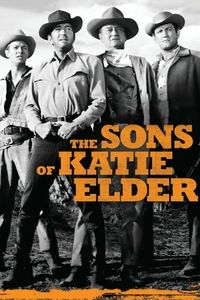
    (YouTube Streaming, August 2021) I’ve been scratching my head for a few minutes in order to find something to say about The Sons of Katie Elder, and it’s harder than you’d think. It’s a western, in colour, from a period in Hollywood history where the studios were running on empty — repeating familiar formulas without quite understanding why audiences were getting tired of them. The film, to be clear, is not a dud: it’s competently-made, with an effective hook (four brothers come back home for their mother’s funeral, and start fighting the resident evil businessman) and some big names on the cast. I’m not a fan of John Wayne, but there’s also Dean Martin to keep things interesting—plus George Hamilton and a young Dennis Hopper. On the other hand, The Sons of Katie Elder is a western film in a very traditional mould, riffing off some questionable frontier justice ideas. It’s watchable, but not particularly memorable. And that, perhaps, is the most lapidary review of all — what else is there to say when the result provokes so little reaction?

  • The Conqueror (1956)

    The Conqueror (1956)

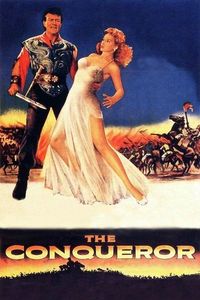
    (On Cable TV, August 2021) Some films have become infamous for all the wrong reasons, and if you polled various cinephiles for their examples of worst miscasting, The Conqueror’s inexplicable decision to hire none other than John Wayne to play Genghis Khan would still be ranked near the top of the list even more than half a century later. It’s not just whiter-than-white Wayne playing a Mongol warrior, it’s everything else in the film seemingly bowing to Wayne’s refusal to adapt anything of his habits to the requirements of the role. Simply put, Wayne shows up here like he’s in a western (something facilitated by much of the film being horseback riding and fighting barbarian tribes) and doesn’t change a single thing about his approach. The film feels stuck with him with no way out — florid dialogue is pronounced with a pronounced American accent and the same nasal intonation that Wayne uses in other cowboy roles. Even the film feels afraid to truly show what it’s about: far too many sequences seem taken straight from a western, almost entirely negating the attempt at Mongolian drama. But Wayne remains the weakest link in The Conqueror — playing a grander-than-life historical figure not with theatrical grandeur but with aw-shucks cowboy stoicism, woefully ill-equipped for the requirements of the role. As someone who can’t stand Wayne (and that’s putting it mildly), I’m surprisingly gleeful at seeing him stray outside the limits of his acting talent, and being derided for it: it’s not because you’re a star that you’re a good actor and there comes a point where talent and wit are about recognizing your own limits. Otherwise, it plays world-wide on screens big enough for generations to see.

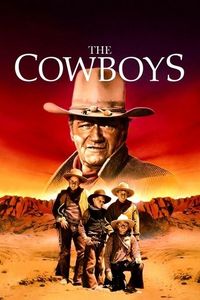
  • The Cowboys (1972)

    The Cowboys (1972)

    (On Cable TV, July 2021) My indifference to John Wayne is vast and profound, but I liked The Cowboys more than I thought largely because of his place in it. For one thing, my perennial crack about Wayne being best portrayed as a cranky bigoted uncle has seldom been better incarnated than here, as he plays a rancher forced to hire a gaggle of boys in order to complete a cattle drive. The film thus has him explicitly assume a semi-parental role toward an ensemble cast, and doesn’t really mince his portrayal as a tough taskmaster. (There’s also another reason why I like Wayne here, but saying more would be even more spoilerrific than usual for me — although is it really a spoiler when it’s the first thing that almost everyone remembers from the film and the fifth line of the film’s Wikipedia entry?)  Wayne’s grumpy performance is somewhat offset by a warmer one from Roscoe Lee Browne as the other adult in the crew. The Cowboys is clearly a western made in the mould of other genre films — it clearly espouses the usual values of the genre, including that of linking manhood to violence, self-reliance and hanging with other men. It’s never subtle, but it can be entertaining as a big adventure for the eleven boys. It does crystallize an aspect of Wayne’s screen persona better than many other movies I’ve seen of him, and the western surroundings are well-photographed along the way. Even as a non-fan of Wayne, I wasn’t disappointed by The Cowboys.

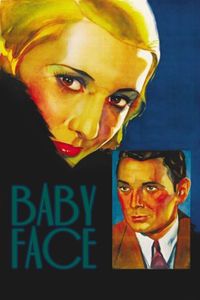
  • Baby Face (1933)

    Baby Face (1933)

    (On Cable TV, November 2020) Every time I think I’ve seen enough of the Pre-Code era, TCM unearths another example of the period from its archives and I’m left agog at how good 1930–1934 movies could be. To be fair, Baby Face is an exemplary example of the form (“The Citizen Kane of Pre-Code movies,” as it’s been memorably called), with Barbara Stanwyck playing a young woman who uses sex to climb up the social ladder. Through a series of seductions and some incredible chutzpah whenever danger threatens to bring her down, she spends the film going from success to success. There are clear plot similarities here with Red-Headed Woman, as Warner Brother was trying to outdo MGM in the salaciousness department. But Baby Face still has the power to astonish by its very direct references to the lead characters’ carnality and her utter amorality—it’s no wonder that it’s often mentioned as one of the dozens of movies that specifically caused the Hays Code to be imposed on Hollywood in 1934-35. Now that it has been unearthed from the archives (and even included in the National Film Registry!), it’s a welcome reminder that the “innocent” Hollywood of 1935-60ish was an imposed fabrication rather than a representation of people who didn’t know any better. Stanwyck is remarkable here, although, as usual, her role is strikingly different from any of the other movies she’s known for: he managed to evade pigeonholing, at the expense of developing a consistent screen persona like so many of her contemporaries. Elsewhere in the cast, a young John Wayne shows up as one of the seduced men. I was really enjoying most of the film until the ending—after so much status-seeking depravity, it seems a bit cheap to have the protagonist see the errors of her ways at the very end. But that may be asking a bit too much for even a Pre-Code film: a completely amoral ending that respected the character would have been going too far. Still, the rest of Baby Face is definitely worth a look: Pre-Code Hollywood is special.

  • The Long Voyage Home (1940)

    The Long Voyage Home (1940)

    (On Cable TV, October 2020) Hailing from that strange period in history where Hollywood was egging an isolationist United States to support England’s WW2 efforts but not quite yet under fire, The Long Voyage Home adapts and updates four Eugene O’Neill plays to contemporary times, following a team of sailors aboard a British steamer during the early days of World War II. This being said, it’s not quite a war movie despite a number of battle sequences and a glum conclusion: it’s far more focused on the characters and their relationship in the face of world events. As a result (plus the presence of John Wayne, annoying at the best of times), I don’t think too highly of the result—the film does feel overlong due to its lack of narrative density. The fairly grim narrative also contributes to the feeling of being stuck in the film longer than strictly necessary: this is not a fun ride, and while you can recognize director John Ford’s Western-ish touch, the setting does not lend itself to the same tone. It’s easy to see why The Long Voyage Home was nominated for a few Academy Awards (including Best Picture), and it does offer a drama of unusual scope when most war movies of the time were more restrained, but it’s not really a film you’ll watch more than once.

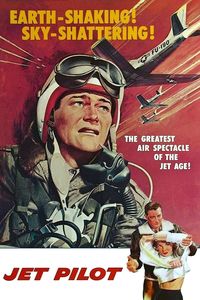
  • Jet Pilot (1957)

    Jet Pilot (1957)

    (On TV, September 2020) Can a film be fascinating for all of the wrong reasons? Of course. Take Jet Pilot, for instance—starting with being far more interesting for its production than for what appeared on-screen. On its own, it’s a bad movie. The premise blends Cold War thrills with romance in what may be one of the worst ways to go about it—featuring John Wayne as a fighter pilot who is asked to seduce an attractive Russian pilot who has defected to the United States. While the film drapes itself in the nuts-and-bolts realism of circa-1950 American fighter jets in luscious colour cinematography, the spy-caper plot itself doesn’t make a shred of sense. The casting alone is ludicrous: I don’t like John Wayne, and he’s completely wrong here as an ace pilot lusting after twenty-year-his-junior Janet Leigh, who’s also badly miscast at the Russian defector. A badly written script leads to titters of amusement, as, in the words of a better film critic than I, “the planes enjoy a more active sex life than the human beings”. Jet Pilot becomes increasingly more ludicrous as it goes on, and the miscast pair ensures that we’re less charmed than relieved that it’s all over by the end. But things become far more interesting once you hit the film’s Wikipedia page and start reading about the incredible production and post-production odyssey of the film. The legendary Chuck Yeager was a stunt pilot for the film. Josef von Sternberg directed some of the film but not all of it. Producer Howard Hugues, clearly lusting after the success of his earlier aviation films, spent no ness than seven years editing the final film—By the time the film appeared on screens in 1957, some footage was seven years old, and the US Air Force had moved on to another generation of planes. Much of that is irrelevant to twenty-first century audiences, but it explains part of why the film was a commercial and critical dud upon release even with some really interesting colour footage of US fighter planes. I like aviation just a bit too much not to find the entire thing interesting, but I would have liked Jet Pilot a lot more with different actors and a script that actually tried to be halfway plausible.

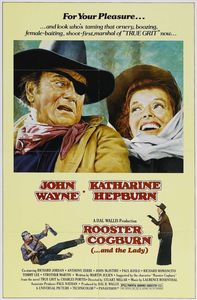
  • Rooster Cogburn (1975)

    Rooster Cogburn (1975)

    (On Cable TV, August 2020) It took a few decades, but in Rooster Cogburn we finally get to see Katharine Hepburn fire a gatling gun. Of course, the price to pay for this treat is having to endure John Wayne’s smarmy arrogance for an entire film. A sequel to True Grit, this film sees Wayne and Hepburn (born the same year; at last, an age-appropriate romance in a Hollywood movie! ) undertake a dangerous journey in the Far West to avenge the death of her friends and family. While both actors are interesting in their own way and the script is tailored to give them plenty of Significant Moments (and riff existing personas; same character for Wayne, same kind of character as The African Queen for Hepburn), Rooster Cogburn at a whole is a disappointment the moment you focus on anything but the stars and the gatling gun. The dialogue is not good, the directing is pedestrian, the narrative is humdrum and while some landscapes are spectacular, that’s really on the location scout more than anyone else. But here’s the thing: When you’ve got WAYNE and HEPBURN together at last (in the only time of their careers), it’s just not possible to pretend to ignore them in the result. Considering this, Rooster Cogburn becomes far more than just its components—it’s nearly a must-watch for classic Hollywood fans, if only for the lone reunion of two screen legends. That’s objective. If you want subjective, consider that Hepburn is at the top of my classic Hollywood list of actors, and Wayne is at the bottom.

  • McLintock! (1963)

    McLintock! (1963)

    (On Cable TV, May 2020) Considering how little I like John Wayne either as an actor or as a personality, my less-than-impressed reaction to McLintock! is entirely predictable. Wayne isn’t good enough of an actor to play comedy, especially slapstick comedy, and finding that he had much to do in imposing the film’s more retrograde aspects (which includes spanking the heroine for her independence and also for the audience’s laughter) certainly did me no favours. Wayne (whose company produced the film) finds himself irresistible as a fanny-spanking straight-talk anti-government mildly-idiotic protagonist, and thinks that the height of humour is pushing people down a muddy slide. Sure, there’s Maureen O’Hara as a Technicolor redhead that’s worth watching… but overlong McLintock! gets worse every moment that Wayne is on-screen. I’m sure that your enjoyment of the film will be higher if you actually like racist misogynistic Wayne… but why?

  • McQ (1974)

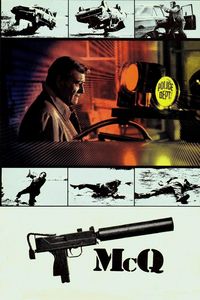
    McQ (1974)

    (On Cable TV, March 2020) John Wayne doing Dirty Harry is pretty much the unholy union of two heave-inducing flavours in one detestable package. The creepy uncle of Classic Hollywood taking on the vigilante fantasies of New Hollywood is far from being the most compelling premise. And Wayne does show up in McQ as an old and bloated cop, shooting corrupt policemen as part of a sombre drug conspiracy. Since the entire film rests on his shoulders, it’s nearly a miracle if it eventually settles for being an average and forgettable affair—a middle-of-the-road neo-noir with local Seattle colour, redolent with 1970s atmosphere but dragged down by a wholly inappropriate lead actor. He’s old, he looks stupid by making dumb cracks about “women’s lib” and is generally treated with undeserved reverence by director John Sturges. But hey—Wayne was a relic of a past era by 1974, and certainly feels like it here too: no fancy car nor big gun can compensate for this 65-year-old having trouble with even the most elementary of action hero business. McQ is certainly distinctive, though—After seeing young upstarts Eastwood and McQueen having their own action movie thunder, old Wayne wanted his, and the result speaks for itself as an indulgence.

  • They Were Expendable (1945)

    They Were Expendable (1945)

    (On Cable TV, March 2020) Hollywood’s World War II years were thick with propaganda films. It seems as if every conceivable part of the US armed forces had a movie or two made about them, usually showing the American soldiers as good people fighting the good fight on behalf of the good people at home. Most of them do have some intrinsic interest for military buffs—even sanitized and simplified for mainstream audiences, these movies usually delight in showing us the way the armed forces operated, and many feature historical footage of real military training or operations. They Were Expendables squarely fits in this category: it’s a look at the introduction of PT boats in the Pacific theatre, featuring John Wayne and Robert Montgomery as clashing officers with different views on the usefulness of those ships—Montgomery as a true believer in the capabilities, while Wayne is cast as the voice of skepticism at the sight of those light, fast boats. The special effects are not bad for the time, as they blend studio footage with what was shot in Florida (a credible stand-in for the Philippines, where the story takes place). While They Were Expendable does have its share of battle scenes, perhaps the most interesting material happens at the PT boat base in repairing and maintaining the ships. Director John Ford seemed to enjoy this movie because the entire film is detailed, credible and enjoyable to follow. Its weakest part, unfortunately, is John Wayne—the film seems to spend far too much time deferring to him, giving him the spotlight and a love interest. (Hilariously enough, the credit sequence is studded with military acronym to represent the service record of the director, actors and crew… except for John Wayne, who never served in the armed forces and so has nothing but his name on-screen.) It’s really interesting that They Were Expendable manages to transform a rout (at the time of the story conception in 1942, the Americans had retreated from the Philippines, vowing to return) into a triumphant film… but this is neither the first nor the last Hollywood production to pull off such a trick. Still, this is a film that still holds some interest today. Thanks to future president John F. Kennedy’s service, there would be other PT boat movies (most notably PT-109), but none with as much credibility in showing the way men dealt with those new ships—part of it has to do with how They Were Expendable takes a break from the battle to talk about operational issues.

  • Rio Grande (1950)

    Rio Grande (1950)

    (On TV, November 2019) I’m cooler than other reviewers on John Ford Westerns and John Wayne as a lead, so I wasn’t expecting much of Rio Grande … and those low expectations worked in the film’s favour. As it starts, we meet a typical Wayne protagonist (actually, the same one as in Fort Apache): a commanding officer in a faraway posting, competent and living as unremarkable a life as possible in those circumstances. But then two new characters walk in: First, his long-estranged son joins the post as a recruit sent from the East, leading to a reunion that is less emotional and more along the lines of no favouritism being tolerated. Then, to complicate everything in between the enemy attacks and peacekeeping role, his estranged wife (Maureen O’Hara, about a third less spectacular without the red hair in a black-and-white film) also walks in, demanding that her son be bought from military service. (And, um, also discuss how her plantation was burnt down by her husband’s men.)  Those familial complications do bring a lot to Rio Grande, and offer a slightly more unusual aspect to this western that the typical frontier genocide material. Because, of course, the hordes of Native Americans are out to kill everyone in this film—your average mid-century western was still horribly racist and Rio Grande doesn’t really deviate from that orthodoxy.  It certainly works better if you can ignore that aspect, but I’ll completely understand if you can’t, especially as the film’s later heroics all focus on killing as many undistinguished nonwhites as possible. This fairly important caveat does explain why Rio Grande is far more interesting today when it deals with tensions between a family and the military life. To be clear, it’s a slickly made Western by the standards of the time, but it’s not groundbreaking, nor does it offer anything spectacular from either Wayne, O’Hara or director John Ford. At times, especially when coupled with Ford’s two other “Cavalry” films—Fort Apache and She Wore a Yellow Ribbon—it often feels like another episode in a longer-running series. But it’s more interesting than I thought, and any movie that manages to overcome my overall dislike of John Wayne has to be complimented for it.

  • She Wore a Yellow Ribbon (1949)

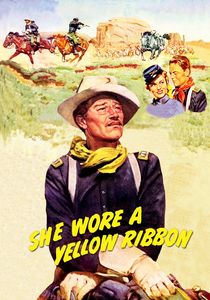
    She Wore a Yellow Ribbon (1949)

    (On Cable TV, June 2019) I was fully prepared to, well, maybe not dislike She Wore a Yellow Ribbon, but at least not quite care for it. The topline description of the movie had nearly everything I don’t care about in a western: John Wayne, frontier fetishism, natives portrayed as bloodthirsty savages… But She Wore a Yellow Ribbon eventually gets better. For one thing, it’s in glorious Technicolor, with director John Ford showcasing Monument Valley at its best. For another, John Wayne isn’t playing the obnoxious creepy uncle characters he so often does, but a grizzled veteran about to retire and trying his best not to cause a war with the natives. (The similarities with Fort Apache are there—same director, star and setting, after all.)  The film adds in a little bit of more evenly gendered content with a female character tagging along the expedition, and after a few bloody confrontations throughout the film, the climax actually avoids wide-scale bloodshed through clever tricks. I still don’t quite like She Wore a Yellow Ribbon, but I can respect it, and was frequently amazed at the truly exceptional cinematography featured throughout the film.

  • Fort Apache (1948)

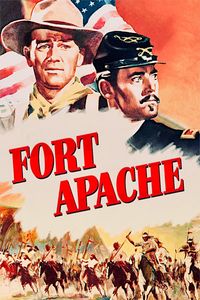
    Fort Apache (1948)

    (On Cable TV, March 2019) To modern viewers, classic Hollywood is as wild a territory as the wild west was to Eastern-Americans. Everything is harsher, our intuitions fail us and only the most traditional of Anglo-Saxon white males find themselves in friendly territory. But there are occasionally a few havens of civilization, even as tentative and rudimentary as they were. So it is that film historians are generally complimentary toward classic traditional western Fort Apache as marking a turning point in Hollywood’s depiction of Native Americans, portraying them as capable, intelligence opponents motivated by real grievances and possessing distinct tribal identities. It’s not a portrayal that sustains much scrutiny today—clichéd, naïve, offensive … but still a step in the right direction compared to previous portrayals as of gratuitously murderous hordes. It also prefigures later nuanced portraits from director John Ford himself, such as The Searchers. As for Fort Apache itself, often considered the first of Ford’s “cavalry trilogy,” it features John Wayne and Henry Fonda butting heads as commanding officers of a small fort, with Wayne playing the reasonable one and Fonda playing the rigid autocratic one. Both of them do well, but Fonda is perhaps more remarkable for an unusual role as an unsympathetic character. There’s some great Monument Valley footage here, especially when the battle sequence starts. Fort Apache reasonably entertaining to watch, although definitely too long in its first hour as the film seems to be flaying about for a story to tell.