Johnny Knoxville

  • Action Point (2018)

    Action Point (2018)

    (In French, On TV, November 2020) It’s a great and terrible thing that, a few months ago, I watched Class Action Park, the documentary about the infamous 1970s–1990s New Jersey amusement and water park called “Action Park.” The documentary itself is terrific, based on events almost too ludicrous to be real. But it also knocks the wind away from any hook that comedy Action Point may have. Clearly inspired by Action Park, this Johnny Knoxville pain-fest relocates from New Jersey to inland California, and knocks production values down a few notches in portraying a run-down amusement park resorting to dangerous stunts in order to stay solvent. With Knoxville (of Jackass fame) at the helm, this means one dangerous stunt after another, regardless of whether they make sense. (The squirrel nuts sequence is a particularly blatant example, but by no means the only one.) There’s an attempt at emotional resonance awkwardly jammed in the works, but the highlights of the film are the cringe-inducing stunts—anyone with empathetic responses to pain will not have a good time here. Knoxville does make a good lead, however—although his attempts at playing older (literally—much of the film is a flashback story from grandfather to granddaughter) make everything feel even more dangerous than the carefree days of 2001 and the first Jackass movie. Action Point is often too blunt and crass to be funny, even though a few jokes land here and there. But the biggest knock against it is that it simply doesn’t even equal to the real thing—try watching Class Action Park and even the documentary will feel more dangerous and darkly funny than even this fictional take on it.

  • Jue di tao wang [Skiptrace] (2016)

    Jue di tao wang [Skiptrace] (2016)

    (In French, On Cable TV, May 2020) The weird pairing at the heart of Chinese action blockbuster Skiptrace—Jackie Chan plus Johnny Knoxville!—isn’t so weird once you realize that both have a comic daredevil persona, and that their differences (Chan as the affable one; Knoxville as the abrasive one) work pretty well as counterbalance. The film’s slight story has them embark on a travelling odyssey while pursued by the mob across Asia (especially Mongolia—when was the last time you saw a film set in Mongolia?), but the point is getting them into one action-comedy set-piece after another. Of course, there’s now a limit to how much bone-breaking behaviour both of them can engage now: They are both getting older and can no longer quite defy the insurance requirements of a major scripted film production. This means action-lite material for Chan (although he can still bring it—the collapsing river houses moment is fun), and largely an observer role for Knoxville, thankfully more subdued than you’d expect. (In another universe, Knoxville could have become an action-movie leading man, and this will show you how.) While the result isn’t one for the history books, Skiptrace nonetheless becomes and remains watchable—it’s amusing and pleasant, even if the climax doesn’t have much grandeur. Renny Harlin directs with professionalism in what’s getting to be the “international action director-for-hire” phase of his career. Of note to action movie fans is how the film deals with globalized mayhem, and relies on Russian mobsters for antagonist—is this going to become a fixture for Chinese movies from now on?

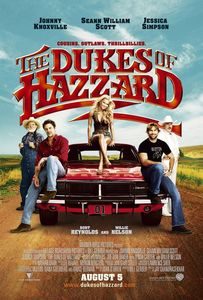
  • The Dukes of Hazzard (2005)

    The Dukes of Hazzard (2005)

    (On TV, August 2015) My memories of the original Dukes of Hazard TV show are dim enough that there was no chance that a remake would offend me.  Early on, The Dukes of Hazard does get to (re)establish its premise: Redneck humor, Southern-US rural charm, that iconic Dodge Charger, those voiceovers still frames… it doesn’t take much for the film to fall into kind of dumb charm, something helped along quickly by Seann William Scott’s sweetly likable performance as a soft-witted young mechanic well on his way to becoming a good-ole-boy.  (Meanwhile, Johnny Knoxville is unremarkable in the other lead role.)  The Dukes of Hazzard, big-screen version, does get a lot of mileage out of its own charm, but the effect gets a bit dulled as it becomes clear that the film won’t have as many car stunts as the premise would imply, and once the dumb corn-fed humor of the film becomes less surprising.  The conclusion feels underwhelming, although it consciously tries to feed the comic assumptions of the viewers.  So is it as good as it could have been?  Certainly not.  Is it watchable?  I’d say so.  Whether one outweighs the other is something that viewers will have to decide by themselves.