José Padilha

  • Entebbe aka 7 Days in Entebbe (2018)

    Entebbe aka 7 Days in Entebbe (2018)

    (On Cable TV, June 2020) The 1976 Entebbe Raid is a real-life dramatic event well worth a film adaptation, but at the end of 7 Days in Entebbe I’m left nonplussed at the approach chosen in dramatizing the true story. From the get-go, the choice to humanize the hijackers (through film leads Daniel Brühl and Rosamund Pike) is puzzling—since you can’t really accidentally hijack a plane and such hijackings depend on the willingness to commit mass murder, their demise at the end of the film is nothing to shed tears over. The film ends in even more dubious thematic territory by tying the hijacking to Middle East conflicts and adopting a cheap rhetoric of both-side anti-violence—and makes the whole thing even more dumbfounding through an action sequence intercut with an interpretative dance performance. Saying that the climax is nothing like you’ve ever seen before is not a compliment in this case. Still, director José Padilha aims high (even as he misses his target) and can depend on Brühl and Pike as remarkable performers. The execution is slick and the real events are credibly portrayed, even if the film is remarkably annoying when it keeps repeating its obvious points over and over again. It doesn’t build to anything except a confused, frustrating and barely adequate thriller inspired by true events. I’m reminded of Truffault’s “no war movie is anti-war,” quote—there’s a contradiction in 7 Days in Entebbe in wanting to draw us in through the promise of violent retribution and then immediately decrying said retribution. Sure, you can make the statement—but you’re mocking your own efforts at portraying it, and exasperating everyone who was lured in.
  • Robocop (2014)

    Robocop (2014)

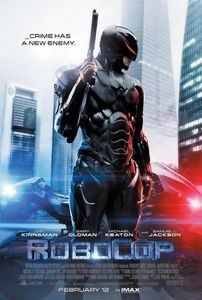
    (On Cable TV, February 2015) I haven’t seen the original 1987 Robocop in at least two decades and wasn’t a big fan even then (I’ve never been fond of grotesque ultra-violence), so this remake doesn’t offend me on any level other than a basic exasperation at Hollywood’s insistence in pilfering existing concepts rather than try to come up with something new.  It turns out that while this remake doesn’t quite make a case for existing, it does tackle a few ambitious themes, is competently directed and doesn’t feel like an outrage.  The basic premise remains the same, as a severely-wounded policeman is remade as a cyborg and has to face dangerous criminals at a time where corruption is institutionalized.  This Robocop clearly exists in an environment where dubious moral judgements are made by corporate executives, where automated force projection is seen as desirable and where the lines between man and machine is becoming blurred on its own.  As a result, the film touches upon issues of political manipulation and free will that weren’t strictly necessary for an action film of this kind.  (It also features a hair-raising scene of pure body horror that goes beyond the limits of its PG-13 rating)  Left untouched is the idea that police work isn’t necessarily all about well-informed deadly firepower, but I suppose that something has to be left for the inevitable sequel.  Joel Kinnaman isn’t much of a presence in the titular role, but Michael Keaton is interesting as an affably evil CEO, while Gary Oldman offers a bit of humanity as a low-key scientist trying to balance curiosity with ethics.  Jay Baruchel and Samuel L. Jackson also have smaller roles that capitalize on their core persona while stretching them a little bit.  Still, the star here should be director Jose Padilha, suffering under Hollywood constraints to deliver a dynamic direction while touching upon quite a bit of thematic content.  If the film has a flaw, it’s that the villains are a bit dull, and the ending somehow fails to cohere and bring everything together: it feels more like a few things thrown together for the sake of resolution and a bit of robot-on-robot combat.  All told, though, it’s a serviceable remake, a bit better than it most likely could have been in other hands.  Make no mistake, though: People are still going to remember the original far more readily than this remake.

  • Tropa de Elite 2: O Inimigo Agora É Outro [Elite Squad 2: The Enemy Within] (2010)

    Tropa de Elite 2: O Inimigo Agora É Outro [Elite Squad 2: The Enemy Within] (2010)

    (On Cable TV, December 2013) It takes a long while for Elite Squad 2 to get going, but when it does it almost entirely upends the certitudes of its predecessor.  2007’s Elite Squad was a Brazilian action film that took a hard look at the war between favelas drug dealers and the quasi-military police forces fighting them.  After seeing the first film’s brutal display of violence and retribution, anyone could have been forgiven for coming to the conclusion that extreme violence is the appropriate response to impose law and order in violent slums, no matter the price paid in dehumanization.  But writer/director José Padilha is willing to push his vision further.  As Elite Squad 2 begins, our returning narrator, once again played by Wagner Moura, is clearly against those “left-leaning intellectuals and potheads” that are threatening his work in cleaning up the slums.  But the film progressively shifts as the drug dealers are replaced by corrupt policemen working alongside equally-corrupt politicians.  Soon enough, the protagonist finds himself fighting “The System” of protective rackets and excess taxation imposed by the very same people who once got rid of the street dealers.  By the end of the film, he’s forced to make allies with the same left-wing intellectuals he once despised, in an attempt, perhaps ineffective, to fight against his new enemies.  While Elite Squad 2 may be a bit too light on the action and a bit too heavy on the drama (there’s little focus to the script for foreign audiences, as it seems more willing to settle scores within Brazil), it’s certainly admirable for the way it graphically describes a complex system of corruption, shifts allegiances and even unceremoniously kills off a recurring character.  When corruption comes from within, there are no easy answers, and even fewer excuses for a shoot-‘em-up climax.