Joseph Sargent

  • Nightmares (1983)

    Nightmares (1983)

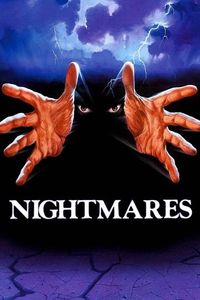
    (In French, On Cable TV, November 2021) As yet another horror anthology film, Nightmares remains in the honest average for the subgenre — uneven stories, some striking moments, a few notable cast members but a lack of cohesion that makes it little more than a collection of short films rather than a deliberate build-up to something bigger. The anthology film is distinctive for being the work of a single director Joseph Sargent rather than several ones, but its origin as a TV series pilot does explain some of the restraints in those segments. The first story is a dull retelling of the killer-in-the-back-seat urban legends, not really setting a promising note for the rest. The second tale is far more ludicrous, and concludes on seeing Emilio Estevez using an arcade laser gun to shoot at a creature escaped from a videogame — it’s silly stuff, but I liked the throwback to the early days of videogaming. The third segment is a more sombre Duel-inspired affair involving a faithless priest, played by Lance Henriksen, confronted with a pickup from hell (yes, you read that right), but it does conclude on a decent car stunt. Finally, the film wraps with a story in which a family confronts a rodent of unusual size in their basement, with Veronica Cartwright playing the mom. All stories work themselves up to a moral of some sort and are mild on the thrills, so that’s a contrast from some of the more gore-oriented horror anthology films out there. Still, you may forget Nightmares faster than you’d think.

  • Colossus: The Forbin Project (1970)

    Colossus: The Forbin Project (1970)

    (Second Viewing, Hoopla Steaming, September 2019) I have vivid memories of watching this film as a kid, and being unsettled by the idea of a supercomputer taking over humanity. If anything, re-watching the film as an adult is not necessarily any less disquieting—The Forbin Project takes an almost gleeful amount of time and details to explain how this new supercomputer is invulnerable, impossible to stop and impossible to starve. There is an effective plot beat early in the movie (“There is another system”) that should prepare you for the nightmare ahead, as the film runs through the steps required for the computer to complete its enslavement of humanity, with our heroes being unable to stop it. The paranoia here is top-notch, and the matter-of-fact direction from Joseph Sargent barely represses the growing hysteria of the situation as any human countermoves are detected and deactivated. The now-primitive technology from 1970 paradoxically makes the film more interesting these days, as it creates a near-allegorical atmosphere that would be surely punctured by any modern remake. There is some interesting material for contemplation in having the computer’s motives being somewhat benevolent despite its harsh methods. I’m not entirely happy by the ending, not as much for its downbeat nature (which follows where the film has been heading all the time) but for its lack of final conflict, or strong coda—especially for techno-horror, where you can have a gut-punch denouement. Still, I quite like the result: Colossus: The Forbin Project is a gloriously nasty nightmare of a film, and one that still manages to unsettle even fifty years and several fundamental technological advances later.

  • The Taking of Pelham One Two Three (1974)

    The Taking of Pelham One Two Three (1974)

    (On Cable TV, February 2019) Knowing that it was coming from the middle of the bleak 1970s, a time when “urban” was always followed by “decay”, I was frankly expecting the worst from The Taking of Pelham One Two Three. How could a movie depicting a hostage taking in the NYC subway be anything but bleak and depressing? Fortunately, this isn’t quite the case: While the film is a slow-burn thriller, it’s not entirely bleak and can even be surprisingly engaging at times. Walter Matthau stars as the city official trying to piece together the elements of a criminal plan before they come to fruition, and the choice of giving this heroic role to an actor like him is indicative of a playful oddball sensitivity that runs through the movie: the characters have colds, are interrupted by visiting Japanese visitors, and one of the hostages stays asleep through much of the excitement. Thanks to director Joseph Sargent, 1970s New York City in this film is grimy but not always bleak and after a relatively tepid first half, The Taking of Pelham One Two Three gets going toward the end with a few good sequences. The musical theme is interesting and complements the interesting period piece atmosphere. I’m always fond of techno-thrillers, and the detail through which the film explains the minutiae of the NYC subway system is absolutely fascinating. In a few words, I had a great time with The Taking of Pelham One Two Three, and it’s definitely worth watching today even if you’re familiar with its vastly less remarkable remake.