Joseph von Sternberg

  • Morocco (1930)

    Morocco (1930)

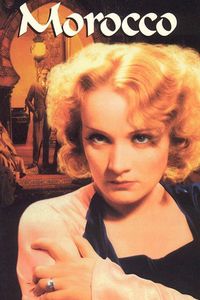
    (On TV, February 2021) I can read about Morocco’s historical meaning as an early blockbuster as well as anyone else, but it doesn’t mean that I appreciate the result. I’ve always had mixed feelings about Marlene Dietrich and director Joseph von Sternberg — there’s something about their acclaimed collaborations that doesn’t work for me. Perhaps it’s because I arrive to their idea of gender-bending with, oh, a perspective that is decades removed. Perhaps there’s something in Sternberg’s approach that doesn’t quite work. Perhaps I just don’t like Dietrich. Perhaps I find lead actor Gary Cooper to be the blandest of the bland stars of early sound cinema. Perhaps I’m not quite as taken by the Moroccan setting as I should be. No matter the reason, I’m not overly impressed by Morocco. Oh, there are still a few good things here: Dietrich is captivating, and the cross-dressing sequence is not bad at all. The Moroccan scenery is a historical document, and it’s not as if you can dislike Cooper. But the overall impact is flat — there’s a lot of fluff to get to what’s interesting about Morocco, and I’m not sure it’s worth the effort.

  • The Scarlet Empress (1934)

    The Scarlet Empress (1934)

    (On Cable TV, August 2020) It may be a few decades in the past, but the working relationship between director Joseph von Sternberg and actress Marlene Dietrich remains a model of successful artistic collaboration. He knew how to build a film around her persona; she knew how to give him exactly what he wanted. They both launched their own careers in Germany with 1929’s The Blue Angel, then went on to make six great Hollywood films at the dawn of the sound age, of which The Scarlett Empress was the fifth. Compared to many other films of the time, this is a film worth digging into, as Garbo portrays the transformation of Russian Catherine the Great from innocent debutante to hedonistic empress. Taking advantage of the rapidly closing Pre-Code era, the film suggests plenty of salacious material with barely repressed glee. Visually, it’s absolutely sumptuous, with a high density of delicately crafted sets, lavish costumes and elaborate camera movements. You can see allegories for early-sound filmmaking, Sternberg’s career, female empowerment and social critique –the demonstration of which has already been completed by scholars far smarter than I am. It does make The Scarlet Empress quite a viewing experience, although the trade-off may be that the film is more interesting than enjoyable – that it’s more fun to discuss than to watch. That’s already not too bad – many films of that time can’t even pretend being worth a look today.