Josephine Baker

  • La sirène des tropiques [Siren of the Tropics] (1927)

    (On Cable TV, April 2022) Considering my unenthusiastic attitude toward silent-era drama, you would have been surprised to learn that La sirène des tropiques was one of my most anticipated DVR recordings of the month – something that popped up as a must-see when perusing TCM’s April line-up and that I watched as soon as possible. What could possibly explain this enthusiasm for a 1927 French silent film? Well, to keep it simple: La magnifique Joséphine Baker. I’ve written about Baker elsewhere, but to sum up: A poor black American girl emigrates to Paris in 1925 and, within a few years, becomes not only a celebrated signer/dancer, but the sex-symbol of the Art Deco era. I’ll leave out the most amazing elements of her later biography to focus on one thing: Cinema history records Baker as the first black woman to star in a major motion picture, which is… La sirène des tropiques.  The plot isn’t necessarily a shining beacon of progressivism, as a French engineer is sent to a Caribbean colony by a romantic rival arranging for a violent conclusion to his trip – but the intervention of a beautiful young woman (Baker) saves him and she falls in love with the Frenchman, stowing aboard a ship bound for Europe in her quest to be with him. Once in Paris, she eventually discovers that she’s ideally suited to music halls, allowing Baker to perform (and for the film to document) several of her best-known early routines. (Amusingly enough, the romance peters out, but it’s still a happy ending because our heroine finds contentment becoming Paris’ newest sensation.)  From a modern perspective, Baker’s character is squarely shown as exotic according to the prejudices of the time – she’s a happy-go-lucky kind of girl, speaks in primitive French and her wildness manifests itself in uninhibited dancing with very few clothes. (This may be one of the very few 1920s films with casual nudity –hers.)  That kind of role would be unacceptable today – but back then? It merely fuelled Baker’s fame. Indeed, she is the reason to watch the film: her performance is delightful, funny, likable, fresh, and energetic to the point of being athletic. It’s amazing that it captures Baker’s early performances at that stage of her career, not even three years in her European stardom. For Baker fans, La sirène des tropiques is a must see – and if you’re not a fan, it just may make you one.
  • Princesse Tam-Tam (1935)

    Princesse Tam-Tam (1935)

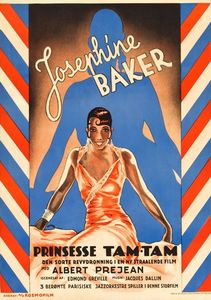
    (On Cable TV, May 2021) Movie reviews can lead to anything, such as when the reviewer starts looking into background information about the film and falls deep into a rabbit hole of a fascinating subject. So it is that, after an hour of reading about Josephine Baker, I’m back to report that everyone should at least have a look at Baker’s Wikipedia article—I was aware of the name and some of the highlights about her life, but the complete story is amazing on so many levels that it defies description—poor black American girl becomes a singer, emigrates to France, makes a few movies, becomes a cultural superstar, has romantic liaisons with a jaw-dropping list of famous men and women, spies on the Nazis for the French Resistance, raises a large family, gets involved in the American Civil Rights movement, and dies in bed literally surrounded by enthusiastic newspaper reviews of her 50th showbiz-anniversary show. Whew. One great way of getting an introduction to Baker-the-performer is to have a look at Princesse Tam-Tam, a mid-1930s French musical that’s interesting for all sorts of reasons. Baker here plays a Bedouin girl befriended by a French novelist looking for inspiration in Tunisia. Taking her on as a Pygmalion-like project, he educates her and brings her back to France, where her close relationship with the author brings her into the spotlight of the Parisian scene. The highlights of the film all focus on Baker — incredibly gorgeous, wonderful singer (even in her second language), energetic dancer and a true star in the sense of compelling attention at every moment. You can make a fair argument that the film does rely on her exoticism, but that would be missing the point that she is the star, and that this reflects her status in 1930s Paris when her very exoticism made her famous (oy, her nicknames…). Baker had been a major star for years at the time of Princesse Tam-Tam’s production, and the film clearly plays on that, especially when she wows the Parisian upper-crust through sheer charisma. Her accent is rather lovely here, and the film does act as more than a star vehicle — 1930s French directors such as Edmond T. Gréville were often more poetic than their Hollywoodian counterparts, and the film does manage not only some terrific Berkleyesque dance numbers, but a compelling twist ending that’s both a bit disappointing and wonderfully ironic. You could read the final minutes as racist — the Caucasian actor in blackface doesn’t help, nor does the “return to savagery” thing—, but then there’s the final shot taking aim at the very idea of civilization that makes everything far more nuanced. Short at 77 minutes but crammed with several wonderful moments, Princesse Tam-Tam has an interesting and not particularly uplifting history in the United States: Produced in France, it was shown in New York but quickly ran afoul the newly enforced Hays Code that forbade interracial relationships and thus was limited to black theatres. Largely forgotten over the decades, it was rediscovered in 1989 and recently restored in 4K. It’s definitely worth a look — and it makes me curious about Zou Zou, the film that inspired it and was Baker’s true breakout film role. If a movie like Princesse Tam-Tam can motivate someone more than eighty years later to learn a compelling slice of African-American history, then it more than served its purpose.