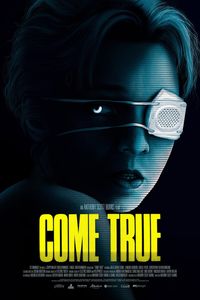
Come True (2020)
(On Cable TV, November 2020) It’s never a good sign when I groan audibly as a film’s ending credits start to roll—a great ending is crucial to a film, especially if it’s a low-budget production that relies a lot on its script to create interest without piles of money to throw on-screen. It’s even more infuriating when an ending comes too early or too late for an otherwise successful conclusion. But here we are with Come True, one of the best Canadian Science Fiction movies of the past few years… if it wasn’t for the way it wraps itself up. There were times during the film where I was giddy with excitement at seeing a film do a lot with little means, exploring relatively new territory in style and going for some nicely creepy moments. It begins as a runaway young woman (the innately appealing Julia Sarah Stone) signs up for a sleep study. But as the film’s synth retro-aesthetics suggest, there are many stranger things going on here, and it doesn’t take a long time for the official explanation to be stripped away: it’s not a sleep study as much as a glimpse into the volunteers’ dreams, and they are all simultaneously having the same dream. At that point, I was really invested in the film—writer-director Anthony Scott Burns is able to do much with little, and the visual polish of the film easily rivals much bigger productions. But then… well, the script goes off the rail. Or maybe not off the rail as much as ever farther away from the rails: the story here is never developed conventionally, which is part of the charm, except when the film seemingly gets rid of its plot to come up with even stranger tangents that get away from what could have been a solid narrative core. There’s a long walk through deserted nighttime Edmonton that takes us farther and farther away from the narrative strengths of the middle act, and a final scene that echoes a classic Internet creepypasta—only to stop there, whereas ending five minutes earlier or five later would have been far more satisfying. Hence my groan, made even worse by the fact that Come True is actually really good in its middle portion. I’m still recommending it to SF fans, albeit with a giant billboard-sized caveat about its disintegrating third act and especially its ill-fitting conclusion.
