Julianne Moore

  • The Fugitive (1993)

    The Fugitive (1993)

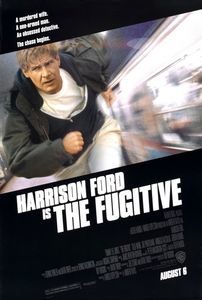
    (On TV, April 2013) The true mark of a film isn’t to be found in its premise as much as its execution, and twenty years after its theatrical release, The Fugitive remains as slick and tightly-paced as ever was.  The cars are starting to look dated, the Internet isn’t there to speed up the information-gathering but no matter: it’s a well-made film, with a few good suspense sequences and compelling writing.  The protagonist is smart, the antagonist equally so, and the plot is able to wring a lot of excitement out of a series of near-misses. Vintage-era Harrison Ford is pretty good as the titular fugitive, while Tommy Lee Jones solidified his onscreen personae with his dogged portrayal of a determined federal marshal. (Elsewhere in the film, keep your eyes open for a short role for pre-fame Julianne Moore)  The cinematography is crisp, the city of Chicago is used to good effect and the pacing seldom lets go. All elements combine to make a familiar premise feel fresh and exciting: Twenty years later, thrillers still don’t get much better than The Fugitive.

  • Crazy, Stupid, Love. (2011)

    Crazy, Stupid, Love. (2011)

    (On Cable TV, June 2012) Romantic comedies tend to live or die on the strength of their cast, so it’s a relief to see that nearly everyone headlining Crazy, Stupid, Love is at the top of their game.  Steve Carell anchors the cast as a recently-separated middle-aged man seeking lifestyle counsel from a capable womanizer, but he’s surrounded by more great performances by a variety of known names in a variety of large-and-small roles, from Julianne Moore, Emma Stone, Marisa Tomei, Kevin Bacon and Ryan Gosling, alongside newer names such as Jonah Bobo and Analeigh Tipton.  Veterans Tomei and Bacon are hilarious to watch in small but effective roles, but Gosling is particularly noteworthy, charming his way through a character that could have been immensely repellent in less-capable hands.  After focusing on the protagonist’s attempt to recapture some of his male seductive powers, Crazy, Stupid, Love soon expands into a mosaic of romantic subplots, occasionally palming a few cards in order to deliver a few almost-cheap twists along the way.  No matter, though: it leads to a relatively pleasant conclusion despite the overused (but subverted) graduation-speech plot device.  Such genre-awareness is a crucial component of Crazy, Stupid, Love’s moment-to-moment interest: Beyond the well-used soundtrack (including a striking usage of Goldfrapp’s “Ooh La La”), the sharp dialogue and the snappy direction, Crazy, Stupid, Love is just a joy to watch: so much so that even the tangled subplots and tortured twists seem cute rather than annoying.  And that, one could argue, is a measure of the film’s success.

  • Game Change (2012)

    Game Change (2012)

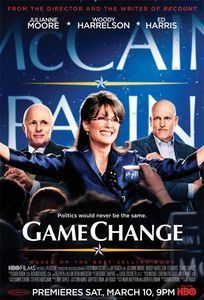
    (On Cable TV, March 2012) Political junkies will get their fix of gossipy fantasy in this made-for-HBO docu-fictive account of Sarah Palin’s role in the 2008 American Presidential race as seen from her Republican entourage.  Fans of the original Halperin/ Heilemann book will be surprised to find out that this adaptation barely mentions the Obama/Clinton contest and focuses solely on Palin’s selection and the backroom dealings of the Republican strategists trying to do what they can with an unsuitable candidate.  At its best, Game Change is a fascinating look behind the scenes of a major political campaign as a team of self-aware political professionals has to deal with a wholly unsuitable candidate.  It plays like a mainstream Hollywood comedy in which a half-wit is thrust in a position of importance… except that it really happened, and it happened recently in an American presidential election.  True enough, Palin occasionally comes across in the film as more admirable than her public personae would suggest: a dedicated mom, perhaps a figure to be pitied for having been asked to do more than she ever could.  Still, she really doesn’t come across well here: out of her depth, overwhelmed, petty and of limited capabilities.   The casting is exceptional: Julianne Moore excels in a nearly-perfect take on Palin, whereas Ed Harris has no problem establishing himself as a sympathetic McCain.  Meanwhile, Woody Harrelson turns in a clever performance as strategist Steve Schmidt, the nominal protagonist of the film.  The film is generally well-directed by comedy director Jay Roach and scripted competently, but it does have to work within the constraints of real-world events: The dramatic arc here is slight (especially compared to Obama’s journey) and even understanding that this is a heavily dramatized version of events as they occurred isn’t much of a comfort.  Game Change will appeal to those who remember the 2008 election well, but may not be all that compelling for others.  Which is fine, really: Even political buffs deserve their slick Hollywood entertainment.

  • The Kids are All Right (2010)

    The Kids are All Right (2010)

    (On DVD, January 2011) If you consider this film solely from its pedigree sheet, you may expect something significant: Film-festival’s favourite, lauded by reviewers, nominated for a truck-load of awards, performances by Annette Bening, Julianne Moore and Mark Ruffalo —The Kids are All Right has to be something special, right?  And if you just look at the surface, the film’s two major tweaks on the usual family-drama template may be interesting: As the two kids of a lesbian couple come of age, they reconnect with their biological father, causing the father and one of their moms to have an affair.  Cue the applause for a frank portrayal of what modern families can be.  But beyond that departure from the usual family drama formula, what’s left?  Not much.  So little, in fact, that once you get the “unconventional family” premise, the film struggles to justifies its existence: The dialogue feels familiar, the plotting is a well-worn formula, the characters are all annoying in their own way, and the laughs in this “comedy” are both rare and slight.  By the time the film remembers that it has a serious adultery subplot, the film concludes at a speed it couldn’t bother to reach at any time before that.  The sex scenes don’t rescue the film, and neither do the actors involved.  There’s a self-defeating quality in how The Kids Are All Right manages to make its unusual family seem as boring as any traditional nuclear family elsewhere in America.  Is the film all right?  Sure it is.  But not much more.