June Allyson

  • Best Foot Forward (1943)

    (On Cable TV, November 2021) Conventional wisdom has it that Lucille Ball was moderately famous throughout the 1940s, but truly became an icon with I Love Lucy in the 1950s. Best Foot Forward, considering Ball’s starring role as herself and its superb colour cinematography, may lead you to believe that it is a 1950s musical comedy looking back at the war years, but not so: Released in 1943, it was meant to highlight Ball’s status as one of MGM’s newest contract stars, with the red hair kept from the striking example set in her previous (and first MGM) film Du Barry Was a Lady. The plot revolves around her as she travels from Hollywood to a small northeastern military academy as a promotional stunt, answering the call of a starstruck cadet. Once there, the musical aspect of the film comes to the fore, as various musical numbers and interludes lead to small-scale romantic subplots for the other members of the cast. The result is fine without being particularly good (this being one of producer Arthur Freed’s earliest efforts, you can see the roots of his method that would lead to his first big success the following year with Meet Me in Saint-Louis and then to the streak of terrific musicals culminating in Singin’ in the Rain and The Band Wagon), but few numbers stand out:  Harry James and his Orchestra do good supporting work, with a highlight being a spirited version of “The Flight of the Bumblebee” (immediately followed by the film’s standout number “The Three B’s”). While Ball is also good-but-not-great in the lead role, the film’s scene-stealer is Nancy Walker as a short and spirited “plain” young girl who gets some great lines and a very funny duet dance number in “Alive and Kickin’.”  The result is very much in the solid average of the WW2 military musicals and is perhaps best remembered as a stepping stone in the careers of Ball, Freed and future musical star June Allyson. Even if it’s in the lower tier of Freed musicals, Best Foot Forward is not a bad watch — and it feels like a later film.
  • Good News (1947)

    (On Cable TV, July 2021) In many ways, Good News is a wholly unremarkable musical — it doesn’t have the top stars of the genre (I mean — yes, June Allyson and Peter Lawford aren’t unknowns but they don’t compare to some of the other people working in musicals at the time) and it doesn’t have memorable tunes other than “The Best Things in Life Are Free.”  It has adequate but not exceptional choreography and doesn’t quite distinguish itself with a campus narrative that draws in football with academics. On the other hand, it’s an infectiously cheerful romantic comedy— it’s practically impossible to stay grumpy once the film gets started and the silliness starts to fly between its football jock male lead and its French-tutoring female lead. Producer Arthur Freed’s touch is evident in the film’s accessibility and moment-to-moment fun. It’s peppy, colourful (thanks to some well-done Technicolor) and remains fun until the predictable end. As a French speaker, there’s some added interest in seeing Good News leads struggle with the language, either as they sing through “The French Lesson” or in hearing their spoken French oscillate between flawless and garbled in the span of a few syllables. (Ironically, Lawford’s French is pretty good, whereas Allyson’s isn’t.)  All of this doesn’t make Good News anywhere near the list of essential musicals. But it’s probably one that I’ll watch again with some pleasure later on — it’s perfectly serviceable in its own way, and a joy to watch even if it’s not a top example of the form.

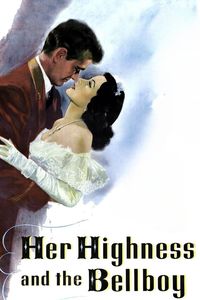
  • Her Highness and the Bellboy (1945)

    Her Highness and the Bellboy (1945)

    (On Cable TV, February 2021) As far as old-school Hollywood romantic fantasies go, Her Highness and the Bellboy is both typical and innocuous, as it embraces the very American notion of class mobility in the core of its narrative. It features a princess falling for a bellboy already pining for a bedridden invalid, but don’t worry given that everything is going to turn out all right for everyone. The casting is perhaps more interesting than the premise, as the role is the Highness is held by none other than Hedy Lamarr (in a relatively rare comic role), while the Bellboy is played by a very likable Robert Walker — while June Allyson transforms the role of a crippled ex-dancer into more than just clichés. (Don’t worry — there’s eventually another man to round up this love triangle.)  Production values for the film are fine without being spectacular — after all, this is mostly a studio-set film featuring a small number of characters: no need to go all-out on the Manhattan location shooting. It gives Her Highness and the Bellboy perhaps more of a sitcom feeling than it should, but that’s the nature of the story: a straightforward narrative, enough time for comic subplots and a big romantic finale upholding anti-monarchic ideals. It’s pretty much exactly what anyone would expect, and that’s its biggest strength.

  • Little Women (1949)

    Little Women (1949)

    (On Cable TV, December 2020) When it comes to the multiple adaptations of Little Women, it’s not as useful to say, “That’s the 1949 one” as much as “that’s the Elizabeth Taylor one” or maybe “that’s the June Allyson one,” considering that Jo is usually the main character of the tale. But it’s also “the one with Peter Lawford, Margaret O’Brien, Janet Leigh and Mary Astor” considering that casting is the most spectacular aspect of how each version is perceived. With the 1949 version, I’ve now seen the fourth of the four major adaptations of the tale as of 2020. If it most closely resembles the 1933 (“Hepburn”) one, it’s no accident – it’s essentially using the same script and score, albeit with a significant upgrade in colour cinematography. It plays more as lighthearted(ish) comedy than the others – fewer reconsiderations about the role of women than later versions, not quite as dramatically weighty as the earlier version. Still, it’s a pretty good time with the March sisters – the technical aspects of the production are MGM-grade, which is to say as good as these things were in 1949. A young Taylor is a huge draw despite a lack of attention to her character – in retrospect, there’s a clear lack of balance between her Allyson in matters of starpower. The first half of the film is generally more fun than the second, but it all evens out when compared to the other version, which you absolutely should do in order to get the most out of your viewing. My recommendation: Watch them in chronological order of production so that you get the most out of the growing technical polish of the form.

  • The Stratton Story (1949)

    The Stratton Story (1949)

    (On Cable TV, April 2020) I must be overdosing on James Stewart’s movies, because there’s an impression of heavy déjà vu that hangs over the entire length of The Stratton Story and never quite goes away. Stewart as a baseball player? Yup, seen that before. Stewart in a biopic? Seen that before. Stewart playing loving couple with June Allyson? I certainly saw that already. The duality of Stewart is that he can do no wrong playing a humble likable character hailing from the heartland. Yet, at the same time, he never becomes anything else but James Stewart—he doesn’t disappear in the character as much as he makes the character him. This is fun to watch if you’re a fan of the actor, but the problem is that he forces the production to become “a Jimmy Stewart film.” Which may be for the best, given that The Stratton Story is otherwise a by-the-numbers biopic in the classical Hollywood mould, full of homegrown wisdom, conflicts between the family farm and the baseball field, terrible odds to overcome and a comeback hailed as a triumph. It’s easy to watch… but maybe harder to respect.