Karl Malden

  • All Fall Down (1962)

    All Fall Down (1962)

    (On Cable TV, August 2020) While director John Frankenheimer is best known for his action movies, he does have an almost-parallel filmography of character-driven drama films. Take, for instance, All Fall Down, released the same year as the far better known The Manchurian Candidate – it’s a relatively low-stake family drama, featuring a charismatic but self-destructive young man who drags down his family into misery. Unusually enough –and you can credit the literary origins of the film –, All Fall Down rarely revolves around that young man, inelegantly named Berry-Berry (the repetitiousness of it becoming an unintentional gag at some point in the film) and played by a very young and charming Warren Beatty. Much of the film is clearly from the point of view of his younger brother, undertaking a journey to the realization that his older brother is to be pitied rather than idolized or harmed. We also have their parents, divided over their older son’s behaviour, and an older woman who becomes the crux of the brothers’ irreversible rift. There is some intense melodrama to the twists and turns of All Fall Down that hasn’t aged particularly well, and having a handsome but dangerous central character is always a cause for mixed impressions. There are some good performances here – aside from Beatty, there’s Angela Lansbury as a misguided mother, Eva Marie Saint as the girl that divides the brothers, and Karl Malden as a father drinking himself to death. For all of Frankenheimer’s skills in directing, he couldn’t quite manage to improve on the screenplay’s least believable elements enough to improve the credibility of the film – it all seemed like an elaborate plotting exercise, moving pieces around without quite thinking about whether it made sense. I eventually tired of Berry-Berry, and wanted him unable to hurt any more people ever again, no matter how we got there. All Fall Down does hold more interest than expected as drama, but it does feel a bit hollow when all is said and done.

  • Patton (1970)

    Patton (1970)

    (On Blu Ray, September 2018) There is a delicate art in making a biography film of a contentious figure, and Patton’s enduring success proves that it hit the right spot. It gets going with an iconic sequence in which we get a greatest-hits version of General George Patton’s speeches set in front of a gigantic American flag, quickly running us through his philosophy before the action starts. Then the film takes only a segment of his life (his involvement in World War II), skipping over tedious “young-Patton” episodes to present him in his full-fledged form. Patton himself is shown fairly, with enough perspective to put the character in dimension. The film definitely toys with the idea that some intolerable personalities can be essential in critical situations, with Patton being the prime example of a warrior archetype only happy in combat and unsuited to the subtleties of everyday life. George C. Scott is magnificent in the title role, credibly portraying a flawed but bigger-than-life character. (Karl Malden gets a good role as Omar Bradley, which isn’t surprising considering that Bradley not only wrote one of the film’s inspirational books, but also actively served as a consultant on the film.) Long movies often feel interminable, but Patton manages to sustain interest even through a nearly three-hour running time—a good script (co-written by Francis Ford Coppola) with good dialogue and memorable scenes help a lot, as well as some impressive war-driven mayhem and explosions. The tank battles in Africa are very impressive, and still mark one of the few times where armoured warfare has been credibly portrayed on film. It amounts to a highly enjoyable film, perhaps light on the horrors of war but strong on a fair portrayal of a character than even people who disagree with the subject matter would appreciate.

  • On the Waterfront (1954)

    On the Waterfront (1954)

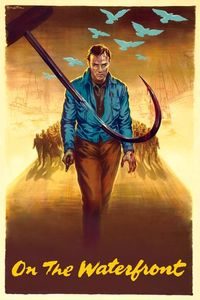
    (On Cable TV, March 2018) It took me a long time to warm up to On the Waterfront. At first, it felt like a chore of a self-imposed viewing. Taking place low down the social ladder in the working neighborhoods around the port, it talks about corruption, coercion and trying to do the right thing when you’re going to be punished for it. Marlon Brando became famous largely thanks to this film (“I coulda been a contender!”), and it’s easy to understand why—compared to other actors in other films of the time, he feels more real, more alive than most of them. Other standout performances include Karl Malden as a tough priest, and a first appearance by Eva Marie Saint. Still, the film is a grim slog for much of its duration—but it gets much better toward the end, as On the Waterfront finally comes into focus and achieves maximum dramatic intensity. The final ten minutes are riveting, which is a good place for a film to conclude.