Katharine Hepburn

  • Love Affair (1994)

    (On TV, July 2021) On paper, the idea of remaking 1939’s Love Affair (itself remade in 1957 as the better-remembered Cary Grant vehicle An Affair to Remember) with Warren Beatty and then-new wife Annette Benning isn’t all that awful as Hollywood ideas go. Sure, it’s recycling, but it’s recycling from earlier decades, which almost makes it affectionately reverent of Hollywood history. Further burnishing this connection to classic film history is Katharine Hepburn, here playing a canny older woman in her final film role. If you look down the cast list, you’ll find names such as Kate Capshaw, Pierce Brosnan (bearded), Garry Shandling, Harold Ramis and Rosalind Chao in a blink-and-you’ll-miss-it role. Still, even a good cast can’t quite save a clunky script that doesn’t update the most vexing elements of the original films, makes new mistakes of its own and can’t create dialogue equal to the original. Beatty and Benning appear self-satisfied with themselves here, but even their star coupling can’t quite translate to screen heat. A series of unlikely events is contrived to make the film happen like it does (including the engineering the entrance of Hepburn’s character) but perhaps the worst is the heavy-handed ableism that powers much of the last act of the film — something that should have been left in the past, even if it had meant not making this film at all. Not all remakes are good ideas, and this may help to explain why this Love Affair has now sunk so thoroughly in obscurity as anything but Hepburn’s final film.
  • Suddenly, Last Summer (1959)

    Suddenly, Last Summer (1959)

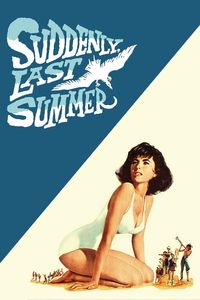
    (On Cable TV, June 2021) It strikes me that a good way to distinguish between new classic movie fans and veteran ones is to ask them about Suddenly, Last Summer: Novice film fans, not having seen the film, are likely to be astounded by the top talent assembled here: Elizabeth Taylor, Montgomery Cliff and Katharine Hepburn on the acting front, with Joseph L. Mankiewicz at the direction and none other than Gore Vidal and Tennessee Williams penning the script, how can it be anything than terrific? Then there are the veteran classic movie fans who, having seen the film, are simply shaking their heads while saying, “You should see it before getting excited.” The most important name here is probably Tennessee Williams, since his specific sensibilities dominate the film’s narrative in such a way as to influence everything else. True to form for Williams, the story he’s telling is a melodrama with a central (but faceless) character who’s as homosexual as could be at the time. If I understand the film’s production history, the Williams one-act play was then adapted for the screen by Gore Vidal, leading both to accuse the other of sabotaging the result. No matter who wrote it, director Mankiewicz went for maximal melodrama in executing it, with Hepburn being an enthusiastic participant in the result — her role as a family matriarch is heightened opera the moment she descends on-screen in an enclosed throne, and the flowery soliloquies she delivers would have been ridiculous from any other actress. Cliff does his best to keep up as the audience’s representative in understanding the profoundly dysfunctional family in which he’s been asked to intervene, but he routinely gets overshadowed by Hepburn’s arch overacting and Taylor’s ability to take her dialogue right up to eleven even with a heaving low-cut dress. The score is another intrusive participant, underlining every sordid revelation with a heavy note. It’s quite wild, and the narrative never stops one-upping itself, eventually reaching for a cannibalistic conclusion reinforcing the era’s prejudice against homosexuals. What’s more, I’m glossing over the rape, incest, and intended lobotomy as a way to keep the family secret — as I’ve said, it’s a wild movie, and one that’s more impressive for how quickly it becomes untethered from reality than for producing the results that the cast and crew would have preferred. By sheer happenstance, I followed up Suddenly Last Summer by the viewing of homosexuality-in-Hollywood-history documentary The Celluloid Closet, and I’m fortunate that this was the order I watched both films because The Celluloid Closet’s description of Suddenly Last Summer’s ludicrousness would have been too wild to believe if I hadn’t just watched the film. There are plenty of landmark movies in classic Hollywood history, and if Suddenly Last Summer is really not one of them, I still feel as if I just graduated to another stage of understanding Hollywood history simply by having watched it. Incredulously.

  • The Iron Petticoat (1956)

    The Iron Petticoat (1956)

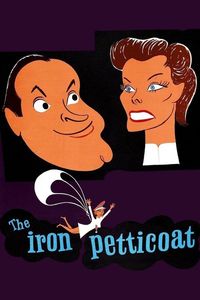
    (On Cable TV, March 2021) As far as unusual screen couplings go, Katharine Hepburn and Bob Hope is about as interesting as it comes. Stuck in a film where she plays a cold-hearted Soviet defector and he plays an American officer tasked with keeping tabs on her (and letting her discover the hedonistic joys of the west), their clashing style makes about half of the result’s entertainment factor. The inspiration from Ninotchka is obvious (both the equally similar Jet Pilot and Silk Stockings would be released the next year), especially in the way she is portrayed as a humourless automaton-like product of a caricatural Soviet regime. The production history of the film was… tumultuous, with the original script being a Hepburn vehicle pairing her with someone like Cary Grant. When Hope came onboard, the script was rewritten to suit his broad comic style (incidentally making him the lead, at her expense), and the finished film feels as if Hepburn is a stranger in her own film, trying to keep up with Hope’s constant mugging and wisecracking. To be fair, a lot of it is actually funny — the quips work and seeing Hepburn stuck in a straighter-than-straight role is amusing in itself. (As a romance, though? Eh.)  The Cold War comedy atmosphere is almost charming at this point and the film would make a splendid double-bill with Silk Stockings, even if it pales in comparison. In narrative terms, The Iron Petticoat does the strict minimum to get the characters to a happy ending — the film’s strongest point comes in the earlier dialogue rather than the wrapping-up of the tale. A must-see for fans of Hepburn, the result is fascinatingly uneven and almost a case study of what happens when two mismatched leads are stuck in the same project.

  • Morning Glory (1933)

    Morning Glory (1933)

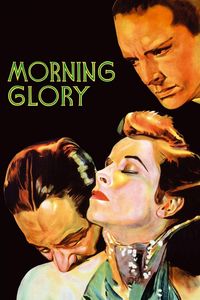
    (On Cable TV, January 2021) I like Katharine Hepburn a lot and the debutante roles she often played in the 1930s do have an obvious attraction, but I had a hard time warming up to her performance as a struggling Broadway actor in 1933’s Morning Glory. That’s all the more surprising considering that it was the film that got her a first (of four) Oscars, and is often identified as the film that launched her to superstardom. There’s some metafictional interest in seeing her as a young actress playing a young actress—and doing so in a way that would be impossible to mistake for any other actress. On-screen, she displays a presence quite unlike anyone else—tall, thin, gorgeous and Hepburnesque from beginning to end. But the character she’s playing definitely takes a while to become likable—hopelessly naïve, chatterboxing her way through early scenes, not discernibly talented until late in the film (and even then, only through other people’s reactions). Anyone aware of Hepburn’s true self—or her later roles—can feel free to be bewildered by this girlish character. Adding to the discomfort, the mixture of Hepburn’s distinctive delivery and very mannered 1930s acting style can often ring false, even for those used to both: it’s no surprise if Hepburn was ripe for imitation by comedians of the time, or if she often sounds like the aspiring actress she plays in the latter, better 1935 Broadway comedy Stage Door. There’s an embarrassing drunken scene midway through that can be tough to watch, and the film seems to end too soon at barely 74 minutes. Still, Hepburn does remain the best reason to watch Morning Glory: the film probably would have sunk without a trace if it had starred anyone else. Extra bonus points are awarded to the film for featuring Hepburn with Adolphe Menjou—by the time they’d star together again in 1948’s State of the Union, his friendly testimony to the anti-Communist witch-hunts would drive a big wedge between then.

  • A Woman Rebels (1936)

    A Woman Rebels (1936)

    (On Cable TV, September 2020) If there is no Katharine Hepburn biography titled A Woman Rebels, then it’s a missed opportunity for the ages. The film of that name is so very much a 1930s Hepburn film, featuring her headstrong personality and embracing surprisingly feminist themes roughly three decades before everyone else. In Victorian England, a woman shows her independence by raising a child out of wedlock, and by becoming an activist for women’s causes -an ideal role for the iconoclastic Hepburn. Often blunt but nonetheless fascinating, A Woman Rebels is an illustration of just how good Hepburn was in the 1930s—a mesmerizing beauty, a ferocious screen presence and a canny performer. Alas, the film flopped and led to a near-career-death experience for Hepburn, who took years to get back on top as box-office performer. File this one under “the future knew better.” Also worth noting: Van Heflin in his film debut. While A Woman Rebels is not that good of a film (a bit fuzzy, a bit jumbled, a bit overlong), Hepburn easily overpowers those flaws to make the film worth watching, especially for her fans or anyone interested in film progressivism.

  • Rooster Cogburn (1975)

    Rooster Cogburn (1975)

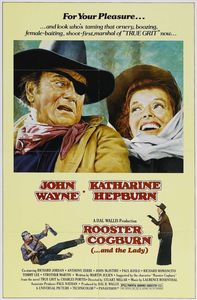
    (On Cable TV, August 2020) It took a few decades, but in Rooster Cogburn we finally get to see Katharine Hepburn fire a gatling gun. Of course, the price to pay for this treat is having to endure John Wayne’s smarmy arrogance for an entire film. A sequel to True Grit, this film sees Wayne and Hepburn (born the same year; at last, an age-appropriate romance in a Hollywood movie! ) undertake a dangerous journey in the Far West to avenge the death of her friends and family. While both actors are interesting in their own way and the script is tailored to give them plenty of Significant Moments (and riff existing personas; same character for Wayne, same kind of character as The African Queen for Hepburn), Rooster Cogburn at a whole is a disappointment the moment you focus on anything but the stars and the gatling gun. The dialogue is not good, the directing is pedestrian, the narrative is humdrum and while some landscapes are spectacular, that’s really on the location scout more than anyone else. But here’s the thing: When you’ve got WAYNE and HEPBURN together at last (in the only time of their careers), it’s just not possible to pretend to ignore them in the result. Considering this, Rooster Cogburn becomes far more than just its components—it’s nearly a must-watch for classic Hollywood fans, if only for the lone reunion of two screen legends. That’s objective. If you want subjective, consider that Hepburn is at the top of my classic Hollywood list of actors, and Wayne is at the bottom.

  • Undercurrent (1946)

    Undercurrent (1946)

    (On Cable TV, June 2020) Wait, wait! There’s a film in which Vincente Minelli directs both Katharine Hepburn and Robert Mitchum? Why did no one tell me? Well, it’s probably because they’ve seen it, considering how all three are playing outside their wheelhouse in Undercurrent. A domestic thriller the likes of which were popular at the end of WW2, it features a demure spinster who marries a mysterious rich man but ends up having a closer affinity with his brother. There’s a bit of gothic romance to the story as hints of mental instability creep in and the action moves to murder: it doesn’t escalate to noir, but there’s still a creepy drama underscoring the entire film. The threat may come from inside the house, but Undercurrent’s biggest twist is that Hepburn plays a meek character, Mitchum plays a sensitive guy (for barely three scenes), Robert Taylor plays the creepy villain, and Minnelli tries his hand at suspense, all of which is completely at odds with their strengths. One of Hepburn’s last role as a debutante (she was 39!), the film isn’t particularly good nor terrible: it’s interesting for the eyebrow-raising use of familiar names in unfamiliar roles, but if you’re looking for a good domestic thriller of the era, you might as well have another look at Gaslight.

    (Second Viewing, On Cable TV, July 2021) The only thing better than a film that brings familiar names together is a film that uses those familiar names against type. Of course, saying that about Undercurrent is misleading, as it takes place early in the career of two of its three marquee names. So here we have MGM musical director Vince Minelli going for a quasi-gothic thriller, steely Katharine Hepburn settling for a soft and weak character, and noir icon Robert Mitchum playing a refined and good-hearted character. (Plus, leading man Robert Taylor going for moustache-twirling psychopathy.)  It’s quite a ride if you’re coming to it with different expectations, and it’s probably that which distinguishes my second better-informed viewing for the first – in between the two, I developed my own appreciation for those three names, and Undercurrent clearly plays against them. Otherwise, well, there’s not much more to say: from a detached narrative perspective, the film does go hard for gothic mysteries, as the new wife of a mysterious man gets to gradually unveil the secrets surrounding his brother. The film is designed to be overly melodramatic, and feels long at something like 115 minutes. It’s not a bad watch but not a particularly fine example of a form perfected by Rebecca or Gaslight – but it’s worth a look if you’re too comfortable in what to expect from any of the marquee names.

  • The Rainmaker (1956)

    The Rainmaker (1956)

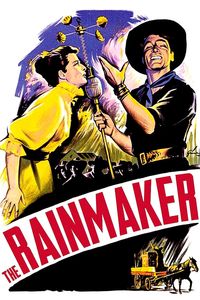
    (On TV, April 2020) There’s some serious star power at the top of the bill for dustbowl romantic comedy The Rainmaker: Katharine Hepburn plays a spinster pining for marriage, and her wishes for a suitable man are answered by none other than Burt Lancaster. He plays his always-travelling conman character (promising rain for a modest price) like a rough draft for the one he’d play three years later in Elmer Gantry. Meanwhile, well, Hepburn is as good as ever, yet about a decade too old to play a coquettish maid, and—being Hepburn—can’t help but being Hepburn even when it doesn’t make sense for the character. (The problems start with casting Hepburn as “plain”—look, Hollywood, even multiple-Oscar-winning Hepburn couldn’t play “plain.”) While the core of The Rainmaker is fine (a woman rediscovering herself thanks to a flamboyant stranger—I’m not saying “manic pixie dream dude” but I’m thinking it), the rest of it loses itself in not-always-interesting tangents and asides. This is probably an artifact of the film’s theatrical origins, just as is the over-the-top acting exhibited in the film. Now, I do like the result—manic Lancaster is the best Lancaster—but the film may be a hard sell for those not used to that kind of performance. Still, The Rainmaker is an interesting film for all sorts of reasons, maybe half of them not necessarily intended by the filmmakers.

    (On TV, September 2021) With the right script, there’s something fascinating in seeing well-known actors facing against each other. Katharine Hepburn and Burt Lancaster were two epochal actors, but The Rainmaker is the only film in which you’ll see them go head-to-head in roles hewing closely to their screen personas. She plays the clever spinster, pining for the right man but not too much. He plays a charismatic conman, with a business model of selling fancy decorations as devices fit to make it rain… and then moseying on to the next town. As the film begins, his hurried escape from a town suddenly opposed to his flim-flammery leads him right to Hepburn’s house. A short antagonistic romance begins, heightened by the difference on both actors’ acting styles. Unsubtly enough, rain ends up being a thematic stand-in for all sorts of things here – but never mind the symbolism, because we’re here for the stars. For Hepburn, the film is solidly in line with her progression from a spinster to a matriarch. For Lancaster, it’s one in a lengthy list of roles for which he used his leading-man good looks as a front for a deceitful character. This is a film where a second viewing can be more interesting than the first: it’s the push-and-pull of the romance that’s more interesting here than its resolution, especially if you think the characters are too mismatched for more than a brief but torrid affair. The Depression-era setting offers an interesting development of the western stories that would have been set in the same geographical area a few decades earlier. Nonetheless, I would recommend The Rainmaker for existing Hepburn/Lancaster fans – you get a lot more out of it as a clash of actors than as a standalone story.

  • The Little Minister (1934)

    The Little Minister (1934)

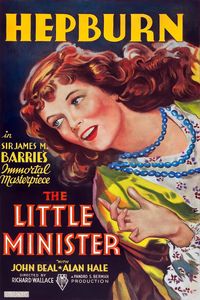
    (On Cable TV, March 2020) Look, I am a simple man: I see Katharine Hepburn looking gorgeous as a curly-haired gypsy, I like. Alas, the rest of The Little Minister is a letdown after seeing Hepburn at perhaps her all-time sexiest. It does help that, as an early dramatic role for an actress who hadn’t yet mastered her full range, this is a film that seems to run for a long time on empty conventionalities. Set in a rather strange nostalgic small-town in rural Scotland, the film is adapted from a J.M. Barrie novel (yes, the author of Peter Pan) as a somewhat serious drama with comic relief, none of which apparently reflects the source material, nor Hepburn’s then-range in romantic comedy. While there’s some heat between Hepburn (who’s not really a gypsy, but a noblewoman passing as a gypsy for some freedom) and John Beal playing a reverend taken by her wild-girl charm, the rest of this pleasant film feels both long and familiar in its take on 1840s Scottish romance. It’s not quite a misfire, even though it tarnished Hepburn’s status at the time as “box office poison.” Still, I like what I like—Hepburn is there, playing up her perennial rebellious persona and that’s quite enough for me.

    (On Cable TV, September 2021) We head over to rural Scotland in The Little Minister, and perhaps more strikingly to a young and radiant Katharine Hepburn as a local noble who enjoys passing as a lower-class gypsy girl in order to go against the action of her betrothed. In walks a young minister who catches her eye while he’s having a hard time integrating in the close-knit community. There’s a fair amount of Scottish mythology at work here, especially in its depiction of a small village with its quirks and issues. But Hepburn stands tall in a role almost custom-fit to her later personas: a liberal rebel out to tweak the establishment and a strong-willed woman who could be as determined as she was beautiful (and considering that mid-1930s Hepburn was a world-class beauty, that’s saying a lot). Everyone else pales in the rest of the film, especially considering that the execution of the plot is duller than it ought to be – reportedly more serious than the whimsical novel penned by J. M. Barrie (yes, “Peter Pan” Barrie), the film often feels laborious and forced. This is even more apparent when Hepburn shows up and seems to be playing something far more interesting. It’s not one of her finest films of the 1930s, but she frequently looks amazing and is clearly shoring up her distinctive screen persona. As such, The Little Minister remains a must-see for Hepburn fans, even if everyone else will have a harder time getting through it.

  • The Lion in Winter (1968)

    The Lion in Winter (1968)

    (On Cable TV, February 2020) Film historians and Katharine Hepburn fans can agree on one thing: She became a much better actress as she aged—from a cute funny ingenue in the 1930s, she switched to a matronly appearance throughout the 1940s and became increasingly adept at dramatic roles throughout the 1950s. The Lion in Winter is, in many ways, the apogee of her acting talents. (Significantly, she won her third Best Actress Academy Award for this film.) The film itself seems designed to let actors display how capable they could be—it’s a complex story of court politics and family intrigue set against the Henry II era (1183) and the kind of film that actors and the Academy both love. Casting-wise, there are highlights from several generations here—Hepburn, obviously, but also Peter O’Toole as Henry II, and much more modern notables as Anthony Hopkins (in his first big movie role) and Timothy Dalton. (This is one handy movie in any Six Degrees of Kevin Bacon game, as you can use it to skip from the 2020s to the 1930s quite easily.) As for its impact, well, it’s all quite more interesting than its Dark Ages setting would suggest—I suspect that anyone who was fascinated by Game of Thrones’ exploration of the perils of hereditary succession will also enjoy this one. It has aged, though: in filmmaking techniques, the 1960s feel increasingly artificial, and some of the values of the time have been imposed on the 1183 setting in not-so-elegant fashion. But that does add a layer of interest that wasn’t in the film when it was first released. At least Hepburn is timeless.

  • Without Love (1945)

    Without Love (1945)

    (On Cable TV, January 2020) While Without Love may not be Spencer Tracy and Katharine Hepburn’s finest comedy, it’s not without its share of high points. As a story of two bachelors who marry out of convenience and patriotic duty then truly begin to fall in love, this is not exactly the sharpest premise in the book. But all is in the details, and the pleasantness is largely to be found in small moments, lines of dialogue and seeing both Hepburn and Tracy play off each other. (One very funny scene has Hepburn sneezing in a diver’s helmet.) The setting is hopelessly dated in many ways: much of the plotting is propelled by World War II concerns, something the film inherits from its theatrical origins. For science nerds and theatre geeks in the audience, the film does throw in a few jokes about distracted scientists (which Tracy’s character is), and pre-famous Lucille Ball does show up in an early supporting role. Anyone who champions Hepburn as a sex-symbol should watch Without Love if only for the brief scene in which she turns up with loose curly hair. As for everyone else: the film is fun, funny and ping-pongs between characters who think they’re too intellectual to fall in love, then spend much of the film trying to deny it’s happening. The very abrupt ending is a bit of a surprise—it ends well, but an additional scene may not have hurt. On the other hand, that’s how they often wrapped things up back then—cut to the trailers, and on to the next short comedy.

  • Alice Adams (1935)

    Alice Adams (1935)

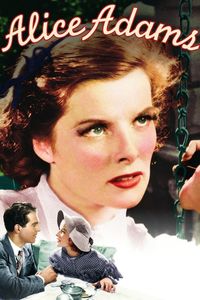
    (On Cable TV, January 2020) Everyone can admire the matriarch of steel that Katharine Hepburn became late in life and career, but I do have a soft spot for the soft ingenue Hepburn of the 1930s, playing against later type as just the kind of irresistible sweet girl that people expected from female leads at the time. So it is that she headlines Alice Adams as a girl from the wrong side of the tracks, trying to woo a much richer suitor despite plenty of social embarrassment and twisted resentment between their two families. It all culminates at a supper where everything goes wrong, and there’s no other way out than a few frank discussions, absolute candour and reconciliation. Alice Adams is a romantic comedy, and a rather good one too: adapted from a 1921 novel, it does reflect early-twentieth-century small American towns, and milks the social mores of the time for romantic complications that are happily resolved. (The novel doesn’t end as happily, and neither did earlier versions of the script.) Fred MacMurray makes for a great suitor, while Hattie McDaniel shows up in a comic role as a maid. While Alice Adams may not bowl over contemporary viewers, it’s a nice treat for Hepburn fans and those who like mid-1930s Hollywood productions.

  • Quality Street (1937)

    Quality Street (1937)

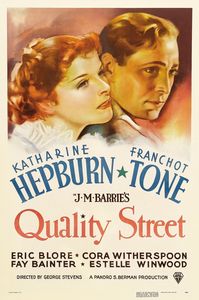
    (On Cable TV, January 2020) One may admire Katharine Hepburn for the incredible longevity of her career, or the steely matrons she played in the latter half of her career, but there’s a place for her cute ingenue roles as well, and that’s what Quality Street delivers in spades. Finding some originality in romantic comedy tropes, the film has Hepburn as a 19th-century-England romantic lead pining for her beau to propose… only to be made speechless when he announces that he’s leaving for the Napoleonic Wars. Ten years pass until his return, at which point she ends up creating a charade posing as her own (fictional) niece for reasons that worked better at a time when unmarried 30-year-old were considered old maids. Many misunderstandings occur until they both get tired of the fiction and take action to get rid of the nonexistent niece in order to keep up appearances. There’s not a whole lot more to the film, but there’s a restrained sense of humour to it all that makes it almost credible despite the ludicrousness of the identity plot. As a costume drama, it hits the necessary high notes with great sets and costumes. While it certainly doesn’t qualify as a great Hepburn film (there’s little here of her famous persona), and she’s not exactly credible as an innocent niece, the film is only 82 minutes long, and it does help round off a career that spanned sixty years. There are better examples of young-Hepburn roles, for sure, but it’s not a bad thing to have a few more of those around.

  • Mary of Scotland (1936)

    Mary of Scotland (1936)

    (On Cable TV, November 2019) Considering the sheer number of 1930s historical dramas, no one will blame anyone for overlooking Mary of Scotland—neither a terrible nor extraordinary example of the form. But there are a few interesting names here, and a vexing historical conundrum to resolve. Considering that the real story of Mary of Scotland does not end well, history-minded viewers will be most interested by the film’s almost-desperate attempts to rewrite history so that the ending is palatable to audiences. (I’m not sure how the Catholic propaganda played in 1936, but let’s just say that it has not aged well.)  But so did nearly every other historical costume drama of the time—and Mary of Scotland certainly fits within the lavish production means used for those movies—extravagant costumes, scripts that combined historical material with accessible dialogue, and sets that crammed the most they could fit in a Hollywood sound stage. Where the film gets interesting, perhaps for the wrong reasons, is in the top names involved in toe production. Fredric March, sure (I’ve never been much of a fan), but Katharine Hepburn yes! She wasn’t particularly well suited for the role at that stage of her career (her take on royalty in The Lion in Winter would be far more successful) and the film seems to be using her for royal demeanour and little else. But the surprise here is seeing John Ford, best known for all-American westerns, undertake an early job-for-hire here as the film’s director. None of his trademarks show up here, which is reasonable considering that this was a fairly early effort limited by mid-1930s Hollywood technical means. None of this makes Mary of Scotland particularly interesting, unless you’re using the film as a parallax measure against other films or later entries in the principals’ filmography. Or if you’re a dyed-in-the-wool fan of 1930s period dramas, of course…

    (On Cable TV, March 2021) I hoped that a second viewing of Mary of Scotland would help me warm up to the movie, but I don’t think it changed much: Katharine Hepburn’s royal performance is the film’s single best asset, and the film spins its wheels for a very long time before delivering a rather good final sequence in which our two strong female protagonists finally meet face to face. It’s mildly interesting to put Mary of Scotland up against more recent historical epics and see how they did things back in the 1930s, but there are probably more engaging films in which to do this kind of comparative analysis. John Ford directs a picture as a costume drama that we wouldn’t necessarily associate with his later career or favourite themes (scuttlebutt has it that he and Hepburn had an affair during the film’s production), but that only brings marginal interest to a surprisingly average film.

  • Pat and Mike (1952)

    Pat and Mike (1952)

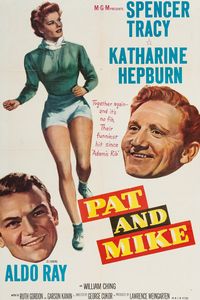
    (On Cable TV, October 2019) I’m on a mission to watch all of the nine Hepburn/Tracy movies, and Pat and Mike is not only the eighth… it’s one of the better ones. It’s certainly one of the nine in which the distinction between actors and roles is most blurred. Written specifically for the pair, Pat and Mike has Katharine Hepburn as a naturally gifted athlete who pairs up with a gruff sports promoter. Sparks fly, a fiancé is ditched and you already know how it’s going to end … but the fun of the film is seeing Hepburn playing Hepburn, relying on her usual clipped dialogue patter and not using stunt doubles for the sport sequences. She actually looks younger here than in some of her late-1940s films, probably helped along by a looser haircut and an active role. Meanwhile, Spencer Tracy is up to his gruff self in trying to keep up with her.  Occasional special effects add to the subjective impact of the comedy. Pat and Mike is not meant to be a deep or surprising film, but rather an occasion to spend some time with two likable stars doing what they do best, and it’s quite successful as such.