Keira Knightley

  • Official Secrets (2019)

    Official Secrets (2019)

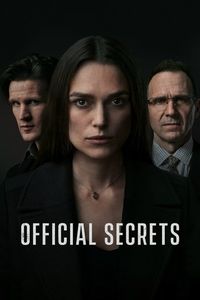
    (On Cable TV, October 2021) It certainly takes a while for Official Secrets to heat up: Limited by its almost-documentarian approach to a true story, it leisurely sets up the elements of its narrative before getting to the good material, which is the aftermath of a whistleblower’s revelation of dirty tricks in the lead-up to the American invasion of Iraq. It’s not enough to tell the truth—the British law is set up to severely punish anyone who reveals classified information and creates a Kafkaesque nightmare along the way. The story is familiar and so is the era (anyone recall Fair Game?) but the message is worthy and the execution is competent. For director Gavin Hood, this feels more and more like a return to the realist thrillers he used to direct before a short Hollywood blockbuster interlude. In front of the camera, Keira Knightley does well in the lead role (is it too early to hail her reinvention in character-driven parts?), with such notables as Matt Smith, Matthew Goode, Rhys Ifans and Ralph Fiennes in supporting roles. After rather a lot of throat-clearing to establish the characters, the institutions and the way they interact, Official Secrets become far more interesting when the whistleblower and her husband are attacked by the British government, with newspapers and lawyers aligning themselves on different sides of the law, and the resolution going all the way to the justification for the war itself. Aimed at older, more patient audiences, Official Secrets eventually becomes as gripping as it should be.

  • A Dangerous Method (2011)

    A Dangerous Method (2011)

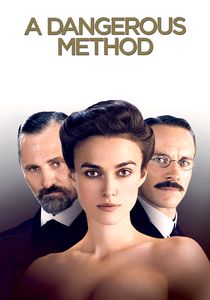
    (On Cable TV, May 2019) Now here’s a subject matter you don’t see every day: A slickly made film exploring the evolution of the relationship between Sigmund Freud and Karl Jung, and the woman between them. A Dangerous Method is clearly an actor’s showcase: In keeping with late-career David Cronenberg’s work, it’s low on gore, violence or overdone drama, but no less intriguing through its solid look at the roots of modern psychoanalysis. Even if you don’t happen to put too much stock in Freudian (or Jungian) theory, there’s some fun in seeing Viggo Mortensen and Michael Fassbender playing two titans of psychology, with Keira Knightley as a patient who becomes something more. (She especially good earlier on, as she plays several shades of hysteria.) The historical recreation is polished—aside from some dodgy CGI depicting a nautical approach to New York City. A Dangerous Method has an unusual, highly intellectual subject matter and I could use more of these kinds of film even if they’re best appreciated in a very specific mood.

  • Seeking a Friend for the End of the World (2012)

    Seeking a Friend for the End of the World (2012)

    (On Cable TV, April 2013) There have been a lot of films about the end of the world lately (a wave that shows no sign of abating), but there’s always a place for something different, and it’s in this light that Seeking a Friend for the End of the World is best appreciated.  Once the first few minutes establish that this is indeed the impending end of the world, the rest of the film follows an everyman protagonist as he witnesses the end of civilization, the various responses to the impending apocalypse, and even gets to find solace of sorts.  It’s too amiable to classify as a drama, but as a comedy, don’t expect big laughs as much as a series of poignant vignettes and a gentle romance.  Steve Carell is almost perfectly cast as the melancholic protagonist, while Keira Knightley gets an easy role as the girl who brightens up the last days of his life.  Based as it is on a road-trip series of vignettes, the film can’t escape some severe tonal consistency problems, but it does end in a satisfying (albeit predictable) fashion.  Cranking up many romantic clichés against the big ticking clock of the impending apocalypse, Seeking a Friend for the End of the World works best as a break from the usual bombastic disaster clichés, and as a slower deliberate exploration of what the end means to everyone.

  • Anna Karenina (2012)

    Anna Karenina (2012)

    (Video On-demand, March 2013) Director Joe Wright has always shown tendencies toward stylistic show-boating, and the first half-hour of Anna Karenina is crammed with directorial flourishes as the film moves in-between interior sets and a larger theatrical stage. As a way to freshly present an oft-told story (Tolstoy’s novel has been adapted to the big screen at least 12 times until now), it’s not a bad choice –except that there seems to be little rhyme or reason to the device, and it seems to be half-abandoned as the film progresses.  While viewers who like a bit of cinematic flourish may be pleased by the way Wright plays along with conventions, it does obscure the story and turns the film into something it’s not meant to be. It also obscures the good work done by the actors, including Keira Knightley in the titular role and Jude Law as her despairing husband. (Meanwhile, Aaron Taylor-Johnson’s mustache steals the show for none-so-positive reasons.)  The costumes are sumptuous and the visuals occasionally evoke a nicely idealized view of 19th century Russian aristocracy, but the self-conscious artificiality of the film’s presentation work at undercutting the impact of those.  As a take on familiar material, this 2012 version of Anna Karenina isn’t ugly to look at… but it’s quite a bit abstract when it starts messing with the way movies are presented, and that may not necessarily work at a romantic drama’s advantage.

  • Never Let Me Go (2010)

    Never Let Me Go (2010)

    (In theaters, October 2010) Kazuo Ishiguro’s Never Let Me Go is generally acknowledged as a Science Fiction novel coming from outside the SF genre, and as such pays more attention to fine prose, character development and inner monologue than SF devices, coherent word-building or narrative excitement.  As an adaptation, Never Let Me Go feels a lot like that, with a thin plot, leisurely pacing and constant focus on the three lead actors.  (Carey Mulligan, Andrew Garfield and -to a lesser extent- Keira Knightley all do well with their roles.)  The muted colors of the cinematography reflect the restraint with which the characters react to their fated lives, and the lack of urgency in the telling of the story is designed to let everyone reflect at lengths about the situation.  It’s one of those rare (and largely mythical) SF movies without obvious special effects, and as such should earn a bit of respect from the genre-reading crowd.  On the other hand, that genre-reading crowd will be more likely to recommend the film to others as accessible-level SF than to appreciate the film for themselves, given how it vaguely sketches the alternate-reality of the story’s universe, and features largely passive characters whose role is to stare into the face of inevitability.  There is, however, something very interesting in the film’s emphasis on sub-culture mythology, with a series of ill-informed rumours (all of them knocked down one after another) forming a good chunk of the characters’ inner landscape due to the absence of more reliable information.  (The final revelation perfectly fits into this motif.)  Does the world of the film hold together?  Absolutely not, but it doesn’t even try to address plausibility, betting instead on the real emotional core of the trio at the middle of the film.  Never Let Me Go will be a bit too slow and thin for some, but it’s a success in the same way that Atonement and other middle-brow character dramas can be.  Don’t let the “Science Fiction” label create false expectations…