Kelsey Grammer

  • Miss Willoughby and the Haunted Bookshop (2021)

    (On Cable TV, October 2022) The lineage of Miss Willoughby and the Haunted Bookshop as a low-end made-for-streaming title is obvious from the get-go—while some of the cinematography is glossy, much of the film lives in this awkward space reserve for films attempting too much on a small budget. It’s also, clearly, the (attempted?) start of a franchise, what with our heroine (Nathalie Cox, adequate) set up as this orphan who grows up, under the tutelage of her loyal butler (Kelsey Grammer, slumming but having fun), to be a mystery-solving detective. To its credit, the film is almost exactly what it presents itself to be: a pleasant small-town non-nonsense British mystery in which the heroine figures the mystery before people get really hurt. Ideal for the prototypical middle-aged audience that doesn’t want too much excitement in their thrillers. “Watchable” is probably where most assessments will land—not spectacular in any way (even the heroine’s deductions are few and slight), absolutely not interested in the supernatural, fairly light on the suspense even when there are gunshots going around. It’s not good, but it’s cozy. [September 2026: Five years later, no further films have been produced in the series.]
  • Money Plane (2020)

    (On Cable TV, September 2022) There’s clearly something wrong with me, because I found Money Plane rather enjoyable despite its significant shortcomings. It’s useless to pretend that it’s anything other than a low-budget action/thriller film. From the opening moments, the cinematography, the actors, and the pacing are all clearly inferior to Hollywood’s quality. And yet… it has a canny goofiness that makes it fun to watch. A regrettably-coiffed Adam Copeland (a wrestler, now a thespian) stars as the leader of a band of professional thieves whose latest and greatest heist falls flat, forcing them to an even grander scheme to rob an airborne casino travelling in international space and catering to the scruple-less ultra-rich. Kelsey Grammer cackles madly as the businessman funding the endeavour (and, eventually, waving a machine gun around), while Denise Richards shows up briefly, but long enough to make us wonder what happened to her. The airborne casino thing doesn’t make a shred of sense, but who cares—at its best (which is admittedly still a low bar), Money Plane glides on chutzpah and insouciance: everyone involved in the film knows they’re not there for high art, and that the ridiculousness is the point. It’s actually able to conjure a few set-pieces out of simple dialogue—many of the scenes set aboard the casino-in the-sky are like that: more words than budget, but they create an atmosphere. Of course, the good bits of Money Plane are brought down by its not-so-good bits, odd moments where the structure goes wonky (practicality in the face of low budgets is usually to blame), substandard special effects or suddenly-bland dialogue. Still, I got a lot more out of Money Plane than I expected—in fact, more than many other so-called respectable movies seen lately. Sometimes that happens: movies happen to hit you at just the right angle, making them feel better than they are.

  • Grand Isle (2019)

    Grand Isle (2019)

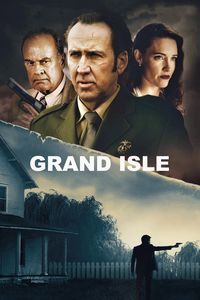
    (On Cable TV, June 2020) Nicolas Cage is certainly cranking out the films in his older back-tax-paying age, and while Grand Isle isn’t a particularly good Cage film, you can see why he was cast in it. A southern Gothic in which a young man is invited in a vast mansion by a man intent on hiring him to kill his wife, it’s a film with a kernel of potential. Despite the film’s low budget, it’s credibly set in the sweaty humid hurricane-prone atmosphere of Louisiana. The age-old setup has a warring couple making demands on the younger stranger brought among them—in the middle of a hurricane, in an old Victorian house, no less. The nervy sound design, with wind and thunder, is designed to keep up on our toes during it all. In the cast, Cage is Cage (although maybe not as intensely as we’d prefer), while KaDee Strickland shows some potential as a femme fatale and Kelsey Grammer is quite enjoyable as a southern lawyer in the framing story. Alas, those promising elements are eventually blown away, most notably during a scattered third act that keeps going long after the action should have been settled and in doing so breaks the time/space unity that thrillers should keep in mind. (It also introduces a different dramatic arc that is resolved very quickly afterward, and doesn’t do much except allow Cage to be shown with a different hairstyle.) Grand Isle’s production history suggests that the production ran out of money before shooting the last two days of filming, but I have a hard time imagining that even one more week would fix what’s flawed here. The only consolation is that if you didn’t like it, well, there are five other 2019 Nicolas Cage movies to help you feel better.

  • The Pentagon Wars (1998)

    The Pentagon Wars (1998)

    (On Cable TV, June 2013) There’s a lot to admire in the first half of The Pentagon Wars and, unfortunately, less and less to like as it goes on.  This is a somewhat unusual film that dares tackle military procurement as a comedy (!) and the beginning of the film has to do a lot of exposition (in a relatively painless fashion) to get viewers up-to-speed with the basic premise.  Cary Elwes isn’t too bad as the sometimes-bewildered officer who comes to learn the dirty history of the M2 Bradley Infantry Fighting Vehicle, whereas Kelsey Grammer doesn’t break any typecasting as the fanatically right-wing general who slowly becomes the antagonist of the film.  The Pentagon Wars is, at first, fairly clever and generally fact-based; unfortunately, this changes in the second half of the film, as it becomes increasingly slapstick based: the script becomes steadily dumber, to the point where characters start acting like buffoons in a broader and broader (read: stupider) military comedy… much like Down Periscope, also featuring Kelsey Grammer.  The film’s visible departure from reality may lead a few viewers to investigate the real story behind the film, leading to further disenchantment with its liberties.  As it turns out, not testing the vehicle to destruction is actually a good idea when dealing with multi-million-dollar items: you get more value out of each test vehicle.  But the film’s insistence in painting everything in goofier shades of black and white ends up damaging what started out as a relatively more clever comedy.  Let’s hand it to HBO, though, for producing a film with a relatively cerebral premise, and following through with a decent budget.  The result may be disappointing, but it’s already more ambitious than many other.

  • Middle Men (2009)

    Middle Men (2009)

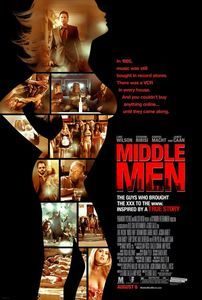
    (On DVD, April 2010) Some worthwhile films fall through the cracks, and this is one of them: A slick mixture of laughs and thrills set against the turn-of-the-century internet porn rush, Middle Men features slick editing, a snappy soundtrack, plenty of nudity, some good screenwriting, a surprising number of recognizable actors and slick cinematography to deliver a fairly enjoyable film.  The voice-over narration wraps up a film that pleasantly jumps back and forth in time (sometimes for mere seconds), explains the way pornography has been a significant factor in the internet’s popularization and reaffirms why doing business with the Russian mob is always a bad idea.  (The unrated DVD also has a bravura long-shot set at an orgy that actually manages to make a narrative point.)  Luke Wilson is the film’s likable protagonist, a businessman who accidentally becomes a porn mogul.  Surrounding him are such notables as James Caan as a crooked lawyer, Kelsey Grammer in a memorable one-scene sketch, Kevin Pollak as a sympathetic FBI agent and a near-unrecognizable Giovanni Ribisi as a paranoid inventor.  Taken on its own terms, Middle Men is a fast-paced film that feels considerably bigger than its small budget, with enough good narrative moments to leave a good impression.  It has a few flaws, like a few unnecessary emotional flashbacks, a too-innocent hero and a script that could have been tightened, but nothing major.  But the film isn’t the whole story: the behind-the-scenes drama is almost as interesting as the end result.  Some digging quickly reveals that Middle Men is not only based on a true story, but that the businessman whose story it is actually financed the production of the film itself… and lost most of its money when the movie failed at the box-office.  The post-film real story features accusations of fraud, broken bones and other unpleasantness… enough to set up a sequel or two.