Kevin Costner

  • Open Range (2003)

    Open Range (2003)

    (On DVD, January 2017) I don’t normally have much patience for westerns that last two hours and a half, and there’s no denying that Open Range could have benefited from a more aggressive editing pace. Still, this is a Kevin Costner western, and after Dances with Wolves and The Postman, we all know what that means: Expansive vistas, rough-hewn charisma from its stoic hero, tepid pacing and melodramatic filmmaking. Open Range is in-line with his earlier work: good without being perfect, with enough old-fashioned charm that should appeal to an older audience. Costner gets to play his own archetype, but the film’s standout role has to be the “Boss” played by Robert Duvall: the saving grace of the film’s 139 minutes is having the chance to hear Duvall crunch down on folksy tough dialogue, the kind of which we easily could have used fifteen more minutes. Otherwise, there’s a refreshing realism to the way the story evolves, with casual violence when necessary, an unforgiving environment and tough guys trying to keep what’s theirs. There’s even a grown-up romance thrown in the mix, and it doesn’t feel too out-of-place. Open Range may not sound particularly exciting on paper (or in the middle of the two hours and a half), but some of its moments stand out, including a gritty gunfight where we can honestly fear for at least one character. Not a bad choice, not a bad western.
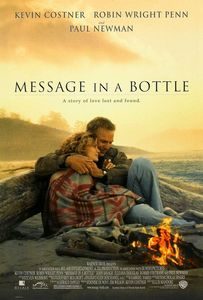
  • Message in a Bottle (1999)

    Message in a Bottle (1999)

    (On TV, November 2016) What?, you say, Kevin Costner playing an idealized stoic male loner figure designed to make women swoon? Well, yes. Message in a Bottle, predictably adapted from a Nicholas Sparks novel, starts with a mystery (who is the man who would write such a heartbreaking letter and toss it off to sea in a bottle?) and gradually ends on the trail of a sensitive model of masculinity, still grieving over the loss of his wife in a picturesque eastern seaboard town. Cue the waterworks, cue the stirring music, cue the sage old man, cue the lies that lead to rifts, cue just about everything that such Nicholas Sparks-inspired movies have. It’s mechanistic and calculated and cynical and obvious and it still works in some fashion. It helps that the actors are good at what they do: Costner is Costner, obviously, but Robin Wright makes for a suitably bland heroine and Paul Newman shows up as a wizened old man. Throw in Ileana Douglas as spunky comic relief and Robbie Coltrane as a gruff boss and the clichés just write themselves into comforting lines. The audiences for this kind of movie are self-identified—the rest of us might as well not even try to comment.

  • The Postman (1997)

    The Postman (1997)

    (On DVD, November 2016) Though largely forgotten nearly twenty years later, The Postman does have a few things going for it. It’s a Kevin Costner-directed movie featuring Costner in his classic stoic persona. It tackles not just the post-apocalypse, but the reconstruction of civilization. It (very loosely) adapts a novel by David Brin, an author I quite like. It is, by nature, fundamentally optimistic about humanity, which is not necessarily something that is expressed all that often in the post-apocalyptic genre. It features some good landscapes from the American northwest, further highlighting similarities with Costner’s western oeuvre such as Dances with Wolves and Open Range. The script isn’t too bad, wrestling a complex subject matter (and often wild source novel) into a relatively enjoyable film. Still, it’s not without its own problems. The most obvious would be the lack of concision in the result, and the overdone sentimentality. The Postman would have been perceptibly better had it been shorter and a bit less overbearing in its mawkishness. Removing some of the slow motion and toning down the insistent score would have helped in making the result palatable to a wider, perhaps more jaded audience. Streamlining the script would also have helped—the final result doesn’t benefit from a lot of repetitiveness and overly-explained context. I’m not overly bothered by the Americano-centrism of the symbolism in what is after all an American movie, but some of the imagery can feel a bit fetishistic to non-Americans. (Woo, post office!) Still, there are a few good moments in The Postman, and the result still feels fresh among other post-apocalyptic Science Fiction films. Even if imperfect, it’s quite a bit better than the crucial consensus seemed to be at the time.

  • Dances with Wolves (1990)

    Dances with Wolves (1990)

    (On TV, August 2016) In an age of CGI-fuelled extravagant spectacles, you’d think that a special-effect-free western Dances with Wolves would be underwhelming … but it’s not. A sweeping western epic, this is a movie that still feels great today largely because it so grounded. You can compare the film’s standout buffalo hunting sequence to the SFX-heavy stampede in Abraham Lincoln: Vampire Hunter (as sacrilegious it may be to even mention both movies in the same paragraph) and there’s no comparison: the best special effect remains reality. It helps that the film itself is solidly put together: Dances with Wolves remains director/star Kevin Costner’s most notable achievement, and still one of his best roles to date. (Contrarily to his other career-best The Bodyguard, his stoic persona hadn’t fully solidified by then, and he seems more adept in the various facets of his role.) There are also notable roles for Graham Greene, and the lovely Mary McConnell. While Dances with Wolves’ pacing can be maddening throughout its three hours, it does help create the sense of scale that the story requires: As shown by the film’s title, it’s very much a character-driven piece set against the immensity of the frontier, as a white man comes to adopt the native way of life. As such, I think that it has weathered the past quarter-century better than other similar pieces. From my limited white-guy privilege, interrogating the story through a white-saviour perspective doesn’t lead to a full-blown condemnation, since the protagonist doesn’t do all that much to save “the others” (arguably, he only creates trouble for them along the way), and “the others” are portrayed with some nuance. While I’m not a natural audience for westerns (nor assimilation narratives, and especially not three-hour films), Dances With Wolves flows better than I expected, and remains just as respectable today as it was back in 1990. It’s still an impressive achievement, even without computer-generated hordes of buffalos.

  • Criminal (2016)

    Criminal (2016)

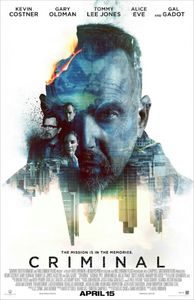
    (Video on Demand, July 2016) There’s something unintentionally amusing in seeing Ryan Reynolds in Criminal as a man whose personality gets transferred into a new body … given that’s pretty much what happened to his characters in Self/Less, RIPD and The Change-Up as well. There are a few crucial differences, though, and the first being that actor Reynolds is sent home early in Criminal after a short thrilling sequence that concludes with his death. The film’s real lead is Kevin Costner, as an unredeemable psychopath who ends up being an ideal memory transfer subject. Much of the movie is a standard terrorist chase through London, but there are enough wrinkles here to keep anyone interested: In particular, the dramatic tension between Reynolds’s do-good protagonist and Costner’s morally empty anti-hero is surprisingly compelling. There’s an impressive roster of known actors in small roles, from Tommy Lee Jones as a reluctant scientist to Gary Oldman as a CIA manager intent on cracking the case, with Gal Gadot as a non-super-heroic turn as the wife of Reynold’s character. As a blend of thrills and SF ideas, Criminal is competent. Less fortunately, director Ariel Vromen seem content in doing things conventionally, and it wouldn’t have been difficult to imagine the film playing out more grandiosely, taking fuller advantage of its set-pieces. The action scenes are fine, but they could have been done better. Still, wasted potential is more interesting than no potential, and if Criminal didn’t do blockbuster business during its brief theatrical run, it’s got enough of a budget, stars and ideas to make it a more than decent cable-TV choice.

  • Robin Hood: Prince of Thieves (1991)

    Robin Hood: Prince of Thieves (1991)

    (On TV, June 2016) Watching Robin Hood: Prince of Thieves twenty-five years after release (almost to the day) is a reminder about the evolution of the Hollywood blockbuster between the eighties and nineties. You can see in Robin Hood the elements that would make up the blockbuster tropes of the nineties, but you can also see the remnants of eighties-style filmmaking stiffness: The slightly-too-slow pacing, the quirks that don’t necessarily reinforce the film’s strengths, the unconscious irritation (such as the attempted-rape elements of the conclusion) the stiff studio staging, and so on. Director Kevin Reynolds doesn’t do a bad job with what he’s given, but it’s a film of its time. It’s good, but it’s not necessarily polished to a shine like latter blockbusters would be. It doesn’t help that Kevin Costner is off as Robin Hood: his stoic persona can’t accommodate the more light-hearted requirements of the role. On the other hand, Alan Rickman is fantastic as the all-out villainous antagonist, Mary Elizabeth Mastrantonio looks great at Maid Marian, and Morgan Freeman gets a pretty good role as an Islamic Moor stuck in the madness. Watching this film today, after the pop-culture clichés and most notably the 1993 full-length Mel Brooks parody Robin Hood: Men in Tights, is strangeness multiplied. But then again I was in high school when Robin Hood: Prince of Thieves came out—much of the pop culture of the time has stuck in my head to a degree that may not be as extreme for other viewers.

  • 3 Days to Kill (2014)

    3 Days to Kill (2014)

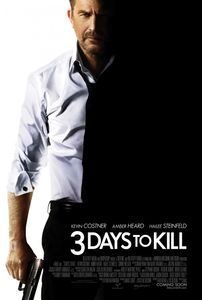
    (On Cable TV, November 2014) By now, anything with Luc Besson as a screenwriter should come with its own warning: “Stupid stuff within.”  The problem isn’t that Besson’s name is usually associated with dumb scripts: it’s that the same issues keep coming back: dumb anti-establishment rants, moronic plotting, blatant misogyny and a striking lack of tonal unity that has the films jumping all over the place.  With 3 Days to Kill, writers Besson and Adi Hasak end up reprising the worst aspects of From Paris with Love: no skill in blending comedy with violence, dim-witted characters and plot-lines that would have been laughable thirty years ago.  Here, a CIA agent suffering from a fatal disease is manipulated in executing “one last job” while caring for his estranged daughter.  What follows is an unlikable blend of torture played for laughs, uncomfortable comedy, fish-out-of-water parenting and a portrayal of espionage that makes James Bond movie feel sophisticated.  The film hits its worst moments when it asks us to believe that a character would forget about violent torture in order to help his torturer bond with his daughter… moments after being electrocuted.  Such uneasy blend of jokes in-between deathly serious violence show the tone-deaf sensibilities of either the screenwriters, or fallen-from-grace director McG, whose Charlie’s Angels heydays are nowhere reflected in his recent work –it’s not this or stuff like This Means War that make him look better.  While 3 Days to Kill does briefly come alive during its action sequences (in particular, a chase sequence besides La Seine), much of the film is just inert, flopping aimlessly and failing to get its audience’s sympathy.  Surprisingly enough, Kevin Costner doesn’t emerge too badly from the ongoing train wreck –he’s able to display a certain weary stoicism through it all.  Once really can’t say the same about Amber Heard, playing dress-up as a would-be femme fatale when she’s got the gravitas of half a beach bunny.  (Her character may be badly written, but the way she plays it make it seem even worse.)  It’s refreshing to see Connie Nielsen in a motherly role, but Hailee Steinfeld may want to re-think playing such unlikable brats flouncing without reason.  3 Days to Kill redefines “scattershot” in the way its scenes don’t seem to flow along in the same film, and how it usually privileges the dumb answer to just about any plot question.  The predictable plot twists, stomach-churning “comic” violence really don’t help… but what else have we come to expect from Luc Besson?

  • Man of Steel (2013)

    Man of Steel (2013)

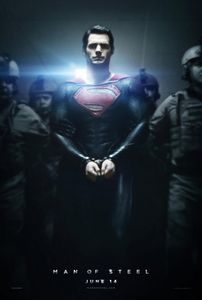
    (Video on Demand, November 2013) There’s something both annoying and admirable about the entertainment industry’s insistence at rebooting and shoving down superhero movies down our throats.  DC’s maniacal insistence at reviving Superman after the 2006’s disastrous Superman Returns is understandable: Superman is iconic, the superhero film genre is still going strong, and there’s still some goodwill among genre fans for a good Superman film.  Man of Steel, fortunately enough, is pretty much as good as it gets from a narrative perspective: Screenwriter David S. Goyer (with some assistance from Christopher Nolan) has managed to find a compelling story to tell about a fairly dull character, and it’s more thematically rich than we could have expected.  Man of Steel, in the tradition of Nolan’s Batman films, voluntarily goes gritty: Zack Snyder’s direction favour pseudo-documentary aesthetics, the cinematography is more realistic than glossy, and the final act’s destruction feel more traumatic than purely entertaining.  Much of this grittiness feels wrong for those raised on the squeaky-clean Superman character, causing more discomfort than necessary.  On the other hand, the result is a film that’s reasonably captivating to watch: Superman has an inner conflict to solve, the action sequences aren’t generic and there’s a real effort to ground Superman to an identifiable reality.  Henry Cavill is pretty good in the lead role, while Amy Adams does the most with a somewhat generic character.  Michael Shannon brings some unexpected complexity to the antagonist, while both Russell Crowe and Kevin Costner get small but plum roles as the protagonist’s two fathers.  While Man of Steel is (ironically) a bit too down-to-earth to feel like a blockbuster epic made to be re-watched over and over again, it’s a cut above the usual superhero fare: There’s some real pathos here, an origin story built on well-used flashbacks, sense of personal growth for Superman (something rarely seen) and the solid foundation for further entries.  Recent superhero movie history has shown that it could have been much worse, and if I’ll happily take a glossy Superman movie over an unpleasantly gritty one, it would be churlish to deny the successes of this version of the character.

  • The Bodyguard (1992)

    The Bodyguard (1992)

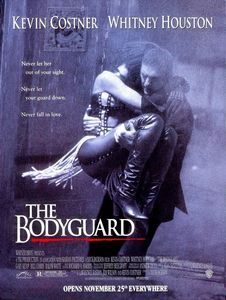
    (On Cable TV, April 2012) The Bodyguard may not have earned unanimously favourable reviews when it came out, but it has stood the test of time relatively well, even though the fates of its two lead actors may now lend it an unwarranted gravitas.  Whitney Houston is now dead, of course, victim of internal conflicts that seem so much more complicated than being stalked by insane fans and professional killers.  Kevin Costner, meanwhile, has retreated into a quasi-parody of his humorless character, reaping scorns from his Waterworld-esque hubris and seldom allowing himself to portray weakness.  The Bodyguard came at the peak of the period where he was a major A-list actor, and it’s not hard to see how it was a star vehicle for his stoic infallible personae.  As a piece of entertainment, though, the film still clicks: The mixture of thrills and romance is carefully dosed for maximal impact (even when the contrivances pile up), Houston is immensely appealing and Costner act as a capable foil for her.  The suspense sequences are cleverly shot, and it’s easy to get caught up in the story despite its familiarity.  The early-nineties period is just beginning to date (the cars are the most obvious tell-tale), but there’s no need to remake The Bodyguard: It’s just as effective now that when it came out, and the number of memorable songs from the soundtrack is impressive… even for those who have never seen the film.