Kiera Knightley

  • Misbehaviour (2020)

    Misbehaviour (2020)

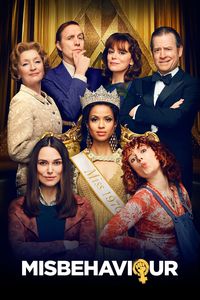
    (On Cable TV, April 2021) The grrl-empowerment drama is a well-established genre by now, and Misbehaviour seems to be following in the steps of half a dozen examples of the form, perhaps most closely the recent Battle of the Sexes. You can check off the elements: a historical recreation a few decades past highlighting unbelievable sexism, plucky heroines banding together to fight the patriarchy, potshots at the institutions’ refusal to move forward, one hissable patriarch as an antagonist, queer characters, lighthearted tone, all savvily wrapped in well-executed crowd-pleasing style. It’s now common because it’s fun, mind you: you can’t be against the message of the film, and the underdog narrative always plays well even if it feels increasingly calculated. Misbehaviour does a little bit than most entries in the subgenre by being slightly more ambivalent about its message than a rote regurgitation of feminist talking points. Largely taking place in 1970 London, it tells us about the protests that targeted the Miss World contest held at the time, featuring a few activists going against none other than emcee legend Bob Hope, who comes to personify the worst aspects of the patriarchal agenda—hero of a generation, villain of the next. Our protagonists, anchored by Kiera Knightley (even though Jessie Buckley has a more striking role), aren’t the only ones with progressive credentials, however, as a very interesting subplot featuring Gugu Mbatha-Raw ends up establishing. Progressivity and diversity are multidimensional movements that have the good luck of all sharing white men as antagonists, and part of what makes Misbehaviour more interesting is in opposing different views about the Miss World contest, and what happens when the contest ends up scoring a victory for diversity even within the confines of the structure that our (white) protagonists are contesting. That kind of complementary complexity is something that reflects real-world tensions within the progressive communities, and something I’d like to see a bit more rather than simplistic underdog fairy-tales. As a result, Misbehaviour does get better as it goes on, and then becomes much better once it hits its final moments. The style is meant to be easily accessible, and the viewing experience reflects that: it’s an easy film to watch and to like even when it plays close to the obvious formula. Despite the film’s hit-job, I still like Bob Hope — but then again, I can pass as a patriarch if I need to.

  • Begin Again (2011)

    Begin Again (2011)

    (Netflix Streaming, August 2018) Mark Ruffalo makes for an unlikely star, but you can’t deny his hangdog charm. He’s one of the two biggest reasons why Begin Again work, the other one being John Carney’s uncanny ability to make great musically dominated movies. I watched Begin Again largely because I was intrigued to see if Carney would match the effectiveness of Once and Sing Street. I shouldn’t have worried. Begin Again takes place in New York City and targets a disgraced record label executive (Ruffalo) as he discovers a new talent (Kiera Knightley, possibly miscast) that he nurtures to success. There are plenty of things here that could have gone wrong: it’s a very familiar story, after all, and under rougher hands it probably would have ended with a mismatched-age romance between the two. But Carney knows better, and after some initial romantic tension, the mentor/mentee relationship proves to be enough, especially when both of them gain from the experience. The centrepiece of the film, as with other Carney movies, is a sequence in which the characters come together for the sheer fun of making music, shooting a video on New York City rooftops and backstreets. While, overall, Begin Again doesn’t have the same punch as Carney’s earlier Once, it’s a lot more fun and colourful. And while Knightley isn’t much of a signer, she does have chemistry with Ruffalo, while Ruffalo himself has enough charm to power the rest of the movie by himself. While Begin Again may not age all that well, it does illustrate the music industry at the beginning of the 2010s, poised between the decade-old traditional system and the disruptive influence of the web. It’s still a worthwhile movie, and a nice link between Carney’s other movies.

  • The Duchess (2008)

    The Duchess (2008)

    (On TV, September 2017) Nowadays, it’s not particularly difficult to make feminist-themed historical movies. Being a woman has seldom been easy in recorded history, and it doesn’t take much highlighting to make the point that it was even worse not too long ago. So it is that The Duchess, even fancifully adapted from historical events, doesn’t have to reach in order to present a credibly oppressed heroine. The plot summary does read like a melodrama: An 18th-century young English woman stuck in an arranged marriage, pressured to produce a male heir, sidelined by her husband’s affair with her friend (herself pressured by having been taken away from her sons), embarking on an affair of her own … and so on. A nudge too far would have sent the film in X-rated territory, especially given how little consent there is all around. While the summary reads like a wild ride, it’s considerably dampened by a running time that feels too long even under two hours, considering the tepid pacing and highly mannered costume drama. At least there’s the acting to admire along the way: Kiera Knightley turns in a serious performance, while Ralph Fiennes has seldom been so detestable and Hayley Atwell distinguishes herself with a difficult character. The visual look of the film is as good as period dramas get, and the Oscar-nominated costumes are indeed pretty good. This being said, The Duchess does feel like an intensely familiar story—from The Other Boyleen Girl to Anna Karenina to Belle to a chunk of the Jane Austen adaptations, there is a lot of similar material out there and if it happens to scratch an itch, then hurrah. Otherwise, it’s a long film with familiar plot points, reasonably entertaining but not essential.