Lana Turner

  • Johnny Eager (1941)

    (On Cable TV, August 2021) Not quite film noir yet but more than gangster films of the 1930s, Johnny Eager does begin on a strong note, with a charming ex-con managing to keep the authorities convinced that he’s back on the straight path, even as he’s back to controlling a good chunk of the metropolitan underground—and being utterly ruthless in doing so. Things get far more twisted when he gets an occasion to seduce the daughter of an influential district attorney. The plotting gets to be a lot of fun after that, with romance, crime and thrills thrown into the mix. Still, the highlight here is Van Heflin in an Oscar-winning performance as an alcoholic intellectual with florid dialogue, the only person able to talk back to the protagonist and get away with it. Robert Taylor is also quite good as Johnny Eager himself, both charming and homicidal. Meanwhile, Lana Turner does her best at, well, being Lana Turner. As a criminal melodrama, Johnny Eager isn’t particularly respectable, but it moves quickly, features a few good performances, and wraps everything up in some well-crafted irony.

  • Latin Lovers (1953)

    (On Cable TV, August 2021) Watching older films is a minefield if you’re particularly sensitive to social equality — as a straight white male, it’s a privilege to watch those movies describe a world built by (and often for) people like me, but even I have my limits and Latin Lovers ends on a note fit to give dry heaves to everyone. And yet, at the very same time, you have actors like Lana Turner and Ricardo Montalban being as charming as they can be, taking much of the edge off but not entirely. The plot, as thin as it is, has our wealthy heroine (an heiress) doubting she can attract men uninterested in anything other than her wealth, which explains her dating an even richer man. Her courtship is humdrum, so it’s no surprise if a trip to Brazil means her meeting and falling for a dashing Latin lover (Montalban, in fine form), at which point the question of money comes back to the forefront. After a few shenanigans, her solution is to give all the money away… to him. Now, it’s possible that this is a wry commentary on how wealth distorts love — after all, the script is from Isobel Lennart, who had (despite an early death) a long list of very good and not-so-misogynistic scripts to her credit. Maybe there’s a satirical intention here that I’ve missed. Maybe the script is simple enough and frothy enough that it invites excessive attention to this flaw. Maybe it’s a romance and I should worry about it all that much. But for all of the colourful pageantry of the film’s trip to Brazil and the romantic comedy of the women, I found Latin Lovers empty until the moment it becomes unpleasant, and then merely unpleasant because that’s how it ends.

  • Bachelor in Paradise (1961)

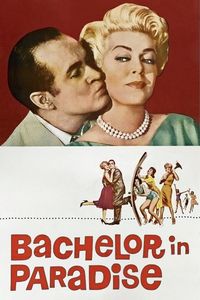
    Bachelor in Paradise (1961)

    (On Cable TV, February 2021) If you believe the movies, Americans woke up in the 1960s and starting to notice all sorts of new phenomena around them. What is that sex thing? ask the movies of the time. The truth is somewhat less revelatory — it’s the movies that unshackled themselves from a prudish reflection of American society, and it had to be done in a very gradual way, as so not to shock the masses. A first step along the way were the cute sex comedies of the early 1960s, in which the films barely hinted at naughtiness — which, to be fair, was a step up from the previous decade. It’s in the vein that Bachelor in Paradise features Bob Hope as a salacious best-selling playboy author who infiltrates a suburban community in the hopes of researching a new book. While over there, he’s confronted by the prejudices of neighbourhood gossip queens, especially when he, a single eligible bachelor, finds himself surrounded by lovelorn housewives. As usual for films of the time, Bachelor in Paradise is as interesting for its unspoken presumptions and period detail than for the elements of its narrative. The sequence set inside a grocery store is a fascinating throwback to how people shopped at the time, while the various social taboos being broken are often more revelatory of 1961 American than the filmmakers would care to admit. Bob Hope does make for a funny protagonist — and seeing Lana Turner as his romantic foil doesn’t hurt, even though I find Turner more generic than many other commentators. (I rather would have liked Paula Prentiss in the role, but that would have broken her expected on-screen pairing with Jim Hutton.)  While Bachelor in Paradise remains quaintly sexist, is not built for social commentary and pales in comparison of more groundbreaking films later in the decade, it’s intriguing, cute, charming, and quite a bit of fun to watch even today.

  • Ziegfeld Girl (1941)

    Ziegfeld Girl (1941)

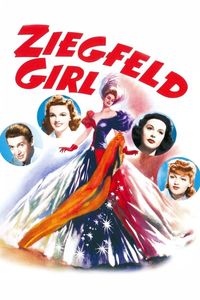
    (On Cable TV, February 2021) In some ways, you can see Ziegfeld Girl as the second of an informal trilogy of MGM movies about Florenz Ziegfeld Jr. —or more specifically the Ziegfeld Follies revue productions that he created for Broadway. Their appeal could be summed up in a word: Girls. 1945’s Ziegfeld Follies was MGM’s attempt to re-create his shows with lavish means and the biggest stars in the business. Before that, 1936’s Academy-Award-winning biopic The Great Ziegfeld showed us the man’s life, and produced some of the most stunning musical numbers of 1930s American cinema along the way. Some of those set-pieces are reused in 1941’s Ziegfeld Girls, which foregoes the man himself to focus on the fictional story of three girls who become part of the show. That, in itself, would be a decent-enough backstage musical, but that’s before taking a look at the cast. Not only do you have James Stewart playing a vaguely disreputable truck driver getting annoyed at his girlfriend’s greater fame (a role somewhat less sympathetic than usual for Stewart, who doesn’t sing a line), you also have the girls themselves being played by none other than Judy Garland, Hedy Lamarr and Lana Turner — a ridiculously stacked cast, if you’ll pardon the expression. Garland is at her youthful best here, not yet showing the strains of studio life — her “Minnie From Trinidad” is the film’s standout number, as long as you put aside the unfortunate cultural issue of having her perform as a darker-skinned girl. Lamarr and Turner don’t sing, but their roles as still good showcases, and the combined impact of all three is not bad — and I’m saying this a someone who’s usually indifferent to Turner and often unimpressed with Garland. Ziegfeld Girl doesn’t manage to be a great musical, but it does have enough running for it to distinguish itself from the crowded arena of Broadway backstage musicals. Reusing some of the lavish numbers from The Great Ziegfeld must have been great for MGM’s bottom line, and it does add visual impact (as well as the gravitas associated with the earlier prestige production) to Ziegfeld Girl. It’s a nice-enough film, although I suspect that some modern viewers (as I nearly did) may run the risk of thinking they’ve seen it already due to its title being very similar to the two other films in MGM’s informal trilogy.

  • Two Girls on Broadway (1940)

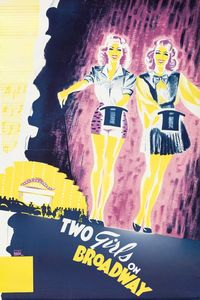
    Two Girls on Broadway (1940)

    (On Cable TV, December 2020) If there’s a slightly familiar quality to Two Girls on Broadway, it’s not as much due to it being a loose remake of the Academy award-winning Broadway Melody of 1929 than being very similar to countless other Broadway musicals. At the time, much of the media attention on the film was on Lana Turner – she was fast rising as a sex symbol, and the film showcased her (largely unfulfilled) potential as a musical star. Little surprise, then, if the film is more remarkable for its musical numbers than its overall narrative – as a story of two sisters trying to succeed on Broadway while not meeting the wrong men, it’s slight, adequate and just enough to bring this film to feature-film length. Joan Blondell is featured as Turner’s sister, but much of the emphasis of the film is on big production numbers, even if they don’t quite leave much of an impression once the film wraps up. It’s definitely not one of the most striking musicals of the era – it pales even when compared to its more daring and less technically accomplished inspiration. Still, Two Girls on Broadway is amiable enough and fits squarely in the idea we have of circa-1940 Hollywood musicals riffing off Broadway’s mystique.

  • A Life of Her Own (1950)

    A Life of Her Own (1950)

    (On Cable TV, March 2020) There are so many examples of how the Production Code undermined the substance of films told between 1934 and the 1960s that it’s hardly useful to throw another example on the pile. Still, there’s A Life of Her Own as yet another example—a visibly toothless portrait of a young woman trying to make it in New York City that flirts with a more mature outlook than other 1930s films, yet can’t quite have the creative freedom to really make any kind of point. (It’s even worse when you measure the film against the original novel, which is remarkably darker.) Lana Turner stars as a Midwestern girl coming to Manhattan, meeting an older woman who didn’t make it (and who then kills herself), becomes successful, gets involved in an affair with a married man, and—well, this is where the film gets particularly fuzzy. The original ending had her kill herself in a cyclical commentary on the process that grinds young hopefuls into washed-up husks (and as evidence that under the Production Code, no one gets away with adultery); the rewritten ending is an unsatisfying step back from the ledge without much meaning to it. Clearly, A Life of Her Own isn’t one of director George Cukor’s finest works—but then again, the film’s production history suggests that he knew that the project was doomed under the Production Code.

    (Second Viewing, On Cable TV, February 2021) Thanks to a large-capacity DVR, I record movies indiscriminately and while my memory (and record of movies watched) is good enough that I don’t accidentally end up re-watching too many things by accident, there’s an entire class of not-too-memorable movies that I don’t necessarily recall watching in the first place. (Also: The pandemic lockdown is playing tricks with my perception of time.) A Life of Her Own ended up (again) on my DVR based on it being directed by George Cukor, but it turns out that I didn’t have too many memories of my first viewing. The somewhat well-worn plot probably explains much of a lack of recollection: As a small-town beauty leaves town to enter the bustling world of Manhattan modelling, it quickly turns to melodramatic romance as she embarks on an affair with a man married to a paraplegic. It’s all quite dull, and my lack of particular affection for star Lana Turner probably further explains why the film washed over me a second time without registering anything specific. Not all of Hollywood’s golden-age movies were good, and even fewer of them were memorable: now that I’ve seen the top films of that era, it’s no accident if I’m going to end up seeing more and more forgettable ones, and be condemned to watch them again if I don’t cross-check my lists at some point.
  • Peyton Place (1957)

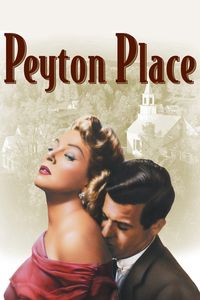
    Peyton Place (1957)

    (On Cable TV, February 2020) I’m not sure it’s possible to put ourselves in the same frame of mind in which audiences first took in Peyton Place. It was the late 1950s, after all, a time at which American society barely started to acknowledge the rampant dysfunction behind its picture-perfect façade. The previous year, Grace Metalious’s novel had become a publishing sensation by acknowledging the rot to be found in small towns, and the film had to tone down or remove much of that material. What remained, however, was enough to create some amount of controversy even at the twilight of the Hays Code era. Of course, we’ve seen much—much—worse since then, and going back to Peyton Place with a modern mindset is closer to “well, what did you expect?” as the town’s sordid secrets are exposed at a time when few took familial abuse seriously. Alas, the result suffers. The film is both far too long at 162 minutes and now too tame to be entirely interesting. Despite the good sequences to be found here and there (most notably Lloyd Nolan as a town-castigating doctor), much of it feels like the talky melodrama it was meant to be. Lana Turner is good in the lead role, but this is really an ensemble cast. The Technicolor cinematography brings a distinctive sheen to the movie, but Mark Robson’s flat direction doesn’t really lead to any cinematographic distinction. I found Peyton Place substantially dull, but then again– I acknowledge that you really can’t perceive the film as audiences did back then.

  • The Postman Always Rings Twice (1946)

    The Postman Always Rings Twice (1946)

    (On Cable TV, July 2019) As others have said, noir is a style more than a narrative genre, and as such it can allow itself multiple deviations from reality that would be unforgivable in another kind of movie. Does The Postman Always Rings Twice make sense? Only barely—even the most forgiving of audiences will probably cry out in disbelief a few times, whether we want to talk about narrative, romantic or even legal incoherencies. But this is mid-1940s noir, and believability takes a distant back step to the atmosphere of two lovers plotting murder and then trying to get away with it. Adapted from a novel by crime-fiction legend James M. Cain, it doesn’t take long for the film to revel in the particularities of that kind of fiction, with all the darkly humorous complications, twisted characters, fatal ironies and (in)convenient contrivances. It does help that the film is spearheaded by capable actors, starting with one of Lana Turner’s best individual performances (as others have said, the problem with being a star is that you’re often appreciated for a body … of work—not always a single role) and John Garfield as a blandly likable drifter who finds reason to stick around. For more contemporary viewers, there’s also a young Hume Cronyn turning in a memorable performance as a devious defence lawyer. At times, it does feel as if the third act runs far too long after what would have been a climax in another movie, but it ultimately turns out that the script has quite a bit more on its mind for the real end of the film—and even gives meaning to the title. The Postman Always Rings Twice all amounts to a classic noir with the qualities and issue of its genre, but no less of a pure pleasure to watch.

  • Imitation of Life (1959)

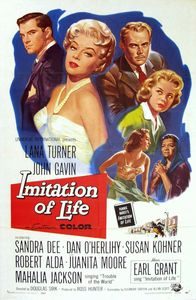
    Imitation of Life (1959)

    (On TV, July 2013) Dipping into Hollywood’s back-catalogue can be a strange experience, as films developed for an earlier generation can become interesting for things they didn’t intend.  So it is that Douglas Sirk’s Imitation of Life becomes fascinating as much for its period background detail than for its subject matter.  From a contemporary perspective, it’s certainly not a tightly-plotted feature film: The story jumps forward abruptly, doesn’t quite know what story it’s trying to tell and ends abruptly, leaving a bunch of threads up in the air.  Still, the point isn’t the story as much as the emotional problems that the characters have: The film’s most compelling plot strand has to do with a mixed-race teenager rejecting her racial heritage, and while the film’s dialogue may feel a bit melodramatic by today’s standards, there’s no denying the impact of lines such as “How do you tell a child that she was born to be hurt?” The film’s other plot, about a suddenly-successful actress ignoring her daughter and leading on a suitor, is almost insufferably dull… except for studying bits and pieces of the decor and imagining being back in the 1950s.  Lana Turner is nice-but-boring in the lead role (much the same can also being said about Sandra Dee as her daughter) but the film’s most compelling performances easily belong to Juanita Moore and Susna Kohner as the estranged mother/daughter pair.  Imitation of Life has held up better than many films of its era not for the melodrama, but for the substance underneath.