Larry Cohen

  • Wicked Stepmother (1989)

    Wicked Stepmother (1989)

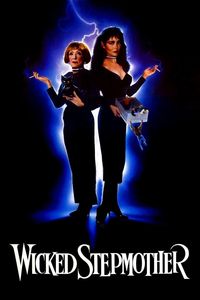
    (On Cable TV, June 2021) Somehow, it makes perfect sense that Bette Davis’ final film role was that of a witch in Wicked Stepmother. It makes even more sense that the production on that film was immensely troubled, all the way to Davis quitting midway through production, leaving writer-director Larry Cohen to try to patch the holes left by a half-performance even though the role had been written for her. (Cohen explains everything in the rather wonderful essay “I Killed Better Davis.”)  Considering behind-the-scenes drama of that magnitude, you’d be forgiven for thinking of the film as a mere adjunct to the story of Bette Davis’ last role. But it turns out that Wicked Stepmother manages to remain an adequate B-movie. The plot follows as a young woman as she returns from vacation and finds out that her father has married an old woman (Davis), who turns out to be a witch and has the ability to transform herself into a young woman. (…and there’s the trick used by Cohen to keep the film going after Davis’ departure.)  The rest of the film is a battle between our protagonist and the witch, escalating in a bunch of special-effects heavy sequences. Wicked Stepmother is not something particularly good, mind you, but it generally holds up on its own as a B-movie, and makes even more sense considering the film’s production problems.
  • The Ambulance (1990)

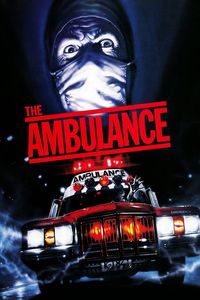
    The Ambulance (1990)

    (In French, On Cable TV, January 2021) One of my emerging cinephile rules is simple: If I see Larry Cohen in the credits, I watch the movie. He was a clever writer-director, and so there’s nearly always something interesting in the mix whenever he’s involved. Despite lower budgets, his determination to remix familiar elements into something quirky and compelling carries through—as does his obvious affection for New York City. While The Ambulance may look like a typical horror film, it plays with slightly more wit and originality than the norm. Eric Roberts (in his regrettable mullet phase) plays a young comic book illustrator who, smitten with a cute young woman working nearby, work up the nerve to ask her out… and is dismayed when she faints and is carried away in an ambulance driven by sinister characters. His day gets worse when he can’t find her at the hospital she was supposed to go, and his attempts to warn the authorities about this mysterious ambulance are greeted with shrugs and derision. James Earl Jones shows up as a skeptical policeman, but the biggest casting surprise goes to comics legend Stan Lee making his first movie appearance playing himself as the protagonist’s boss. The rest is a chase conspiracy thriller with many paranoid moments and refreshing side characters, including a crusty veteran journalist played by Red Buttons and an attractive policewoman played by Megan Gallagher. The film keeps our interest by being clever, sidestepping some clichés of the genre while reinforcing others, and keeping its biggest irony at the very end. (But you won’t feel too bad for the protagonist, as women throw themselves at him throughout the entire film.)  The Ambulance is not what I’d call a great movie, but it falls straight into that more interesting subgenre of solid B-grade films, wittily imagined and decently executed. It fits with the rest of Cohen’s filmography and it has a few surprises in store, even for jaded viewers.

  • It’s Alive (1974)

    It’s Alive (1974)

    (On Cable TV, September 2020) I had semi-high expectations going into It’s Alive: writer-director Larry Cohen often worked in B-movies, but he usually had an extra spark of imagination that made them worthwhile regardless of budget. In It’s Alive, you can see his intention of doing something weirder than usual, but also the limitations of his approach. In a premise fit for the ages, this is a film about a mutant baby that goes on a murder spree from birth (an experimental drug is involved, in classic mid-1970s post-Thalidomide fashion), and the efforts of the police forces and his new father to track it down. It sounds crazy enough and, to be fair, the film does a lot of mileage out of that premise. Unfortunately, the film is not all that pleasant to watch: the gritty New Hollywood style compounded by the low budget means that the film is ugly from beginning to end, and that’s before getting into the gore inherent in the premise. In typical Cohen fashion, it’s got more on its mind than just murder, and you can have a relatively good time decoding the various themes and issues that the film touches upon beyond the horror premise. Still, it doesn’t make It’s Alive any more compelling to watch—call it a half-miss or a half-hit, depending on how generous you feel.

  • Maniac Cop 2 (1990)

    Maniac Cop 2 (1990)

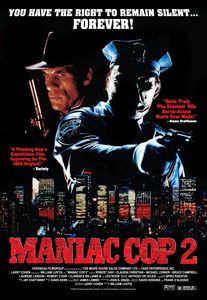
    (In French, On Cable TV, August 2020) Considering my low opinion of slashers, it’s a bit surprising that I ended up moderately enjoying Maniac Cop 2. Interestingly enough, it’s a sequel that assumes the best parts of its predecessor, and strategically maximizes a few elements in order to get even larger audiences. For one thing, it takes as granted the supernatural nature of its titular Maniac Cop brought back from the dead. For another, it frequently trades gore for action with more stunts than the previous film. The iconography of the killer cop is also maximized, which is nearly always a good thing in creating great visuals. (There is one great fire-stunt shot that’s so good I’m wondering why it hasn’t been stolen by later generations of filmmakers.) Best of all, though, is how writer Larry Cohen and director William Lustig stick to their B-movie guns: Maniac Cop 2 is wall-to-wall entertainment, clearly dedicated to being a pure thrill machine. Claudia Christian has a starring role, and Bruce Campbell is back for a brief encore. This being said, this does remain a B-movie bordering on slasher exploitation—keep your expectations in check.

  • The Private Files of J. Edgar Hoover (1977)

    The Private Files of J. Edgar Hoover (1977)

    (On Cable TV, June 2020) There are several good reasons to dislike J. Edgar Hoover, but you can’t deny that he is fascinating as a historical figure: he was, after all, the BOI/FBI’s director for 48 years—longer than most people’s entire careers! As such, he became a bigger-than-life figure, with character traits exaggerated in crossdressing (unproven!), homosexuality (unproven!) and secret files used to blackmail politicians (proven!) While we twenty-first century viewers now know more about Hoover’s documented life than before, we don’t have access to those who knew him best any more. Iconoclast writer-director-producer Larry Cohen had the inverse—not much official documentation, but plenty of contacts with those who knew him. The result of his investigation is the nervous exposé The Private Files of J. Edgar Hoover, which uses a delicious framing device (a mad rush to secure Hoover’s secret files after his death) as the starting signal for a quasi-documentary rush of chopped-up editing, fast pacing and a whirlwind tour of Hoover’s life (as known in the mid-1970s) that does not bother with niceties. Given that it’s from Cohen, it’s interesting throughout—and even more so when you measure Cohen’s own opinion of the man against other sources, such as the much more recent J. Edgar. For instance, The Private Files of J. Edgar Hoover almost brushes off the rumours of Hoover’s sexuality, but presents what feels like a more complete portrait of the man. Despite the rebellious rock-throwing, the film does serve to further cement Hoover’s mythological status by associating him with decades of American history—showing the turnaround of the FBI in the institution it became, and later suggesting that Hoover’s secret files would precipitate the Agnew resignation and pave the way for Watergate. (An assertion ahead of its time, knowing what we now know about Mark Felt.) In the end, The Private Files of J. Edgar Hoover is fanciful, choppy yet enjoyable—and the mid-1970s period atmosphere is quite nice.

  • Maniac Cop (1988)

    Maniac Cop (1988)

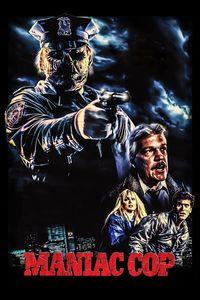
    (In French, On Cable TV, April 2020) So there’s this maniac and he’s a cop and this is a slasher horror film set in New York City and I can probably stop the review right here because you know all you really need to know about Maniac Cop. It’s directed by William Lustig (who also directed 1980’s execrable Maniac) but written by Larry Cohen, so there’s something that can’t easily be dismissed in the script and the result is, much to my dismay, an above-average slasher—maybe even a dark supernatural thriller. One of the interesting tricks that Cohen plays is changing protagonists every so often, eventually landing on none other than Bruce Campbell (albeit in a histrionic-free turn) as the protagonist. Richard Roundtree also shows up! There are a few surprisingly good stunts at the end of the film, and the entire thing is very much a New York City movie—and proudly made as a B-movie. While I can’t bring myself to call Maniac Cop a good film, I liked it better than I thought, and feel that with police brutality being under an unprecedented scope, the film should find a specific audience in the ACAB crowd. Maybe we’ll end up with a remake one of these days.

  • The Stuff (1985)

    The Stuff (1985)

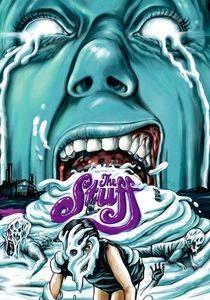
    (In French, On Cable TV, January 2020) If you’re familiar with writer-director Larry Cohen’s 1970s–1980s filmography, then The Stuff makes complete sense. Everyone else, though… be ready for a wild ride. Avowedly more satirical than horrifying, the movie revolves around a creamy-white substance oozing from the ground that is quickly marketed as America’s latest dessert sensation… until it turns people into mindless zombies. The commentary on consumerism may be a bit too obvious by now, but the B-movies goodness of seeing people consume and being consumed by the white stuff still remains a lot of fun. The Stuff squarely goes for the rich and still-untapped vein of what can be called social horror—in which everyone is doing things that are harmful to everyone. It also goes in places seldom seen in horror, such as industrial settings and possible complicity in the upper echelons of business. All good stuff, if you’ll pardon the expression. But even if The Stuff can remain a cult favourite, it’s still a bit too messy to be as effective as it could be. Even discounting the satirical intention, the plotting is messy and doesn’t sustain a lot of scrutiny. The zigzagging plot could have used some rigour, and the ending doesn’t quite knock it out of the park. Still, it’s memorable for more or less the right reasons: being dissatisfied with the narrative should not stop anyone from seeing The Stuff it its madcap glory.