Lars von Trier

  • Nymphomaniac: Vol. II (2013)

    Nymphomaniac: Vol. II (2013)

    (On Cable TV, June 2019) The second half of Lars von Trier’s Nymphomaniac is not a standalone story—it requires having seen the first film and does not stand on its own even as it concludes the story. It does start with a few revelations, though, as the nature and motivations of both the narrator and interlocutor become clearer in the first few minutes. Less digressive and surprisingly more plot-heavy than its predecessor, this Part II takes us through more eventful episodes of the narrator’s life. The sex gets quite a bit more unusual (all the way through to the clinical services of a sadist with a waiting room of women waiting for his harsh whips) while remaining just as graphic as the first film. If frontal erect nudity is your thing, then Nymphomania should satisfy. In keeping with the this-is-not-porn aesthetics, however, none of the nudity is meant to be arousing. Still, we get more of the first part’s strange mixture of the comic and the dramatic, except significantly less comic and far more dramatic as this second part eventually build a plot to go along with the philosophical musings. It ends on a cheap and depressing note, although one notes that the worst of it happens after the traditional “fade to black.”  Still, Charlotte Gainbourg and Stellan Skarsgård do equally well—Gainbourg has a bit more to do here than in the first part. Willem Defoe shows up in a small role, although Jamie Bell gets a more substantial part as the professionally sadistic K. Does Nymphomaniac amount to much? Well, I suppose that everyone will have their say. While I did see the “censored” four-hour version, I feel absolutely no desire whatsoever to see the full five-hour-plus original Director’s Cut: I can’t see what it would add to the story or the point of the film. In fact, as I write this after making it through the finishing line of Part II, I feel no desire whatsoever to re-watch ever again—I may have to follow up this viewing with a dumb comedy. And yet (and this is a becoming a familiar refrain with this director’s work), I didn’t dislike Nymphomaniac as much as I thought it would—there are some laughs, insight and cinematic success in the middle of the self-pretentious lengths and pointless digressions and cheap graphic sequences. While I’m done with Nymphomaniac, I may eventually watch another von Trier film at some point.

  • Nymphomaniac: Vol. I (2013)

    Nymphomaniac: Vol. I (2013)

    (On Cable TV, June 2019) Maybe, one day, they will make a movie in which some poor battered soul will tell a non-cinephile about his or her lifelong quest to appreciate Lars von Trier. Maybe they will call it Cinephiliac, and split it in two parts. I put off viewing Lars von Trier’s Nymphomaniac for about five years, only succumbing to the temptation when the two parts of the film played in rapid succession on cable TV. That delay was probably for the best—I have at best mildly appreciated von Trier’s work before (such as Melancholia). He comes to movies from an entirely different approach, and we’re clearly not interested in the same things. But even in his most irritating production (Probably Breaking the Waves so far) has something intriguing to it—a style, an idea, an approach not quite any other film. That streak goes unbroken with Nymphomaniac, a four-hour two-part exploration of a broken woman’s life, as told by her bruised self to a good Samaritan happening upon her after a violent attack. As she recuperates in his small apartment, she goes through the episodes of her life, through trauma and heartbreak and tragicomic incidents. The portrayal of the sexual episodes couldn’t be more graphic, but this is not meant as pornography—for one thing, there is not attempt here to arouse; and for another, the sex is a symptom of a deeper condition that the film keeps exploring. References to philosophy, religions and classical music (with graphical inserts) keep viewers on their toes, while the extreme portrayal of behaviour well outside norms (as the protagonist says, juggling two handfuls of men per day) is executed with some deftness. Charlotte Gainsbourg is quite good in a movie that rests upon her shoulders, while Stellan Skarsgård makes for a sympathetic audience surrogate. Shia Labeouf and Uma Thurman are featured in showy secondary roles. This is not a film built for mainstream audiences—the subject matter alone would send most casual audiences screaming from the theatre, while the extreme length of the result (and there’s no use pretending that Part I is a complete story) will sap the good will of most others—especially when it becomes obvious that the digressions are the point of the film. Now let’s see what Part II has in store.

  • Dogville (2003)

    Dogville (2003)

    (On DVD, September 2016) There are many reasons that would explain me hating Dogville. It’s almost ludicrously long. It’s got an extremely pessimistic view of human nature. It plays games with the notion of traditional filmmaking by simplifying the sets to a chalk outline … wait, that’s actually something I like about the movie. In fact, it’s probably the reason why I feel curiously positive about it. From the very first shot, in which an entire small town is depicted as chalk outlines on a theatre stage and characters act against minimal props meant to symbolize their surroundings, Dogville goes meta even as it presents a story that doesn’t rely all that much on this abstraction. It’s fascinating for a few minutes, then intermittently interesting as the movie occasionally tries to use this limitation to work around conventional sequences. There is a lot of narration, some of it intrusive in the manner of a classic novel. Various high-profile actors (notably Nicole Kidman, who plays a punching back for half the film, but also Paul Bettany, Stellan Skarsgård and narrator John Hurt) are puppets in writer/director Lars von Trier’s hands as he presents a lengthy and cynical take on human nature, filled with ordinary townspeople turning abusive toward a designated victim. It’s horrifying to the point where the violent take-no-prisoners finale feels satisfying to a ghoulish degree. While not appealing to the angels of our better nature, Dogville does earn a few points for style … even though this may not be a film to be watched a second time.

  • Dancer in the Dark (2000)

    Dancer in the Dark (2000)

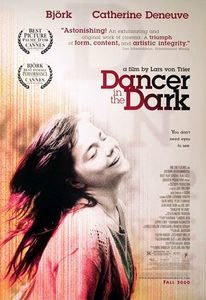
    (On Cable TV, August 2016) I’m reasonably sure I disliked Dancer in the Dark, but it does have a few interesting things going for it. I’m not normally a fan of writer/director Lars von Trier, and the first thirty-some minutes of this film feature his worst tendencies: Muddy naturalistic cinematography (filmed on early-generation digital cameras), tepid pacing, depressing characters in even more depressing situations… This example being set, it would be easy to figure that the rest of the film would just as unbearable. But then, a full musical number happens! That’s when Dancer in the Dark becomes interesting, clashing between the slick expectations of a musical number with the naturalistic low-fi style of an independent drama. It’s a remarkable effect, and it does much to make the film interesting despite its worst characteristics. The rest of the film arguably gets better and worse: On the plus side, there’s a murder, more musical numbers and an exceptionally unusual conclusion. On the minus side, everything drags on much longer than it should and the melodrama gets ridiculous to the point where even the depressing conclusion feels like unintentional comedy. (Thematic critique of the United States? Oh boy.) I’d shorten the last hour considerably, but unfortunately that may mean losing the pretty good courtroom dance number. Bjork feels like a special effect of her own, singing her numbers, holding her own in acting scenes and, of course, looking innocently cute throughout. So, what to make of Dancer in the Dark? I’m favouring mild dislike, even despite a fondness for conceptual daring. But I don’t know, really.

  • Melancholia (2011)

    Melancholia (2011)

    (On Cable TV, October 2012) I wasn’t expecting to enjoy Melancholia, but I expected it to be interesting.  “Dogme 95” director Lars von Trier isn’t usually associated with science-fiction or special effects, so seeing him handle a spectacular end-of-the-world disaster film had its own particular fascination.  There’s little in Melancholia that’s conventional, of course: it opens with a series of exquisitely photographed slow-motion portraits expressing the film that will follow.  Then we’re boldly thrown into an hour-long dramatic first section that seldom even acknowledges the ultimate science-fictional aims of the film.  This first hour is all about a young woman getting married and causing/suffering the worst day of her life.  The key to Melancholia is the idea that depressed people cope well with apocalyptic situations.  After that, the dramatic dynamics of second half of the film, describing in an intimate setting the reaction to impending disaster, makes perfect sense: The depressive is unaffected, the rational shatters under stress, the normal retreats into shock and the innocent isn’t aware of what’s going on.  It may be a frustratingly slow film, but it’s more than occasionally beautiful in its own way, and it forces actors such as Kirsten Dunst and Kiefer Sutherland to show some real acting capabilities. (Particularly Dunst, too-often dismissed in more superficial roles.)  For SF fans, it’s fascinating to see how carefully von Trier limits his scope: isolated location, four characters, scientific jargon that acknowledges the hard-science behind the scenario while using it for more fanciful purposes.  It’s also a revealing take on material that would be treated far differently in a pure-genre film.  Best seen on a small screen with plenty of distractions on-hand (it is a rather slow-paced film, and often skips over connective material), Melancholia nonetheless has its own languid appeal, a cozy catastrophe brought to the screen and an intimate exploration of a subject that, handled more conventionally, would seem downright ordinary.