Leo Tolstoy

  • Anna Karenina (1948)

    Anna Karenina (1948)

    (On Cable TV, March 2020) It’s a gift to cinephiles to see so many adaptations of a few classic novels—especially when they’re released within a few years. So it is that Leo Tolstoy’s Anna Karenina had two high-profile English-language adaptations in 1935 and 1948, forever begging for comparative pieces. I won’t quite do that here—not having read the novel is a handicap, and at some point, most black-and-while period dramas sort of blur into each other. Still, a back-to-back viewing of both versions shows that if the British 1948 one doesn’t have Greta Garbo, it does have a wonderful Vivien Leigh in the title role. The rest of it is a very respectable adaptation, once again focusing on the romantic tragedy of Karenina rather than the myriad subplots. (Some of the ensuing plot shortcuts can be confounding, but that’s the way it goes.) Anna Karenina is, in many ways, very Russian: winter, ballet, ill-fated protagonists and a shrug at the capriciousness of fate. I prefer this version to the prior one, what with a better use of exteriors, more confident directing and more expansive storytelling. Some of this reflects technical progress accomplished during a thirteen-year period—but some of it is due to writer-director Julien Duvivier’s approach to the material—and perhaps the influence of crowd-pleasing producer Alexander Korda. There’s some good control over the material, whether it’s the technical aspects of recreating historical Russia, the costumes, or the very good execution of the final scene. This being said, Anna Karenina does remain a costume drama, and one executed with late-1940s means. Modern viewers, if they’re just looking into checking out the story, may want to ease themselves into it by watching the 2012 version—maybe not quite as good as the early ones, but certainly more technically accomplished.
  • Anna Karenina (1935)

    Anna Karenina (1935)

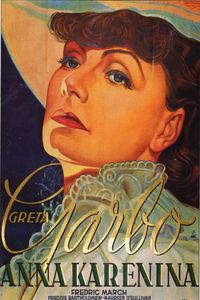
    (On Cable TV, March 2020) Another one in a long list of 1930s Hollywood literary adaptations, the 1935 version of Leo Tolstoy’s much-adapted Anna Karenina does have Greta Garbo, Fredrick March, and David O. Selznick as a producer—the three of them as close to Hollywood royalty as it was possible to get in the mid-1930s, which should give you an idea of the pedigree and importance of this Anna Karenina production. It goes without saying that Garbo is the main reason to see this version—it was a familiar role (she also played in a 1927 version), but this time she could use her voice. Although handsomely shot with big-budget production means most visible in sets and costumes, this production doesn’t quite have the technical polish nor expansive cinematography of later versions—but it does focus on the nuts and bolts of the story with good costume drama instincts (which includes a thorough culling of the novel to its most dramatic elements to fit within 90 minutes), so it’s still quite watchable today. I still prefer later versions, though.

  • Anna Karenina (2012)

    Anna Karenina (2012)

    (Video On-demand, March 2013) Director Joe Wright has always shown tendencies toward stylistic show-boating, and the first half-hour of Anna Karenina is crammed with directorial flourishes as the film moves in-between interior sets and a larger theatrical stage. As a way to freshly present an oft-told story (Tolstoy’s novel has been adapted to the big screen at least 12 times until now), it’s not a bad choice –except that there seems to be little rhyme or reason to the device, and it seems to be half-abandoned as the film progresses.  While viewers who like a bit of cinematic flourish may be pleased by the way Wright plays along with conventions, it does obscure the story and turns the film into something it’s not meant to be. It also obscures the good work done by the actors, including Keira Knightley in the titular role and Jude Law as her despairing husband. (Meanwhile, Aaron Taylor-Johnson’s mustache steals the show for none-so-positive reasons.)  The costumes are sumptuous and the visuals occasionally evoke a nicely idealized view of 19th century Russian aristocracy, but the self-conscious artificiality of the film’s presentation work at undercutting the impact of those.  As a take on familiar material, this 2012 version of Anna Karenina isn’t ugly to look at… but it’s quite a bit abstract when it starts messing with the way movies are presented, and that may not necessarily work at a romantic drama’s advantage.