Leslie Howard

  • The Animal Kingdom (1932)

    The Animal Kingdom (1932)

    (On Cable TV, January 2021) Regrettably enough, I had a really hard time staying interested in The Animal Kingdom, even restarting the film midway through in an attempt to goose my interest as my attention kept wandering elsewhere. It does have elements that I like—a Pre-Code era production (with some risqué themes), a protagonist associated with the publishing world, a choice to make between a safe-but-dull romantic prospect and another wild-but-unpredictable one. Myrna Loy is one of the most interesting actresses of the 1930s, while Ann Harding and Leslie Howard are not to be dismissed either. George Cukor had a hand in directing, and the film has theatrical roots that translate into better-than-average dialogue for the time. Still, there’s something to the rhythm of the film, its approach to the material and its audiovisual flatness (which, to be fair, is common to many early sound-era films) that simply had a hard time keeping my attention. When I realized, late in my second attempt to watch the film, that I simply wasn’t going to enjoy it, I also felt that nothing was going to help this time around. The film is in the public domain—it’s not going to take much for me to watch it again eventually.
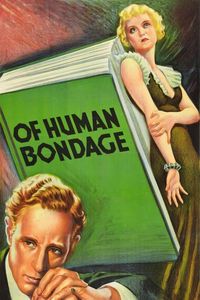
  • Of Human Bondage (1934)

    Of Human Bondage (1934)

    (On Cable TV, February 2020) In retrospect, it wasn’t such an idea to watch all three filmed adaptations (1934, 1946 and 1964) of W. Somerset Maugham’s novel Of Human Bondage back-to-back-to-back. Not so much because they all blend together (they all have their own particularities) but because their story is so trite that a triple dose of it can be overdoing it. This first version is probably the best—or at least the most interesting. Casting makes it worthwhile: With Bette Davis’s star-making role here, the film becomes a showcase for both her (in a shrill, somewhat unpleasant role) and for co-star Leslie Howard—although we know who’s the biggest star here. The film’s most striking moment is simply seeing Davis in full frame, her big eyes staring at the camera and showing where the Kim Carnes song comes from. Other than that, this Of Human Bondage does manage to make good use of its pre-Code status by showing a destructive love affair between two flawed individuals. It does have the qualities of 1930s prestige productions: Despite the restrained camera techniques, rough technical qualities and acting styles, the sets and costumes are lush, and the brightly-lit cinematography does have its own charms. The antagonistic romance between the two leads is interesting, and the literary origins of the story are never too far away. (Although the film, like its later remakes, does occlude a lot of detail from the original novel in the interest of focus and length.) Even today, the film is best remembered for offering Davis a plum role that would define her persona—she was at her best playing devious, often unlikable characters and she gets a good dose of that here. Given that the film is in the public domain, who can even watch it from the film’s Wikipedia page.

  • The Petrified Forest (1936)

    The Petrified Forest (1936)

    (On Cable TV, April 2019) By 1936, Humphrey Bogart was a repertory player in the Warner Brothers stable inching toward leading-man status, and they were clearly trying a few things for him to see how he’d catch the audience’s attention. One of his early successes was The Petrified Forest, a thriller in which he plays a gangster evading a police chase, and taking hostage the patrons of a small desert diner. It’s clearly not meant to feature Bogart as a lead character—that would be Leslie Howard as a writer turned drifter who’s affected by the characters and events of the diner. As a semi-confined thriller, the film makes a good double-bill with Bogart’s latter Key Largo, but does make effective use of its desert atmosphere to crank the tension between its characters. Bogart, young and with a full head of hair, is convincing as the heavy (something that would clearly be noticed in later films) but the film isn’t quite a gangster picture. As the third act rolls in, it becomes closer to a contemplative meditation on life and death, as befits its theatrical origin. That’s when our intellectual protagonist is transformed into someone who discovers, perhaps too late, a reason to live. Great dialogue and great characters make this a potent 1930s film, although let’s be honest—most viewers will seek this out for Bogart first.

  • Romeo and Juliet (1936)

    Romeo and Juliet (1936)

    (On Cable TV, March 2019) There are films that I watch out of obligation, and the 1936 version of Romeo and Juliet is one of them—It’s directed by notable filmmaker George Cukor, won a few Oscars, features a few name actors from the era and still ranks on extended best-of lists. The problem (and I’ve discussed this elsewhere) is that Shakespearian dialogue in English bores me beyond belief. So, I may have listened with half an ear—with some help from an adaptation that adapted, shortened and simplified some of the material. This being said, there’s enough in the film on a visual level to keep things interesting—great costumes, decent sets, and actors looking as if they’re really enjoying doing Shakespeare on-screen. (Oh, and Edna May Oliver as the nurse!) Cukor directs with a sure hand, while Leslie Howard does well as Romeo, John Barrymore distinguishes himself as Mercutio, and Norma Shearer makes a decent Juliet. Frankly, the whole thing still looks so good that you can be forgiven from not paying much attention to the dialogue. It’s interesting to compare and contrast it with later versions: Put against the (dull) 1968 Zeffirelli version and the (hyperactive) 1995 Luhrmann version, this Romeo and Juliet feels closer to what we would imagine a lavish theatrical production to look like.