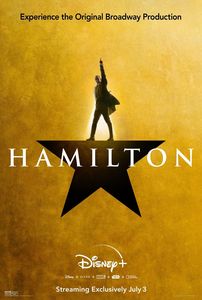
(Disney Streaming, July 2020) Like everyone else, I couldn’t escape the critical acclaim for Hamilton the musical back in 2015–2016. Still, it took me a surprisingly long time to have a listen at the soundtrack. My reaction to the songs of Hamilton was very much in-line with everyone else: Holy Washington, this is really good. The blend of historical material (even acknowledging the deviations from reality—Broadway is no place for historical accuracy) with catchy modern music made for an addictive experience, and my expectations ran high for a professional recording of the show given the high unlikeliness of seeing (or being able to see, of being able to afford to see) the show live, especially after the end of its initial run. The announcement that the recording would be released on digital to coincide with Independence Day was a rare bit of good news in an otherwise dismal 2020. My expectations ran high as I settled down to stream the film, and even they were amply exceeded. Seeing the show adds an extra dimension in the songs and my typically non-hyperbolic self feels justified in labelling this as a work of genius. Much of the credit goes to Manuel-Lin Miranda, whose book, music and lyrics are perfectly executed. I’m not that familiar with live theatre, so much of the typical touches of the form (the ensemble, the musical quotes, the staging) feel fresh and inspired, and make perfect sense in reinforcing the aspirational fantasy of the content. While Miranda couldn’t have done a better job in creating the show, its interpretation rests on a strong cast with few weak points. Leslie Odom Jr. is particularly good as Aaron Burr (to the point of barely feeling like a villain despite, well, shooting the protagonist), Jonathan Groff is a comic highlight as King George III, and Renée Elise Goldsberry is spectacular. Other players get their spotlight in the second act: Daveed Diggs is very funny in a pair of Francophile roles, Phillipa Soo gets more attention as the story goes on and Christopher Jackson is imposing as Washington himself. The video credits are a nice touch—especially for the much-deserving ensemble. The songs I liked best on the soundtrack (My Shot, The Schuyler Sisters; You’ll be Back; Ten Duel Commandments; The Room Where It Happens) are equally good here, but the staging (and accompanying body movement, much of it sarcastic) elevates some numbers far above their audio-only component: “Satisfied” become heart-wrenching as it rewinds time, “The World Turned Upside Down” is a triumphant new favourite with rolling guitars and bombastic dancing, “What’d I Miss?” has some great comic staging, both Cabinet Battles are fantastic (they were already great as songs) and “The Election of 1800” is fun and dramatic at once. The concentric turntables are used to good effect during the duels and the eye-popping Hurricane sequence, with the dramatic climax of the entire production hinging on simulated bullet-time summation of a man’s life as he gets shot. If I’m effusive in my praise, it’s because Hamilton is a rollercoaster and I was on-board for every laugh, every cry, every killer line and dramatic twist. I strongly suspect that much of this intense reaction comes from living-in-July-2020, measuring an authentic piece of Americana at its best against the vertiginous decadence of the United States over the past few years, with an incompetent leadership embracing corruption, authoritarianism, and intentional division to the point that it cannot handle a crisis killing citizens by the tens of thousands (soon the hundreds of thousands: Oceans Rise, Empires Fall)—the exact opposite of the values embraced and demonstrated by Hamilton’s appealingly multicultural cast and moral outlook. While I’m looking forward to a cinematic version of Hamilton in a decade or so, this June 2016 live recording is a striking time capsule and a reminder that many Americans do have their heart in the right place. As we wait for an end to the current catastrophe, Hamilton couldn’t have come at a better time—and despite not being much of a movie in traditional terms, it looks as if it’s going to be in the running for best-of-year contention. I would be surprised if I had a bigger emotional reaction this year to anything else but a landslide repudiation of the current administration on election night.