Lin-Manuel Miranda

  • Encanto (2021)

    Encanto (2021)

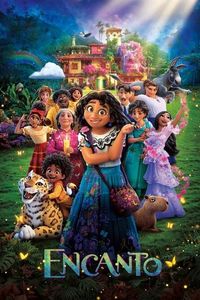
    (Disney Streaming, December 2021) I really shouldn’t care all that much about what happens to a film from a gigantic multi-billion entertainment behemoth, but as of this writing, the cultural impact of the sixtieth mainline film by Disney Animation Studio is slight — Encanto, like many other films of the 2020s-so-far, has suffered from the COVID pandemic scrambling the usual marketing and release institutions of Hollywood. While new Disney movies are usually a Big Deal, this one briefly popped up in theatres (at a time of contagion-wary audiences) before finding a home on the Disney+ streaming service. As a result, it’s not clear whether it has had any cultural impact yet — quantifiable popular interest is down compared to other Disney films, and there’s a sense that it may be too closely associated with Raya and Coco to develop a distinct identity. It’s early, though — and I suspect that in time, the true winners of these strange plague times will become clearer. [December 2022: I worried needlessly: Encanto, a year later, has found its public and then some!]  It may or may not help that Encanto is, in the end, roughly of similar quality than other Disney films — the Mouse knows how to make movies, and this one is just as satisfying as most of their New Renaissance era. Not necessarily a classic, but a solid well-crafted hit with just enough to set it apart once you watch it. Heading to Columbia for inspiration, Encanto is about a family with magical powers… and the lone offspring that does not. Exceptionally cute in look and behaviour, Mirabel (ironically the name of an infamous Montréal-area airport) struggles to understand why she’s not gifted as the rest of her family, but ends up being the ideal one to investigate why their powers are slowly weakening. Clearly taking after the South American tradition of magical realism, but pushing it into, well, magical fantasy, Encanto also benefits from the musical talent of Lin-Manuel Miranda as he contributes eight songs to the film and several of its highlights. The fantastic opening “The Family Madrigal” is clearly in Miranda’s style in cadence and delivery, while the theme of “What Else Can I Do?” brings to mind Frozen’s power ballad “Let it Go.”  “We Don’t Talk About Bruno” has the film delivering some well-paced editing, rounding up the best songs of the film. As for characters, it’s tough to ignore the magical Casita taking care of the domestic needs. While I found the ending perhaps a bit too subtle in fixing the character’s thematic issues (the film clearly wasn’t going to go for “what happens after the magic fades away?”, but it could have been clearer in exposing the pre-renewal hidden conflicts.), it ages well upon reflection. I expect that Encanto will, similarly, do well in future and repeat viewings — the Disney formula is a formula, but it’s a good one that succeeds and builds trust that the next films from the studio will also be worth a look. As the sixtieth full-length Disney Animation Studio films, Encanto joins a large and illustrious group but doesn’t look out of place.

  • Siempre, Luis (2020)

    Siempre, Luis (2020)

    (On Cable TV, October 2020) With the massive success of the Broadway musical Hamilton, it’s inevitable that it would lead to a number of movies, books and other works that may not necessarily be derivative, but would not exist without Hamilton’s popularity and fan base. So it is that the documentary Siempre, Luis is both about the efforts to bring Hamilton to Puerto Rico in the wake of Hurricane Maria, but also the life of Luis Miranda, the father of Hamilton’s creator Lin-Manuel Miranda. It’s a compelling story, as we follow the ever-active Luis making his way to New York City, where he studies and gets involved in the political process as an activist and then an organizer. Woven throughout the documentary is a strong appreciation for Puerto Rico, along with a gentle push for statehood by summarizing the territory’s unusual situation. (The film’s politics are not subtle.) Luis is a strong character, although putting him next to the incredibly charismatic Lin-Manuel is one of those situations where the documentarian can’t really win. The other issue is that while the film uses the Hamilton musical’s tortuous road to Puerto Rico as a framing device, the show’s ultimate performance is often given short thrift. Still, it’s interesting enough, and the glimpses at Lin-Manuel’s origins make for compelling viewing for fans of his musicals. (“In the Heights” is given a few minutes to properly contextualize the breakthrough that it was.) The way Miranda-père helped Miranda-fils in his early days is certainly not to be discounted.

  • Mary Poppins Returns (2018)

    Mary Poppins Returns (2018)

    (Netflix Streaming, December 2019) Much has already been written about Disney’s all-out effort to sell generations’ worth of its own pop-culture reference back to modern audiences, and at times it feels as if Mary Poppins Returns is an exemplar of that effort. Ripping off an earlier classic as a matter of course, this sequel seems happy to simply go through the same kind of story, the same kind of songs, the same kind of structure, the same kind of jokes. It’s competently made, amiable enough, and with some spectacular special effects to sweeten the deal, but it does struggle to justify its own existence as anything more than a money grab. Artistically, none of the songs or musical numbers seemed to grab me on first viewing—although I suspect that “The Cover Is Not the Book” and “Trip a Little Light Fantastic” may do better on re-watch. The cast is quite good, with Emily Blunt turning in as a perfectly decent Mary Poppins—I particularly liked her somewhat harsher tone this time around. Lin-Manuel Miranda is also a highlight, although only occasionally used to the fullest extent of his skills. Still, for all the prodigious technical skills used to make Mary Poppins Return, the impact is considerably lessened. I don’t think that there’s a single pixel of the result that hasn’t been meticulously art-directed half a dozen times, and yet the result isn’t that much better than the original. (It is, however, mercifully shorter.)  Thematically, the film doesn’t quite know where it’s going for besides making money—but if we’re going to talk about the film’s twisted relationship with capitalism, we’re going to be here all night. At least now the kids know about compound interest. Which, I’m sure, the Disney stockholders will approve. But in between Mary Poppins Returns’s paean to banking and Christopher Robin’s bemoaning executives not having enough time to spend with their families, I have a feeling we’re getting far too raw a glimpse into the Disney boardroom’s mindset through their movies.