Liv Tyler

  • Ad Astra (2019)

    Ad Astra (2019)

    (On Cable TV, June 2020) On paper, Ad Astra doesn’t look like my kind of movie—moody ruminations in space? Eh. But I was willing to cut it some slack, and the opening moments of the film do set an intriguing tone—this is going to be moody ruminations all the way to the end of the solar system, but if you’re going to do yet another riff on Heart of Darkness, you might as well commit to it and hop on board for the ride. In retrospect, I should have listened to my instinct when I started twitching at the “International Space Antenna” that doesn’t even make a credible upgrade to the idea of a ribbon space elevator, or workers dumb enough not to follow basic OSHA tethering procedures when working in space. Or the wonky gravity that portended an entire movie’s worth of bad gravity. But there are a few things that work, and for far too long I kept clinging to those elements. The visuals are terrific, and the frame-by-frame credibility of the setting is astonishing—they really went for plausible-looking gear here, and even if we could quibble for roughly sixty years about how late-twenty-first century space gear will not look like twentieth-century NASA (especially not that even SpaceX suits don’t look like that), this film plays heavily on visual callbacks to familiar material—all the way to a 2001 HAL room nod later on. I brushed off the small chorus of inner voices pointing out one scientific mistake after another—This is Hollywood, after all. But I did start to have my doubts about the Moon rover pirates. Supposedly raiding US Armed Forces convoys in trips across vast swaths of the lunar surface that seem measured in minutes rather than hours. I brushed this off as filmmakers bending to studio pressure to have cool action visual stuff to liven up an otherwise atmospheric film. But even by that stage, uneasiness had set in. While I do like quite a bit of Ad Astra’s surface sheen (and Liv Tyler, and Ruth Negga, and even Brad Pitt has his moments) and while I was willing to play along with the glum Heart of Darkness structure, I was starting to have my doubts about the whole squishy middle layer of the film between intention and visual execution. But then…then the film thinks that the laws of physics allow for rescue stop on a ballistic trip from the Moon to Mars. Which leads to space baboons. That explodes when depressurized. Jesus Heinlein Christ, why does this movie have to be this stupid??!? This isn’t 1983’s Outland. This is 2020 and STEM career paths are considered important enough to warrant national programs. I’m not that smart and I don’t have an astrophysics degree, but there is something absolutely hopeless when a film that claims to be hard-SF becomes an unceasing carnival of scientific mistakes that I can easily point out. The lack of tracks on the Moon. The gravity mistakes. The chronological errors. The goddamn stupidity of the rocket hijacking sequence in which a character manages to climb a ladder aboard a rocket being launched into orbit. This is not a hard-SF film, even by Hollywood standards. This is an emo daddy-issue drama hideously cosplaying as hard-SF while not really liking any of the characteristics that make the genre. It gets worse at the end, what with a visibly rock-filled Neptune ring and—oh why bother I don’t care anymore. Even the main dramatic thread is cut off unceremoniously—while revolving daddy issues by killing off Daddy is unorthodox, it’s also trite enough to feel as if we’re given a big comic slide whistle at the end of the trip. Fortunately, I had given up on the movie at that point. If there’s an Ad Astra anti-fan club, I’m in.
  • That Thing You Do! (1996)

    That Thing You Do! (1996)

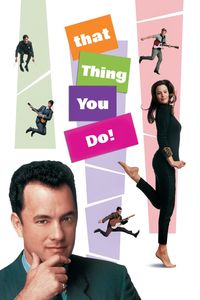
    (On TV, January 2020) I have a surprisingly soft spot for band movies—basically, anything having to do with the rise and fall of music groups. The Commitments ranks high on my list of favourite films, I unaccountably liked Bohemian Rhapsody despite knowing better and no amount of familiarity will keep me away from musical biopics. With his directorial debut That Thing You Do!, Tom Hanks goes straight for comforting familiarity in charting the unlikely path of a one-hit wonder musical band (called, knowingly enough, “The One-ders”) during the mid-1960s. The period recreation is solid, and so is the formula followed by the film: As our teenage protagonists are plucked from obscurity by a catchy up-tempo take on their song, we’re also driven across America from Pennsylvania to California. The screenwriting is deceptively straightforward, going right to the heart of the formula and never letting go. The performances are just as good as they need to be, with Tom Hanks hovering in the background as a record executive, Liv Tyler in a likable supporting role, and a longer list of cameos than is worth listing here. Musically, it helps a lot that That Thing You Do! can depend on actors with the ability to convincingly play instruments, and sports an insanely catchy tune. (In one of the film’s best touches, this one-hit wonder band almost always plays that one hit, meaning that the audience gets tired of it within the span of the film just as the audiences do in the film’s reality.) There are plenty of references here to mid-1960s pop culture—I caught some of the obvious movie-related ones, such as the wink to the “beach party” series, but there’s a lot more for those who know the period. This captivating historical recreation more than supports the rest of the film and the result is a solid hit for Hanks-the-Director, and a highly enjoyable film in its own right.

  • Empire Records (1995)

    Empire Records (1995)

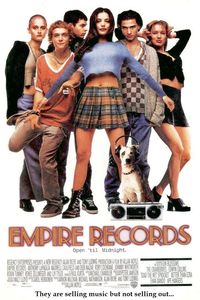
    (On TV, January 2020) I started watching Empire Records without great hopes, expecting that I’d go do something else while it played. But I ended up unexpectedly captivated by the result. It’s not much of a movie in strictly conventional terms: Structured as a day-in-the-life of record store employees (albeit on the store’s last day as an independent, as they also host a major 1980s singer), it’s a mixture of various short subplots thrown together around a common setting. But there’s quite a bit of charm to the result—and even more now as a time capsule of what it could have felt like to work in a record store in the mid-1990s. As befits the setting, Empire Records has a wall-to-wall soundtrack of 1990s alternative music, and it sounds even better today than back then. The script has a pleasant rhythm to it, with some characters inhabiting a slightly different reality from the others—at least two of them have a special relationship with the fourth wall, leading to some of the film’s funniest moments. Other characters have their own far more conventional dramas, and the ensemble show the fun dynamics of a close-knit group. The cast is remarkable for featuring early appearances by some actors who would go on to better things. Robin Tunney and Liv Tyler are both eye-catching enough, but the out-of-persona surprise here is probably Renée Zellweger as a promiscuous teenager. Empire Records is all slight but good fun, although I suspect that my age (I was twenty in 1995) has something to do with it. [January 2025: It’s funny what sticks in mind from a film, and five years later my favourite quote from the film is still “Empire Records, open ’till midnight, this is Mark. (beat) Midnight.”]

  • The Strangers (2008)

    The Strangers (2008)

    (Crackle Streaming, October 2017) Ho, boy. Another home-invasion horror movie. Another group of psychopaths. Another couple of innocent victims. Another unnecessary attempt at “evil can strike at any time!” messaging, submerged under the cheap thrills of psychopaths running amok. No, there really isn’t anything to The Strangers worth noticing when there’s an entire sub-genre of home invasion horror movies out there. I don’t like the genre, and I don’t like The Strangers, even more so given my girl-next-door liking for Liv Tyler. It’s a really dull movie, and the best thing that can happen for anyone who wants to see it is to goof up on similar titles and see 2008’s The Visitor instead.

  • Space Station 76 (2014)

    Space Station 76 (2014)

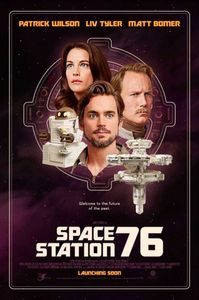
    (On Cable TV, May 2015)  I seldom want to throw things at my TV during closing credits, but then again most movies aren’t as frustrating as Space Station 76.  I’ll admit that part of my frustration has to do with expectations: Nearly everything about the film’s marketing, from the title to the trailer to the poster to the premise, suggests a light-hearted ironic spoof far lighter than what we get here… because after only a few minutes, it becomes glaringly obvious that we are stuck in the saddest indie-drama imaginable.  As Space Spation 76 goes forward, the laughs never come: instead, we are prisoners of a bleak drama about crushing isolation, unhappiness and narcissistic characters.  The Science Fiction elements are not used with any rigor or invention, and the comedy goes way past humiliation into depression.  Fair enough; I wouldn’t be the first time marketing would sell an entirely different movie than what it is.  But what kills Space Station 76 isn’t mismatched expectations, but unfulfilled potential.  The film is bleak from beginning to end, and some sequences would be hard to stomach under any circumstances.  But the ending doesn’t actually resolve anything: it basically fades to black without much hope for the relatively small number of sympathetic characters imprisoned with the crazy ones.  People with sensitivities toward kids stuck in bad situation will be particularly infuriated by the Space Station 76’s refusal to provide closure.  But then again, most people will be frustrated by the film, no qualifiers needed.  As much as I usually like Liv Tyler and Patrick Wilson… I don’t usually go out of my way to suggest people should avoid a movie, but –again- I’ll make an exception for this one.  

  • Robot & Frank (2012)

    Robot & Frank (2012)

    (On Cable TV, July 2013) At a time when most Hollywood Science Fiction blockbusters seem to be exercises in over-the-top action and densely dazzling visuals with little left for heart and compassion, it’s good to find an antidote in the form of a low-key SF comedy.  Here, five minutes in the future, an aging robber reluctantly forms a bond with his newly-imposed robotic assistant, to the extent of recruiting his new buddy for one last score.  Filmed with a surprisingly low budget, Robot & Frank even dispenses with extensive special effects work by using a simple robot suit worn by dancer Rachael Ma: it’s a film about relationships and subtle ideas, not really about spectacular visuals.  Frank Langella is essential to the film as the protagonist with a troubled past: he anchors the film in a believable reality and effectively acts as a foil to the entire cast as they all seem determined to do what’s best for him.  Meanwhile, Susan Sarandon is lovely as an aging librarian who becomes the object of his affection, and Liv Tyler makes the most out of limited screen-time as a daughter who learns better.  Much of the film is a slow burn, executed with calm and confidence.  It does builds up to an effective moral dilemma, though, and its exploration of memory (the tragedy of losing it, but also the curse of remembering everything) is as subtle as any film about aging could hope to feature.  While some late-film twists and revelations fail to convince, much of Robot & Frank remains charming in its own quiet way.  One of the best things about the mainstreaming of Science Fiction and the greater availability of filmmaking tools is that SF movies can now reflect a variety of viewpoints.  The blockbusters are here to stay, thankfully, but it’s good to know that there’s something else out there.

  • Jersey Girl (2004)

    Jersey Girl (2004)

    (In theaters, April 2004) Ouch. While it’s not fair to begrudge writer/director Kevin Smith’s desire to grow up after five raucous comedies, it’s not poor efforts like Jersey Girl that will demonstrate anything. What’s nearly unbearable, though, is the dawning realization that the film’s problems stem from one source: The writing. The direction is surprisingly unremarkable for a Smith film (it looks like just about any cookie-cutter romance, which is a step up for Smith’s notoriously static style) and all of the actors do really good work, from Ben Affleck’s uneasy blue-collar worker to Elizabeth Castro’s adorable kid character. (Heck, even Liv Tyler has never looked hotter; it’s the glasses, I swear!) But the stuff that comes out of their mouth… eeew. Smith’s writing has always been the chief attraction of his films, but he completely (and repeatedly) misses the mark here: He brings to romantic drama the same sledge-hammer quality so obvious in his comedy and the result is a disaster. Characters spout off “on-the-nose” monologues to sleeping infants, react in broad and obvious ways that have no equivalent in the real world and engage in conversations that feel more like dramatic check-lists. Yikes. To add insult to injury, whatever comedy writing is in the film falls flat and feels forced. All in all, it’s not Smith’s new intentions that are at fault (despite everything, you can still sense the heart-felt bond between father and daughter) but his inept execution. Too bad.