Lloyd Bridges

  • The Whistle at Eaton Falls (1951)

    The Whistle at Eaton Falls (1951)

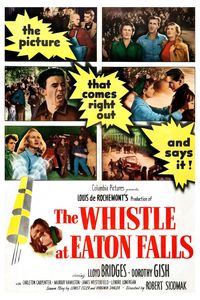
    (On Cable TV, May 2021) Turner Classic Movies often uses its annual Film Festival to virtually resurrect films that have been nearly forgotten. Typically using a recent studio restoration as a pretext for a “world premiere,” they unearth a surprisingly steady stream of films from the archives, polishing them off and giving them a new chance at modern viewership. The Whistle at Eaton Falls is a movie that has time-travelled very well, considering that it’s about a factory town dealing with new technology, efficiency efforts and the inevitable layoffs. The cast has some strong highlights, with Lloyd Bridges in the lead role, and notables such as Dorothy Gish and Ernest Borgnine in supporting roles. The restoration simply looks crisp and terrific, with impeccable sound. Best of all is the small-town atmosphere that turns into a pressure cooker, as commercial imperatives threaten to split the community apart. (Fortunately, there’s a happy ending.)  The emphasis on characters trying to do the right thing in the face of capitalist imperatives, navigating between owners and unions, does add some depth to a film that doesn’t fit neatly into the big genres of the early 1950s. The Whistle at Eaton Falls is not a spectacular film, but it’s a satisfying one, and it can be watched more easily than you’d think. Another solid case for film restoration.

  • Around the World Under the Sea (1966)

    Around the World Under the Sea (1966)

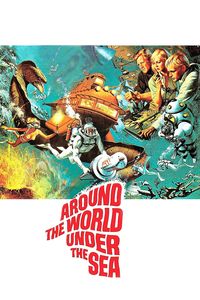
    (On Cable TV, March 2020) If you ever wanted to see what a space-age underwater exploration movie would feel like, search no further than Around the World Under the Sea, which brings the can-do spirit of the American space program to the business of deep-sea exploration. Clearly a science-fictional thriller, it supposes a near-future world in which deadly waves require the installation of five warning sensors. This becomes an excuse for a didactic presentation of underwater attractions, with the scientists of the single submarine able to complete the work bickering among themselves to add a bit of drama—and there’s one single female character for exactly the expected reasons. Lloyd Bridges stars, probably on the strength of his turn in the earlier Sea Hunt TV show. (Both share the same producer.) Shot in colourful tones, the film is at its best during the underwater sequences. Combined with the rather charming mid-1960s fashion out of water, it all makes Around the World Under the Sea interesting enough—although still not that good.

  • Blown Away (1994)

    Blown Away (1994)

    (Second Viewing, In French, On TV, January 2020) Back in 1994, there were many comparisons made between Speed and Blown Away, most of them to the second film’s disadvantage. The pairing wasn’t arbitrary: here were, after all, a pair of movies talking about a mad bomber targeting protagonists in picturesque American cities. Most reviewers felt that Speed fully indulged in the craziness of its premise, while Blown Away was too dour and, crucially, disarmed its bombs when, in the words of Speed’s script, “A bomb is made to explode. That’s its meaning. Its purpose. Your life is empty because you spend it trying to stop the bomb from becoming.” Having seen both at the time (Blown Away at a drive-in theatre, if I remember correctly), I definitely agreed: Blow Away was too dull, too serious about itself, especially in comparison to Speed, which remains one of the all-time greatest action movies. A second take on Blown Away twenty-five years later is more generous, but not by much: Absent unfair comparisons with Speed, Blown Away is a good-enough thriller—conventional but with a few good moments, although with too many odd missteps along the way to be fully satisfying. Jeff Bridges does well as the protagonist, although the film’s troubles start at the opening scene as it mines the murky fractious nature of the Irish Troubles for backstory and uncomfortable character motivations. (He does get a few scenes playing opposite his father Lloyd Bridges.) Tommy Lee Jones is far more enjoyable hamming it up as a crazy villain, although it’s worth noting that his character’s various eccentricities run dramatically at odds with the more serious tone of the rest of the film. This issue pops up again and again throughout Blown Away: A crazy idea creating tone problems when placed against the darker underpinning of the story. It tries to be both a hard-edged thriller but can’t resist the pull of an overblown action scene or funny moment. Forest Whitaker hangs at the edge of the plot as another bomb specialist with personal animosities with the lead—he’s an unconventional choice for the role, but the adversarial relationship between the two characters works well. Finally, Boston plays the fourth-biggest role in Blown Away, as the script gives up a highlight tour of some of the city’s tourist attractions. As someone who has visited Boston more often than any other American city (perhaps even combined) since the mid-1990s, I really enjoyed seeing big action sequences set in places I’ve seen a few times—with a particular affection for the explosive Trinity Church sequence. Blown Away does exemplify a kind of thriller that we frequently saw in the 1990s and less since then—it’s pretty much the same exact “killer psycho fixates on protagonist, kills his friends and colleagues, etc.” plot although with bombs. Still, it doesn’t quite understand how to have a consistent tone and exploit the elements it has at its disposal. A common critique of 1994 remains just as valid today and tells much: Here is a film with a climax in which an orchestra plays the 1812 overture… and it doesn’t even bother synchronizing the music with the climactic explosion.
  • Sahara (1943)

    Sahara (1943)

    (On TV, October 2018) Considering the time it now takes to make movies and bring them to market, it’s sometimes amazing to watch WW2-era films discussing events that happened mere months prior to their release. It’s even more amazing to find out that some of them remain remarkably effective even despite their ridiculously short gestation period. So it is that Sahara is a welcome surprise: a solid war adventure set during the African campaign of WW2. It certainly helps that it features no less than Humphrey Bogart as the commanding officer of a lost tank trying to rejoin their main battalion after a fierce battle. Lost in the desert, they gradually find other survivors and spend the first half of the film searching for an oasis. Alas, their troubles only begin when they do find a source of water—before long, they find themselves guarding a dry well against a much larger force of Nazi soldiers. Action, derring-do, amazing coincidences and character drama all punctuate the second half of the film, raising the stakes and providing a capable war adventure made as it was going on. There is a really interesting moment midway through the film in which the Italian character blames the German character for his nation having duped in joining the alliance—a far more nuanced portrait of the enemy than you would have expected at the time. Bogart is quite good in the lead, with a secondary role by a young Lloyd Bridges—and this is one of those rare films with an all-male cast. Sahara firmly belongs in the “war is an adventure” school of filmmaking: the film is not trying to make a statement about the futility of it, but neither is it unbearable propaganda. A clever, tight script wraps everything together in a topical war drama that has nevertheless withstood the test of time significantly better than most of its contemporaries.

  • High Noon (1952)

    High Noon (1952)

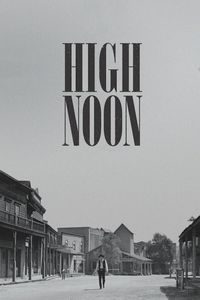
    (On TV, June 2018) There is, at first, not a lot to distinguish High Noon from countless other westerns—there’s the hero (getting married), there are villains waiting for their boss. A confrontation is coming to a small Western town, and that seems to be the extent of it. But High Noon does go farther than that—first, by taking place in near-real time, it does create more tension than a less time-compressed film, especially as our retiring hero fails to find allies in confronting the coming threat. It culminates in a classic shootout in which help comes from an unlikely place, and concludes with a highly skeptical look at some of the Western’s most cherished clichés. It helps that rock-solid Gary Cooper (looking a bit older than his prime) stars as a good man forced to take one last stand. Grace Kelly is merely fine as the newlywed bride, but Katy Jurado is more eye-catching as a source of wisdom. Keep your eyes open for smaller performances from Lloyd Bridges and Lee van Cleef. Director Fred Zinnemann keeps things stirring until the climactic shootout, and High Noon has survived admirably well even today. 

  • Hot Shots! Part Deux (1993)

    Hot Shots! Part Deux (1993)

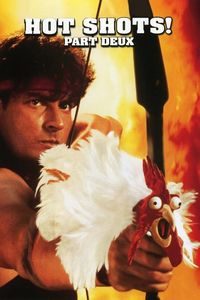
    (Second viewing, On DVD, November 2017) I remember seeing Hot Shots! Part Deux in theatres, first week of release, with a bunch of friends and then driving back home while upholding the time-honoured tradition of quoting the best parts of the film to each other. Nearly twenty-five years later, the film holds up pretty well, although it’s somewhat funnier if you have recently viewed its primary sources of inspiration such as Rambo III and Basic Instinct. (“I loved you in Wall Street!”) Unlike latter, less successful spoof movies, however, Hot Shots 2 works on its own as a comedy even if you ignore the parody: there’s wittiness to the script, physical comedy, much absurdity and wry references. The influence of early-nineties pop culture is strong and getting more esoteric by the year (“War … it’s fan-tastic” requires explanations today), but that’s not necessarily a bad thing. Charlie Sheen is very good in the title role, while Lloyd Bridges’ unhinged performance as a gaffe-prone president is endearing in the ways the current gaffe-prone president isn’t. It was a great decision for the film to abandon the flying satire of the first film and take on a slightly different military parody. Unusually enough for sequels that usually move on to a new love interest, the beautiful and hilarious Valeria Golino is back and the film does deals with her return in surprising narrative ways. Even today, the film remains very funny, and the presence of a few known actors in smaller roles (Miguel Ferrer, Rowan Atkinson, Richard Crenna) is a great bonus. At a tight 86 minutes, Hot Shots! Part Deux doesn’t overstay its welcome, and is probably best watched soon after its predecessor for even more spoofy fun.