Lochlyn Munroe

  • When Sparks Fly (2014)

    When Sparks Fly (2014)

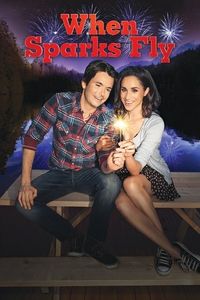
    (On Cable TV, November 2021) Let’s face it: viewers seldom, if ever, choose to watch those formula Hallmark romantic comedies because of the casting. Acting talent is usually redundant in those films — replaceable, undistinguishable, and seldom remarkable. But I had two cast-related reasons to give a chance to When Sparks Fly:  Having a look at one of Meaghan Markle’s last feature-length roles before she got swept up in the British Royals madness, and dropping in on Lochlyn Munroe, a Canadian actor whose early turns as a supporting character in Hollywood comedies never quite panned out to a major career. (Not that he’s likely complaining: unlike many of his contemporaries, Munroe is still steadily working, even now.)  The plot itself is unremarkable except in its details, as (all together now:) a young career professional goes back to her hometown, meets her old flame and helps the town with something. In this case, there’s some interest in the fireworks subplot (her parents have a fireworks company, the town can’t afford the fireworks they already paid for, and nobody dares mention the breach-of-contract lawsuits waiting in the wings) or in the specific details of how the film will handle the jilted fiancé when he’s not such a bad guy. (There’s never any surprise in this film, so if your money is on the two lead couples swapping partners, well, you don’t get any points.)  So, what’s left besides some unobtrusive directing, splendid British Columbia landscapes (decked in Fourth-of-July paraphernalia), comforting screenwriting and grade-school-level dialogue? Well, Markle does have the advantage of being significantly more attractive than the usual Hallmark heroine. (There’s a science to it — Hallmark viewers won’t accept anyone hotter than “cute” in those movies.)  Meanwhile, Munroe is affable enough in the undemanding role of a good-guy-fiancée-who’s-just-not-The-One. Knowing that wraps up my interest in When Sparks Fly, which is perhaps slightly better than your average Hallmark romantic comedy, but not by much. It only takes one of those films to understand whether you’re going to like them all or not.
  • Scary Movie (2000)

    Scary Movie (2000)

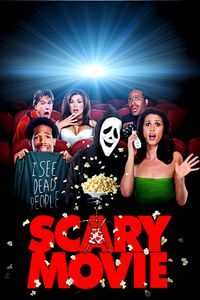
    (In theaters, July 2000) If ever there was a genre which deserved its satiric roasting, it’s the late-nineties “teen slasher horror” craze, which -for all its hip self-awareness- wasn’t all that much better than its early-eighties predecessors. Scary Movie takes up the task with gusto, and despite an annoying intrusion of gross-out comedy, the film is oodles better than most satiric comedies have been in years. The script is filled with genuinely funny material, and most parodies are on-target. I’d have cut about five minutes of unnecessary vulgar material (which gets old real quickly, and ends up annoying rather than amusing), but the rest works well. Wait for the TV network version.

    (Second Viewing, October 2021) After the past few years’ Friday the 13th and Halloween end-of-October horror marathons, I thought I’d do something lighter and have a second look at the five Scary Movie comedies back-to-back. Revisiting them twenty years later is bound to be strange—as parodies, they reference pieces of pop culture that are no longer particularly current—I may remember them, but ever-so-faintly. Blending Scream and I Know What You Did Last Summer (the first one is still a reference, the second one not so much), the script goes in full spoof mode with re-creations going into jokes, background gags (alas, not enough of them) and references that don’t always make sense. The lack of fluidity of the result is more apparent, as is the way some material is jammed in the film without grace. Written and directed by the Wayan Brothers, Scary Movie does not play in subtlety—while it occasionally remains funny, it lacks trust in the audience’s ability to grasp the jokes quickly. If you belong to the school of thought that comedy is surprise, nothing kills a gag faster than having it being so drawn out that you can see it coming. And while it may be strange to complain about the violence and sexual content in an R-rated spoof on R-rated horror films, there are definitely a few instances where the film is more gross than funny, the dial having been set just a bit too high for comfort. While never tasteful, some of the material (about gay or trans characters, in particular) now feels even more dubious. Still, compared to many later spoof comedies (and in particular the repellent Freidman/Seitzer “spoofs” of the 2000s, their credits here as writers heralding the worst) Scary Movie is actually not too bad—it has low but sufficient production values, a script that tells a story, and jokes that don’t stop at being mere recreations. I smiled a few times, maybe even chuckled more often than I expected going in. It’s interesting to see, twenty years later, what happened to the cast: Anna Faris (as a brunette?!?) did well for herself as a comedian, while Regina Hall achieved some dramatic respectability later on. Lochlyn Munroe never quite had the career anticipated for him, although he’s working steadily on lower-budget productions—which is more that can be said for much of the cast. While I had my doubts about the value of revisiting the Scary Movie series, I’m now set straight: It’s not a wise project, but will have its moments. Although I dread that Scary Movie 2 is up next—I recall it as being the worst of the bunch.