Lucille Ball

  • Du Barry was a Lady (1943)

    Du Barry was a Lady (1943)

    (On Cable TV, July 2020) Like many other hobbies, movie-watching gets more rewarding the more you put into it. If you’re the kind of person who watches a film a year, then go ahead and enjoy the film on its own merits. But if you’re the kind of cinephile who enjoys tracking down filmographies, sub-genres and how movies exist in context, then a film can become far more than the sum of its parts. While watching Du Barry Was a Lady, for instance, I was struck by how it brings together many people that I liked elsewhere. It has one of Gene Kelly’s earliest roles, for instance—and even at this early stage, he gets play the likable cad, singing and dancing even if it’s not (yet) to his own cinematography. It has one of Lucille Ball’s foremost movie roles, where she gets to be strikingly beautiful and funny. It has Red Skelton, semi-restrained from his usual comic tics and funnier for it. It has one of my favourite supporting actresses of the era, Virginia O’Brien, lovely and hilarious as she sings in her usual deadpan style. (“Salome” has funny lyrics, but half of the song’s many laughs come from O’Brien’s side glances, facial expressions and hand movements.) It has Zero Mostel playing small-time hustler, Tommy Dorsey as (what else?) a band leader and an entire song dedicated to Vargas pin-ups girls (Happily, Miss September is the best). Du Barry was a Lady is also, perhaps more significantly, one of Arthur Freed’s early MGM musicals and you can see bits and pieces of it as inspiration for the tone and content of his later movies. Compared to this thick web of associations and context, it does feel as if the film itself is not as good as its components. Much of the first half is a nightclub comedy (giving generous time to the on-stage acts) paying particular attention to Ball, Kelly and O’Brien, while the second loosens up by going back to Louis XV-era France for some sillier comedy focused on Skelton. It’s not bad, but the film is more interesting for its numbers and showcases than by itself—as mentioned before, “Salome” is worthy of an anthology reel, and it’s a treat to see Ball, Kelly and Mostel in early roles. I liked Du Barry was a Lady a lot, but I suspect that I’m getting a lot more out of it by virtue of having seen, in rapid succession, many of the other movies with which it shares a web of associations.

    (Second Viewing, On Cable TV, November 2021) What I like about revisiting classic Hollywood films is that even a few months can mean a world of difference in how you approach a film knowing more about its stars and their careers. You can watch Du Barry was a Lady (as I did the first time) without knowing much about its players and still appreciate the film on its own terms. But come back to it with a greater appreciation for Red Skelton, Gene Kelly, Lucille Ball, Virginia O’Brien, Zero Mostel and Tommy Dorsey and his Orchestra, and the film becomes nothing short of a quasi-miraculous union of distinctive talents. Skelton delivers another of his usual performances here, and stays (mostly) under control for the first half of the film. Ball was on the upswing at the time, distinguishing herself as a dependable comic performer – but this was the film (her first as an MGM star) that changed her hair colour to red… a distinction she’d keep the rest of her career. Kelly was barely known at the time, but here gets a terrific solo dance number that clearly wowed others enough to give him bigger roles as a dancer. Gorgeous O’Brien gets an anthology number in “Salome” (sung deadpan, but complete with hilarious acting) as well as a decent supporting role. Zero Mostel makes his big-screen debut here, whereas Tommy Dorsey (aka D’Orsay in the French Royalty sequences) and his orchestra get a welcome showcase. Finally, who can resist the rather wonderful “I Love an Esquire Girl” featuring no less than twelve terrific Vargas girls? (Miss September being my favourite, even the second time around.)  The film itself is uneven: the first present-day half is not bad, but the second historical one is rather dull. But it’s by bringing together several talented performers that Du Barry Was a Lady finds its true calling. It’s not a completely satisfying film, but it’s well worth another look, possibly fast-forwarding from one great sequence to another.

  • Yours, Mine and Ours (1968)

    Yours, Mine and Ours (1968)

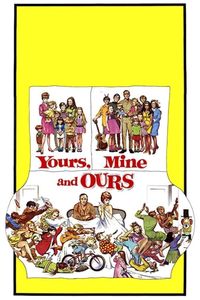
    (On Cable TV, July 2020) It may be based (somewhat) on a true story, but the premise of Yours, Mine and Ours is comic gold: A widower with ten kids meets a widow with eight of her own and, well, chaos ensues. Henry Fonda plays the patriarch, Lucille Ball (aging, but still funny) the matriarch, and an ensemble cast’s worth of 18 kids fills out the rest. The film feels as if it has two halves—a more sedate beginning in which the adults get together, and then a higher comedic pace once the family moves together and modern logistics have to be used to wrestle control over a household of 20. While clearly a mainstream 1960s comedy with the expected exaggerations, minor conflicts and gags, it does have a fair amount of character development and heartfelt emotion toward the end. Yours, Mine and Ours is clearly not a great or refined film, but it does hit its comic targets. While there’s a 2005 remake that may be slicker and more attuned with modern values, this one now has a definitive historic charm to it.

  • Too Many Girls (1940)

    Too Many Girls (1940)

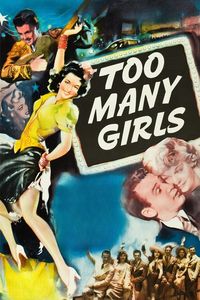
    (On Cable TV, March 2020) In Hollywood history, Too Many Girls usually gets a footnote mention as “the movie where Lucille Ball met Desi Arnaz,” leading to their long and fruitful marriage/partnership. Some commentators often feel compelled to comment in the same breath on the film itself being not good. Well, phooey to that—I’m here to tell you that Too Many Girls is a perfectly entertaining blend of college comedy, implied naughtiness and some football thrown in for good measure—plus the excellent Ann Miller tap-dancing. The premise is something that could have become a splendid 1980s sex comedy: As a millionaire’s daughter (played by a good-but-not-yet-great Lucille Ball) decides to attend a college far in the west, the rich man hires four strapping lads to act as bodyguards unbeknownst to her. Complications ensure when the four young men turn around the winning record of the college’s football team and one of them falls in love with the heiress. While an adaptation of a Broadway Musical, Too Many Girls is curiously forgettable when it comes to the songs and dances. Also not present enough is Ann Miller—while she’s there and performs, she’s clearly in an early-ish supporting role with little opportunity to shine in the spotlight. OK, all right—Too Many Girls is, at best, an average musical of the era for low-budgeted RKO: watchable, even amusing, but not all that memorable. It would be far less fondly remembered (and for that, largely for Ann Miller’s filmography) if Lucy and Desi hadn’t met on set. [April 2022: Being the Ricardos even features a scene meant to recreate the film—complete with what’s supposed to be Ann Miller’s legs!]

    (Second viewing, On Cable TV, March 2021) As a silly college comedy (yup, they had those in the early 1940s!), Too Many Girls is perhaps more interesting for its setting than its content, although it does have an unusual spark to its premise. Everything begins as four ace football players are convinced (somehow, by a billionaire) to let go of a bright college career in order to act as bodyguards/chaperones to his rebellious daughter going to study in the American south-west. What makes the film a bit unusual is the location of the college, and its refusal to stick to Ivy-league atmosphere: “Pottawatomie College” in New Mexico is proudly set in a desert, and the Mexican influence is felt throughout: Too Many Girls is colourful despite being in black-and-white, and Ann Miller plays a character meant to be of Hispanic origins (which mostly consists in letting her curls run wild and calling her “Pepe”) – her signing segments are predictably some of the highlights of the film. Many musical set-pieces take the form of vigorously choreographed crowd dancing, which is not a bad thing at all. The cast does have its attraction as well – other than Miller, who really plays a supporting character, there’s Lucille Ball as the supposedly rebellious daughter (she’s mildly energetic at best), the very likable Desi Arnaz as one of the bodyguards (not the one who romances her, but no matter – in real life, they married two months after the film was released!) Perhaps overly slavish to the original Broadway musical, the plotting sort of loses its way midway through and the ending doesn’t quite satisfy. Too Many Girls is a pleasant-enough time, but there are many ways in which it could have been better: Shooting in colour, letting go of Broadway in order to focus on more cinematic qualities and working on the film’s last half would have been obvious starting points. Still, it’s fun enough, the scenery is a change of pace and the parallels with other, more modern campus comedies are intriguing enough.

  • Without Love (1945)

    Without Love (1945)

    (On Cable TV, January 2020) While Without Love may not be Spencer Tracy and Katharine Hepburn’s finest comedy, it’s not without its share of high points. As a story of two bachelors who marry out of convenience and patriotic duty then truly begin to fall in love, this is not exactly the sharpest premise in the book. But all is in the details, and the pleasantness is largely to be found in small moments, lines of dialogue and seeing both Hepburn and Tracy play off each other. (One very funny scene has Hepburn sneezing in a diver’s helmet.) The setting is hopelessly dated in many ways: much of the plotting is propelled by World War II concerns, something the film inherits from its theatrical origins. For science nerds and theatre geeks in the audience, the film does throw in a few jokes about distracted scientists (which Tracy’s character is), and pre-famous Lucille Ball does show up in an early supporting role. Anyone who champions Hepburn as a sex-symbol should watch Without Love if only for the brief scene in which she turns up with loose curly hair. As for everyone else: the film is fun, funny and ping-pongs between characters who think they’re too intellectual to fall in love, then spend much of the film trying to deny it’s happening. The very abrupt ending is a bit of a surprise—it ends well, but an additional scene may not have hurt. On the other hand, that’s how they often wrapped things up back then—cut to the trailers, and on to the next short comedy.

  • Stage Door (1937)

    Stage Door (1937)

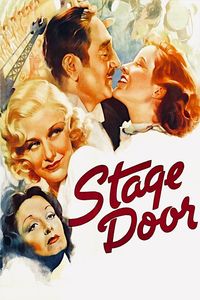
    (On Cable TV, October 2019) The links between Hollywood and Broadway remain an enduring source of fascination, especially in the early years of sound cinema where stage shows could finally be portrayed on film with some fidelity. Consider Stage Door, which takes us to a 1930s boarding house dedicated to young women trying to find a place in showbiz: an ideal environment to feature many young actresses, and to riff on themes of interest to movie audiences without quite talking about movies. To modern viewers, much for the initial attraction of the film will be its cast. Not only do we have Katharine Hepburn, Ginger Rogers, and Lucille Ball in leading roles, but Ann Miller (who was, amazingly only 14 at the time) is unmistakably recognizable in a smaller role. But as Stage Door begins, it’s the quality and the snark of the free-flowing dialogue between the ensemble cast that holds our attention. The women here have fast wits and some of the film’s best moments consist in merely hanging out in the building’s foyer with them as they chat about their careers, their dates and their shared dislike of the house’s food. Hepburn is magnificent as a haughty upper-class girl wanting to make it as an actress and becoming far more sympathetic in the process. She’s not the only one that changes quite a bit along the way, as the film goes from fast-paced comedy to drama somewhere around the beginning of the third act. Despite the sobering (but not entirely unpredictable) shift, that change of pace works rather well and provides to the film a dramatic heft that a purely comedic approach may have lacked. It certainly improves the ultimate impact of the result, with Stage Door surviving admirably well even today.

  • Mame (1974)

    Mame (1974)

    (On Cable TV, April 2019) Seeing the musical remake Mame only two weeks after seeing the original comedy Auntie Mame was clearly not at the 1974 film’s advantage. While the bones of the story have been transported, simplified, heightened, and set to song and dance, the result is far from being as satisfying as even the uneven original, and bring further credence to my assertion that nearly every musical made in the 1970s was terrible. I’ll admit that the story is a difficult one to tell—episodic, scattered across several years, not quite comic throughout—it challenges even the original film. But this adaptation makes it worse. Generations of reviewers have noted how much Lucille Ball is miscast here (critics were so scathing in their initial assessment that it was the last theatrical film that Ball ever made) so I’m not going to pile up. On the other hand, it’s always fun to see Robert Preston show up even in a momentary supporting role. Elsewhere, well, the comedy isn’t funny, the musical numbers feel laborious and the result is more puzzling than exhilarating. I’d like to say that my impressions of Mame would have been higher if I hadn’t just seen Auntie Mame, but I suspect that’s not true—even after acknowledging that it’s a lesser film, it’s obvious that it’s not much of a good one no matter if compared or not.