Maggie Smith

  • The V.I.P.s (1963)

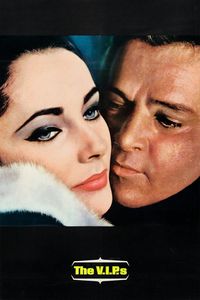
    The V.I.P.s (1963)

    (On Cable TV, May 2021) In the end, I expected too much from The V.I.P.s. Admittedly, it’s easy to be seduced by the all-star cast and the simple premise: As fog envelops London Airport and prevents departures, an ensemble cast of characters has a last chance to resolve their problems. How can you resist a cast headlined by Elizabeth Taylor, Richard Burton, Orson Welles, Maggie Smith, Rod Taylor, Louis Jourdan and many others? But in the execution, the film falls flat — the rhythm is not a match with the sense of urgency that the characters are supposed to feel, the subplots scatter, the drama doesn’t build up and the pieces don’t come together to make something more than a collection of subplots. (Had they added a mad bomber à la Airport, mayyybe we’d have something to pull the strings together.)  The characters aren’t the only ones stuck here — viewers may tap their feet often during the nearly two-hour running time. This being said, it’s not a complete waste of time either — the accumulation of familiar actors has something interesting, and there is at least a minimum of drama going on, even disguised under British restraint. It does, if nothing else, offer the chance to hang out in an elite airline boarding lounge in the early 1960s, which is not a bad privilege. But even that may outstay its welcome in the end.
  • The Pumpkin Eater (1964)

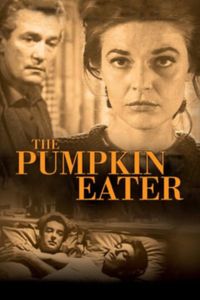
    The Pumpkin Eater (1964)

    (On Cable TV, April 2021) Terrible people generally make for more interesting movies than good dull people, but it’s a fine line in dosing the awfulness of characters and keeping audience sympathy. It’s especially challenging in films that don’t have much else going for them — neorealist black comedies like The Pumpkin Eater featuring a woman with a high-but-unspecified number of kids from three marriages wedded (for the third time) to a man juggling multiple affairs. The pacing is slow, the structure bounces back and forth in time, the epiphanies are small and the characters are more irritating than anything else. Fortunately, there are occasional moments to draw us back in. Cinephiles will have fun seeing James Mason in glasses and a moustache playing an utterly despicable character. Or seeing a young Maggie Smith play the homewrecker (even if the home was self-destructing anyway). Or the fight that triggers the third act. And then there’s Anne Bancroft, who got some critical attention at the film’s release for playing a terrible person, a woman with substantial mental health issues who has kids as a form of self-therapy and otherwise wanders aimlessly through the film. Oh, I’m aware that The Pumpkin Eater can be read on a few levels as a story of a woman forced into a role she did not want — but that hardly excuses the dull, bloodless way the film deals with its material and the almost innate revulsion these characters cause. They are terrible people—maybe not entirely through fault of their own, but they are terrible people. The film will probably be more interesting to those who like to witness self-contained character drama, abstracting notions of “likable” characters. For everyone else, though, The Pumpkin Eater may be a mixed bag.

  • Travels with my Aunt (1972)

    Travels with my Aunt (1972)

    (On Cable TV, September 2020) I’m a big fan of George Cukor and will make a good-faith attempt at watching most of his filmography, but Travels with my Aunt is clearly from the twilight of his career—still amusing, but a clear step down from his previous films. The somewhat convoluted plot has a young shy English gentleman discovering an eccentric aunt during his mother’s funeral, and being manipulated in extensive travels through Europe and eventually Africa in the pursuit of a ransom. Plenty of opportunities come along for him to grow up along the way. He may be the protagonist, but the dominant character of the story is the titular aunt, played with exuberant panache by none other than Maggie Smith. Considering that the story switches back and forth in time between the present-day travels and excerpts from the aunt’s younger wilder days, Smith ends up playing an old version of her character and a really good-looking younger self as well. The effect for modern viewers is delightfully strange, as “old” Smith looks like the one with which we’re most familiar, making the impact of the younger Smith all the more apparent. The complex plot takes us across the continent and to personal growth for the oddball characters, but the way to that point feels loose and indulgent. If you read about the film’s genesis, there’s quite a bit of material there about this being a picaresque episodic novel first, before being adapted for the screen by an uncredited Katherine Hepburn (!) Fortunately, Travels with my Aunt does hold up as a mildly entertaining comedy with a production that obviously travelled as much as its characters did. It’s colourful, light, twisty and fun. Perhaps not as much so as earlier Cukor movies, but you can put it against a lot of other early-1970s New Hollywood productions as an antidote to their dreariness.

  • Hot Millions (1968)

    Hot Millions (1968)

    (On Cable TV, September 2019) I started watching Hot Millions for the dumbest of reasons — The film’s log-line mentioned something about computers, and as an IT professional I’ve developed something of an interest in the depiction of computers in movies. Of course, this is a bit of a bait-and-switch: Hot Millions isn’t about computers as much as it’s a comic caper about an embezzler updating his methods to take on the computer age as represented by the machine at his new workplace. Peter Ustinov is progressively likable as the criminal mastermind, but part of the spotlight also goes to a surprisingly young (and redheaded) Maggie Smith as a love interest who turns out to be a mastermind in her own right. Come for the computer, stay for the laughs—while amiable for most of its duration, Hot Millions does reach its comic streak late in the film with a surprise revelation that makes everything funnier. Otherwise, it’s a decent but not overwhelming film, cute enough to be likable even today, but not one that we’d call a classic for any reason. Still, that’s good enough.

  • A Room with a View (1985)

    A Room with a View (1985)

    (On Cable TV, March 2019) Merchant Ivory films get some flak for being middle-of-the-road filmmaking, often undistinguishable and stuck in a very specific style. That’s largely true … but what that criticism misses is that these are consistently good movies, made with some filmmaking skills and great actors. So it is that A Room with a View feels unimpeachable in its chosen genre—a small masterpiece of gentle atmosphere, where every character is impeccably well mannered, humorous and well spoken. It’s a love story with a happy ending—what more do you want? A superlative cast is up to the material: Maggie Smith, Judi Dench, even Daniel Day Lewis is amusing in a bit of a comic role. Meanwhile, baby-faced Helena Bonham Carter is simply adorable in the lead role while there are very likable roles and performances by Denholm Elliott as Mr. Emerson and Simon Callow as Reverend Beebe. The now-period perspective on a 1908 novel does reinforce its then-daring critique of the Victorian era and wraps it up in a 1980s patina. While humorous, the story is made even more respectable through a lush recreation of an earlier era, perhaps slow paced but with some odd enjoyable notes here and there. As a comedy, A Room with a View feels a bit insubstantial to have been nominated for an Oscar, but then again why not? Merchant and Ivory know what they’re doing and why.

  • The Second Best Exotic Marigold Hotel (2015)

    The Second Best Exotic Marigold Hotel (2015)

    (On TV, April 2017) Perhaps the biggest surprise of The Second Best Exotic Marigold Hotel is how neatly it follows-up on the first film. Despite a few new characters and situations, subplots are carried through, the tone is consistent and nearly every character gets a role to play in the sequel. The film picks up not too long after the first, which means that you can see the two film back-to-back and it will feel like a whole. The portrait of India is pleasantly complicated as the story goes a bit beyond the surface impressions of the first film. Judy Dench once again takes on a substantial role, but the ensemble cast does give substantial characters to Maggie Smith (continuing a solid character arc), Bill Nighy (charming in a role that could have been irritating), Dev Patel and, newly introduced in the series, Richard Gere. While The Second Best Exotic Marigold Hotel is slightly more formulaic than the already schematic original (all the way to climaxing at a wedding), it’s a decent-enough follow-up to the first film—those who were charmed by the first Exotic Marigold Hotel are likely to feel just as pleased with this one.

  • The Best Exotic Marigold Hotel (2011)

    The Best Exotic Marigold Hotel (2011)

    (On Cable TV, April 2017) Ensemble romantic comedies are a dime a dozen, but few of them tackle the topic of retiree romance as well as The Best Exotic Marigold Hotel. While I don’t entirely buy the premise (pensioners moving from Britain to India for their last few years), it does make for a clever way to put familiar characters in new situations. As they navigate the unfamiliarity of modern India, our cast of character grows from their new surroundings, we viewers get a good dose of exoticism and various subplots are left free to develop. A good ensemble casts helps—While Judy Dench and Tom Wilkinson are the standouts here, Bill Nighy manages to make a weak-willed character sympathetic and Maggie Smith gets the difficult role of a stone-cold racist changing her ways after immersion in a foreign culture. Dev Patel also gets a good role as the young Indian man trying to hold a plan together despite the actions of his western guests. Colorful, sympathetic and gently upholding admirable values, The Best Exotic Marigold Hotel is the kind of pleasant surprise that British cinema does so well. It’s not spectacular, but it works well enough.