Malcolm McDowell

  • Caligola [Caligula] (1979)

    (YouTube Streaming, August 2021) Even in the vast universe of wild movies in cinema history, there has never been and will never be anything quite like Caligula. Produced at the end of the 1970s by pornography mogul Bob Guccione with the intention of bridging the mainstream movie world with the “porno chic” movement of the permissive decade, this is a film that has both well-known actors (Malcolm McDowell, Helen Mirren) and pornographic footage. Even knowing all about Caligula’s reputation, I still blinked whenever the X-rated material showed up on-screen, gradually pushing back the familiar limits of what we’re used to seeing on-screen: Nudity: Yes. Erect phalluses: Yes. Graphic Oral Sex: Yes. Full penetration: Yes. Ejaculation: Yes. And that’s not even getting into the far less entertaining gore and violence. But wait, because the film’s production is one for the history books as well. Offering perhaps the purest example of how movies are written thrice, we here have a script by Gore Vidal (!) meaning to explore the concept of total power leading to total corruption, being handed over to exploitation director Tinto Brass meaning to show luridly how a corrupt individual becomes even more corrupt once powerful, being handed over to producer Guccione, who shot the X-rated footage that was then added after the main actors had left the film, blending everything into a bizarre mash-up of sex, violence and some remaining satire. Caligula is fascinating, but it’s not a good film: The many hands that rewrote the film just end up producing an incoherent historical drama with jolts of hard-core sex. On the other hand, it does offer the irresistible trivia that Mirren once starred in a film with unsimulated sex — and she still to this day seems amused by it, which is appropriate considering that her character is probably the most appealing in the film. Still, it’s a surprisingly dull movie, and its length is made even worse by the way the film repeatedly stops to highlight hardcore sex with no relationship to the plot. A unique viewing experience and a wild filmmaking history don’t always end up equalling a good film. The idea that there will never be another film like Caligula is frankly more of a relief than something to mourn. Fun fact: Midway through watching Caligula, the police came knocking at my door… but the explanation (it turns out that leaving a fully-lit garage door open at 1:30 AM in my quiet neighbourhood will get the police to come knocking to ask if everything is all right) is not quite as satisfying as the fun fact itself.

  • The Caller (1987)

    The Caller (1987)

    (On Cable TV, July 2021) The life of an avid cinephile is not always fun — watch too many bad movies in a row, and you’ll start wondering why this is the hobby you’ve chosen. As you make your way out of the list of classics and start working on the rest, you’ll start fearing that you’ve seen all there is to see — that the future is going to be a parade of similar plots, clichés, undistinguishable characters and few surprises. But then there are movies like The Caller to give us hope all over again. To be clear, The Caller is not a big or perfect movie: It’s very nearly a theatrical piece, chiefly concerned with an elaborate cat-and-mouse verbal joust between a woman living alone in a house and a mysterious stranger who intrudes upon her life during one evening. It doesn’t take all that much time for a mysterious fog to permeate the film — the way the two speak to each other is not normal, and there’s clearly more than we’re seeing to their relationship. They overtly speak of murder and give each other points for seeing through their deception. The following day, their intricate dance continues with even more unexplainable exchanges and abnormal behaviour. It’s all compelling stuff, and the repartee here is quite good. The cast is minimal, but Malcolm McDowell brings his usual menace to the role, while Madolyn Smith looks beautiful and gives as good as she gets in the dialogue. You can keep guessing throughout the entire film (I still like my theory of this being extreme role-playing between a kinky couple), but I almost guarantee that when the finale hits, you’ll be still be amazed at it all. Now, I don’t think that the film makes a whole lot of sense when you factor in the conclusion, but there’s a lot more to it than the twist, and even knowing the twist is not enough to distract from the enjoyable moment-by-moment acting joust. The Caller may not even be a particularly good movie but it’s something rarer: a surprise, an original and a reassurance that the world of film is vast and will always contain something new.

  • Time After Time (1979)

    Time After Time (1979)

    (Second viewing, On Cable TV, March 2018) I remember seeing Time After Time as a teenager and liking it quite a lot. A second viewing only confirms that the film is a surprisingly enjoyable time-travel fantasy involving no less than H.G. Wells and Jack the Ripper travelling through time to late-1970s San Francisco. With Malcolm McDowell (as an atypically heroic protagonist), David Warner (as the Ripper) and the ever-radiant Mary Steenburgen as the modern foil for the Victorians visitors. The plot is a big lend of genre elements, but it’s a measure of the success of its execution that even the hackneyed “fish-out-of-water” moments don’t come across as irritating—it helps that Wells’ character is written as a smart person, and so is able to adjust to the environment as quickly as one could manage. The script gets clever in the last act, although maybe not quite as clever as it could have been—it scratches the surface of what’s possible with access to a time machine, but doesn’t really get going with the possibilities. (And I’m still mildly disturbed that one minor sympathetic character is allowed to die and remain dead because she wasn’t the main sympathetic character.)  Still, minor quibbles aside, Time After Time has aged well. The late-seventies San Francisco setting has become a nice period piece, while seeing Wells and Ripper face off is good for a few nice ideological exchanges about the nature of then-modern society. (We haven’t progressed very much in forty years.) Writer/director Nicholas Meyer went on write and direct two of the best Star Trek movies (II and VI) but I’m not sure that he ever topped Time After Time’s blend of suspense, humour and imagination. A strong cast, clever writing and competent directing ensure that Time After Time will remain a good solid genre choice for years to come.

  • Halloween (2007)

    Halloween (2007)

    (In French, On TV, October 2017) I’m really not a fan of slasher movies, horror remakes or the Michael Myers Halloween movies, but even by those low standards, the Halloween remake is a remarkably boring affair. Too bad; I’m an unlikely fan of writer/director Rob Zombie’s music, but his trash-horror sensibilities don’t translate all that well to the screen. In this version of the John Carpenter horror movie, we delve deeper in the screwed-up dynamics of the Myers family leading to the rampage, but this doesn’t provide depth or substance as much as it adds thirty minutes of prologue to an already dull and superficial film. This is one of those horror movies punctuated by gruesome deaths every few minutes—it’s bad enough, but the lack of originality, wit or even decency does much to confirm the film as a soulless remake undistinguishable from so many other cheap horror films. Perhaps the only thing setting it apart from other horror remakes is the copious amount of nudity—alas, usually as a prelude to the butchery. The last half-hour of the film is particularly annoying, as its soundtrack becomes a quasi-nonstop series of female screams as Myers kills almost everyone he sees. Malcolm McDowell makes a decent showing as Doctor Loomis, but the rest of the cast is largely undistinguishable in the small scream-and-get-killed roles that they’re provided. Halloween is hampered by its own antiheroic sensibilities: There is little reason to care about the victims, and trying to humanize an unrepentant mass murderer just isn’t interesting. The result is entirely optional to anyone, including seasoned horror watchers.

  • Blue Thunder (1983)

    Blue Thunder (1983)

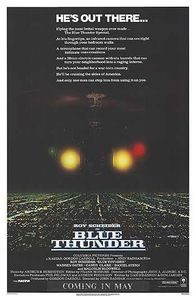
    (On Cable TV, July 2017) You say “dated”, I say “period piece”. You say “techno-thrillers age poorly”, I say, “techno-thrillers preserve the obsessions of the time”. But mostly, I say that Blue Thunder remains far more relevant today than anyone would have expected. It is, for sure, a movie of its exact time: In 1983 Los Angeles, the police force experiments with a high-powered helicopter for crowd control in anticipation of the 1984 Olympic Games. The fancy titular helicopter brings together a package of high technology such as on-demand access to police databases, pervasive surveillance technology, stealth features, deadly weaponry and primitive augmented-reality targeting. Hot stuff—even if today, you could get nearly everything in that list in your average phone save for the weaponry. If the evolution of technology in older movies fascinates you, then Blue Thunder ought to be on your list of movies to watch given how clearly it exploits 1983’s cutting-edge … yet has quite a bit of relevance to today’s hot-button topics of government intrusion in private lives, and indiscriminate targeting of civilians in the name of security. You may want to ignore the plot along the way, though, given how many contrivances are required to set up the action sequences. On the other hand, come for the technology and stay for the action sequences, because Blue Thunder does eventually work its way to a spectacular prolonged action sequence above the skies of downtown Los Angeles, between helicopters and military jets, buildings and police cars. Director John Badham shows his mastery of action sequences here, to the point where they still compare well to contemporary movies. Roy Scheider is sympathetic enough as the protagonist, while Malcolm McDowell almost earns hissing as the villain. I expect a drone-centric remake any time soon. In the meantime, Blue Thunder is well worth revisiting, both for what it has to say (usually against its titular helicopter) and for the way it illustrates its message with well-executed action sequences.

  • How to Make Love Like an Englishman aka Some Kind of Beautiful (2014)

    How to Make Love Like an Englishman aka Some Kind of Beautiful (2014)

    (Video on Demand, August 2015) Despite its rather saucy title, How To Make Love Like an Englishman (retitled to the much blander Some Kind of Beautiful in the United States) is a fairly mild-mannered romantic comedy, albeit with some amazingly ill-conceived moments.  Featuring Pierce Brosnan in a role that superficially looks like a vanity project (he’s listed as an executive producer), this is a film that asks you to sympathize with an older booze-pickled academic lothario who moves to California to be with his unplanned child’s mom, even after she kicks him out to the pool-house (which is more luxurious than most main dwellings) and takes up with another man.  Ludicrous complications ensue, from his falling for his ex-partner’s older sister, being arrested for DUI, being deported and then sneaking back in US soil among Mexican illegals… it’s really hard to figure out why the script does what it does, but the result is both charming and creepy at the same time: Anyone else but Brosnan in the role would have made the film fail loudly.  Even as it is, it’s hard to know whether we should be laughing or cringing: How To Make Love Like an Englishman embraces the lovable-alcoholic trope far too long, even after it’s proven to be actively dangerous to other characters.  It also seems to live in a genial Neverland of strange human emotions and fairy-tale California sets never to be experienced by us humble viewers.  At least Brosnan has a bit of slimy adulterer’s charm, while Salma Hayek gets to play sexy for a while and Malcolm McDowell is the ideal crusty father-figure.  (Poor Jessica Alba doesn’t get much to do, though.)  There are a few genuinely amusing sequences; others are just puzzling.  The result is all over the place, including some genuine head-scratching moments.  There may be weirder romantic comedies out there at the moment, but contemplating this one is more than enough.

  • Tank Girl (1995)

    Tank Girl (1995)

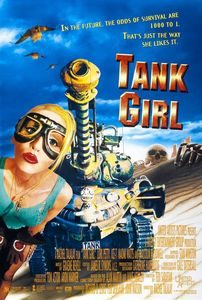
    (On TV, August 2013) I’m not sure how I went so long without seeing this oddball take on post-apocalyptic science-fiction, but I can say that while the film is uneven, it’s striking enough.  Lori Petty stars as the titular Tank Girl, an irrepressible punk-inspired heroine battling against an evil monopoly with designs on all remaining water in the world.  It’s not meant to be realistic: adapted from a comic book series, Tank Girl keeps, even today, a manic energy exemplified by energetic editing, unusual scene transition, caricatures in lieu of characters and a one-liner-spouting heroine that never has a moment of self-doubt.  That last never-say-die attitude eventually grates, as it’s hard to tell braggadocio from brain damage.  Still, Tank Girl (a rare SF film directed by a woman, in this case Rachel Talalay) has its share of odd and unique moments, whether it’s a sudden musical number, a heavy-metal-riffed tank-customization sequence or terrible kangaroo-human makeup.  Petti can be curiously sexy at times (when she’s not being annoying –no mean feat), but from a contemporary perspective the most interesting performances belong to Malcolm McDowell as an over-the-top villain, Naomi Watts as unglamorous “Jet Girl” and what appears to be a self-loathing Ice-T in a role best left undiscussed.  The films gets more strident and less interesting the longer it goes on, so this is one of those where if you feel the need to stop, it’s probably best that you do so immediately.  Still, Tank Girl remains worthy of a look for fans of cult cinema.