
Mandy Patinkin

  • Before You Know It (2019)

    Before You Know It (2019)

    (On Cable TV, February 2021) If we’re going to chat about movie genre, let’s have a bit of a discussion about how “indie dramedy” has become a genre and how its stylistic quirks often work against itself. Case in point: Before You Know It, a low-budget family melodrama that wastes a good premise, a fascinating atmosphere and some good actors with a script more interested in pointless and irritating tricks than telling a story in a credible fashion. Set in the intriguing world of early 1990s Manhattan showbiz, it features a level-headed woman trying to manage a family-owned off-Broadway theater despite the loopy flights of fancy of a has-been playwright father, an absent mother and a whimsical sister. Things come to a boil when the father dies and the two sisters discover that their mother, long believed dead, is a successful soap opera actress who actually owns the building they live in (and its associated debts). So far so good, and once you throw in the acting talent of Mandy Patinkin as the father, Jen Tullock as a flighty sister (who steals pretty much every single scene she’s in) and Hannah Pearl Utt (who also directs) as the level-headed protagonist, you can reasonably expect something interesting. Alas, the script seems determined to be too cute — even considering the grief and lack of common sense from its over-dramatic characters, some fundamental plot points are manipulated beyond reason, revealing the artifice of the script. (You’d think that “Hey, Dad is dead” would be the first thing a grieving daughter would tell her mother, but the manipulative script somehow doesn’t get around to it until much later. You’d also think that a mom would keep an eye on her daughter while she’s gallivanting around town, but then again: manipulative script). To the dubious plotting, we can also add some irritating character touches: There are at least two hideous examples of terrible parenting here, and neither quite get the scrutiny that you’d expect (but then again: see manipulative script). It doesn’t help that in-keeping with much indie dramedy, Before You Know It thinks that “comedy equals discomfort” — nearly all of its decisions seem designed to annoy audiences, and there’s a limit to the effectiveness of that specific artistic intention. Given that Utt and Tullock co-wrote the script, there’s not a lot of wiggle room to blame some unseen screenwriter or studio interference: this is the film they wanted, notwithstanding production constraints. A less slavish adherence to the quirks of indie dramedy could have polished most of the roughest edges of the result — as it is, it’s simply too irritating to do justice to its likable stars, or to showcase what Utt and Tullock can do on the page or behind the camera.
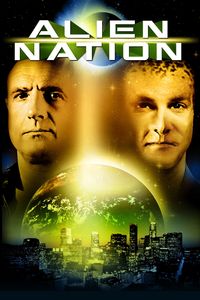
  • Alien Nation (1988)

    Alien Nation (1988)

    (In French, On Cable TV, August 2020) The Science Fiction genre has a long history (especially in print) of using murder mystery narratives in order to illustrate a future society: it’s a great way to examine what makes a society tick, allow the detectives to meet various people and show a science-fictional device as a wrinkle in the investigation or the crime. Conversely, Hollywood has an equally long history of using science-fictional environment as mere backdrop for a thoroughly ordinary plot that could have worked just as well in contemporary settings. The difference between the two is subtle but significant: in one case, the plot enhances the genre, while in the other the plot is irrelevant to the genre. Seasoned SF fans clearly prefer the first—there’s even a dismissive expression from the Turkey City Lexicon, “Abbess phone home” to call Science Fiction that could have been anything else. Alien Nation straddles the line between the two in such a way that can often look like one or the other. One way of looking at it is that Alien Nation takes us in a decently imagined “near future” of 1988, in which a ship of aliens has landed on Earth and been assimilated in American society. They have their own language, biology and physical capabilities, and much of the film’s first half-hour is spent illustrating those changes through the early stages of a murder investigation, complicated by the pairing of the first alien policeman with an investigator (James Caan) resentful since aliens killed his partner. The metaphor for immigrant integration really isn’t subtle here, from the title onward. Still, that first half-hour is probably the most interesting thing about Alien Nation, as the aliens have their own alphabet and language, live in ghettos (with their own strip clubs), and love drinking sour milk recreationally. But then the film loses interest in taking refuge in “ordinary story labelled SF” territory: The mismatched-cop duo clearly cribs from racial integration films, and as the story advances, we’re left with a cops-against-a-monster conclusion that strips away nearly anything that had been interesting about earlier worldbuilding. (Not to mention basic questions: why would an alien species so vulnerable to saltwater choose to stay in a coastal town?) At least Caan has a decent role as the human cop, while Mandy Patinkin is unrecognizable as his alien partner. You can gauge the interest of Alien Nation’s premise and underlying concept in the long list of TV movies and novels that were produced as spinoff—the idea was so good that it couldn’t be left alone. But the film itself merely achieves a middle-of-the-road cop drama and nothing more. That’s not too bad, but it could have been better.

  • Yentl (1983)

    Yentl (1983)

    (Criterion Streaming, January 2020) So, Barbra Streisand dressing up as a boy is… curiously sexy? I didn’t have that on my list of expectations in tackling Yentl. [August 2020: Oh, and now there’s Seth Rogen making the same joke in An American Pickle…] It’s a surprising film in many ways—as the story of a Jewish girl who crossdresses in order to gain an education reserved for men in 1904 Poland, you would be right to expect a fairly maudlin tale with little entertainment to it. But the result, co-written and directed by Streisand herself, is a lot more than the pat drama you could expect—it’s got humour, intensity, musical numbers (although not that memorable), a pivotal revelation scene, a young Mandy Patinkin and what feels like an education in Jewish culture. Plus, Streisand is looking far too attractive with short hair, although I’ll note that since Streisand remained a significant screen beauty from the mid-1960s to well into the 1990s, it’s not that unexpected of a turn here. No, the real surprise is that Yentl is surprisingly watchable—far lighter on its feel than you’d expect for a labour of love fifteen years in the making, and yet dense with thematic material. I don’t exactly love it, but I found it far more interesting than I expected.

  • Wonder (2017)

    Wonder (2017)

    (On Cable TV, October 2018) Frankly, I expected much worse from Wonder after seeing its rather misleading trailer. To believe the coming attraction, we have to brace ourselves for an entire film’s worth of seeing a facially disfigured boy trying to fit at a new school. But, as we know, trailers lie—or at least misdirect, because even if the film is about a facially disfigured boy’s adventures in fitting at his new school, it’s also quite a bit more than that, and in this case the subplots are what keeps the film interesting beyond its predictable premise. Wonder soon becomes about the boy’s entire family as they, too, experience that first year in school in their own way. There’s nothing truly earth-shattering here, and one of the mildest surprises of the film is how easy it goes on the inevitable scenes of cruelty and abuse by the boy’s schoolmates. The result is one of relief, as the film remains rather gentle and sympathetic in its approach. Jacob Tremblay continues to impress in the lead role, while other notables such as Owen Wilson, Mandy Patinkin and Julia Roberts take supporting roles in a youth-focused film. As a result, Wonder remains an enjoyable film … even for jaded curmudgeonly critics such as myself.