Marie Wilson

  • Boy Meets Girl (1938)

    Boy Meets Girl (1938)

    (On Cable TV, May 2021) I have a fondness for Hollywood movies satirizing Hollywood, but the ones from the 1930s will always have a special place in my heart — Hollywood was still giddy about itself back then, and a bunch of urbane screenwriters were still having fun selling the Dream Factory to the rest of America. Boy Meets Girl (while not strictly meeting the definition of Hollywood-spoofing-Hollywood, being an adaptation of a Broadway play) is one of the better such films of the era, thanks to its witty dialogue, jaded-but-not-cynical approach and having James Cagney in the lead role. Our two protagonists are screenwriters trying to keep their studio job while helping out a pregnant woman, and the film’s stage-bound origins can best be deduced by the number of sequences set in the studio executive’s office. The chaotic humour here is as fast as Cagney’s ability to rattle off dialogue, and the best moments of the film are impromptu improv sessions in which Cagney and his writing partner (Pat O’Brien, gamely keeping up) create new—if repetitive—variations on the old “boy meets girl” story. It’s all in good fun, with a fake over-the-top trailer clearly showing the film’s satirical bend. Marie Wilson is nothing short of adorable as the pregnant young woman that the protagonists are trying to help — and, more importantly, the beacon of sanity that makes the manic energy of the rest of the film mean something. Even acknowledging that I’m an easy audience for this kind of material, Boy Meets Girl is still a lot of fun to watch.
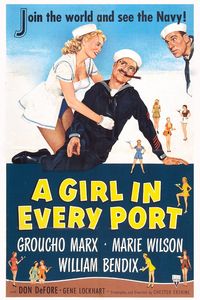
  • A Girl in Every Port (1952)

    A Girl in Every Port (1952)

    (On Cable TV, October 2020) My answer to “Which Marx Brother do you find the funniest?” is immediate, constant and definitive: Groucho, always Groucho. His typical verbal wit is my kind of humour, and he was, to me, always the highlight of any of the Brothers’ movies. A Girl in Every Port is something slightly different, as we have Groucho without his brothers playing a sailor who gets embroiled in racehorse schemes while his ship is stationed in town. At no less than sixty-two at the film of the film’s release, Groucho is easily a few decades older than his character, but those (along with the painted-on moustache) are the conventions we have to play with if the film is to make any sense. The script is willing to complicate and overcomplicate its own fraudulent schemes until even the characters comment on easier ways of doing things. (But the gag of a horse being helped on a warship is worth it.) The result isn’t all that funny, but it’s amusing enough, and a welcome opportunity to have Groucho go for one of his last starring movie roles. Groucho himself may not hit any peaks of verbal humour, but he breaks the fourth wall quite a bit, and he gets his laughs. Don DeFore anchors the film as the henpecked victim of the scams, while Marie Wilson provides the romantic interest. Notably an early Irwin Allen production, A Girl in Every Port is probably best suited for Groucho fans and those who have the patience for an average comedy. But it’s fun all right, and who can resist Groucho commenting to the audience on the unlikeliness of his own movie’s plot?