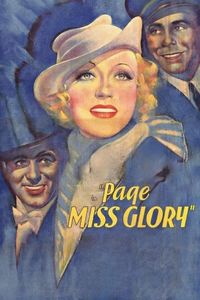
Page Miss Glory (1935)
(On Cable TV, February 2021) While I like 1930s comedies a lot more than you’d think, an issue I’m noticing from those films is that they are frequently featureless from an audiovisual perspective compared to later movies. This is not a criticism — more an acknowledgement that technical means being limited at that time, 1930s films work within a narrow range of audiovisual constraints, something that can be further throttled by films that have not been (or cannot be) restored. It’s almost all black and while, or rather shades of gray with very little dynamic range. The audio is usually scratchy, with very little range between the highs and the lows. Soundtracks are usually made of classical music pieces with few variations. The result, unfortunately, means that movies of that era will not catch your eyes and ears as well as later films — if you happen to be distracted, the film will not draw you back in through an arresting colour scheme, flashing lights, loud noises, catchy songs or any of the techniques that decades of filmmaking have perfected. I’m bringing this up regarding Page Miss Glory not only as an example of a widespread issue, but also to explain why, despite a promising plot in which a made-up star has to be played by a real person, the film had a really hard time keeping my attention. There’s no real reason, from a script-centric point of view, why it should be so: the story itself still has some originality, the stars are fine (including Marion Davies, Pat O’Brien and Dick Powell), director Mervyn LeRoy’s work is adequate for the time… but the film itself seems to flitter away at the slightest distraction. I could, I suppose, watch Page Miss Glory again under the strictest constraints to give it my full attention. Or I could just complain about its relative flatness.