Mark Robson

  • I Want You (1951)

    (On Cable TV, December 2021) There’s a clever double sense to I Want You’s title that hints at its dual nature — an expression of romance, of course, but also an exhortation to enlist: “I want you for U.S. Army,” says Uncle Sam. And that, in a nutshell, is what the film is about — small-town romantic drama as the Korean War heats up and American men are once again asked to go back into combat despite knowing exactly what this means this time around. This film is very much of its time, and that’s perhaps what’s most interesting about it: it’s a slice-of-life dramatization of what must have been an overwhelming topic of conversation across American circa 1950 and the film’s decidedly low-key approach makes it feel more convincing than an overblown melodramatic approach. Director Mark Robson can depend on decent performers (Dana Andrews and Dorothy McGuire in the lead) to get the film’s rather delicate drama across. It’s probably not the kind of film that you want to sit down for thrills and laughs, but it’s a remarkable film for its own specific reasons — capturing America at a specific time, not a dramatic one but still a pivotal one.

  • Avalanche Express (1979)

    (On Cable TV, September 2021) It’s fun to go back to Cold War thrillers and experience the paranoia of the time. The era is rife with movies in which the heroes are clearly Americans and the villains are clearly Soviets, with no less than a credible nuclear war hanging in the balance. Seldom have the spy-versus-spy tropes been so complex and variations so elaborate. In Avalanche Express, a familiar starting point veers into a somewhat original premise, as an important defector is put on a transcontinental train going to western Europe, and the Soviet empire targets the train to eliminate the defector by all means necessary, all the way to causing an avalanche. The existence of such a train is nonsense, and so is much of the plot — but it’s the thrills that count. Accordingly, there are a few good elements at play here: The premise has juice, the cast is led by Lee Marvin’s exemplary tough-guy persona, and you can see here the elements that could have been used for a strong film. Unfortunately, the execution doesn’t quite match the early expectations. Once past the necessary bits of plotting required to get everyone aboard the train or in pursuit of it, the joy very quickly goes out of Avalanche Express. Some of the incoherence comes from production issues: both director Mark Robson and star Robert Shaw died during the making of the film, and we can only imagine what impact that must have had on the production. Other issues, though, are more fundamental to the screenplay: There’s a useless romance, for instance, that gums up the pacing of the film. The various incidents across the train trip are not very well structured, and for all of the good-for-their-time special effects used for the avalanche sequence (which is, surprisingly, not the climax of the film), the sequence itself isn’t particularly exciting. Of course, we’re looking at this from the perspective of audiences used to decades of technical refinements — a modern version of Avalanche Express (not a bad idea!) would use digital effects and time-tested structure. But even contemporary films did better with similar elements — I’m specifically thinking of Von Ryan’s Express, from the same director fifteen years earlier, which crammed a lot more characterization and action out of a train-bound journey. Even the final shootout seems curiously anticlimactic, visually flat and dramatically inert. Too bad — I think that there’s a better movie trying to get out of Avalanche Express. It’s just a shame that we couldn’t get it.
  • The Harder They Fall (1956)

    The Harder They Fall (1956)

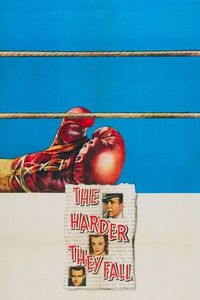
    (On Cable TV, July 2021) Even if The Harder They Fall doesn’t feature guns, femmes fatales, violent crime or private investigators, there is absolutely no doubt that it is a film noir, and that’s part of why it remains so interesting. Let’s see: Humphrey Bogart (in his last movie before his death), boxing (and the violence of it), corruption both of the system (in showing a series of fixed matches meant to promote an incompetent boxer) and of the individual (in having the protagonist help create the deception), organized crime (touch your nose and grab your ear), great black-and-white cinematography, and a hard-nosed tone suggesting that the real world is much seedier than most movies. Bogart doesn’t play a man of action, but as a former sports columnist his character understands better than most the darkness that lies behind the façade of boxing, especially when he’s asked to create the illusion of a heavyweight contender from a big but unskilled Argentinian. There’s an elusive but solid narrative drive to the results, helped along with a wealth of credible details. The Harder They Fall has aged amazingly well in becoming a time capsule of mid-1950s boxing corruption — the numerous exterior shots featuring Bogart walking down the streets of Manhattan are almost worth watching the movie by themselves. If you do a bit of research on the film’s boxing figures, you’ll find out that at least two roles are essentially two boxers playing themselves — something that audiences would have known in 1956 but not in 2021. Still, there’s no denying the effectiveness of the result even today—Director Mark Robson keeps things moving, and the boxing scenes are still surprisingly effective. I’ve seen quite a few boxing movies, but few are as scathing about the sport as The Harder They Fall — and few are as interesting either.

  • Peyton Place (1957)

    Peyton Place (1957)

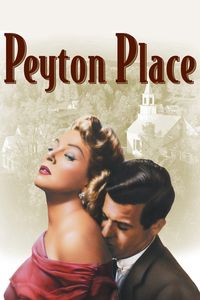
    (On Cable TV, February 2020) I’m not sure it’s possible to put ourselves in the same frame of mind in which audiences first took in Peyton Place. It was the late 1950s, after all, a time at which American society barely started to acknowledge the rampant dysfunction behind its picture-perfect façade. The previous year, Grace Metalious’s novel had become a publishing sensation by acknowledging the rot to be found in small towns, and the film had to tone down or remove much of that material. What remained, however, was enough to create some amount of controversy even at the twilight of the Hays Code era. Of course, we’ve seen much—much—worse since then, and going back to Peyton Place with a modern mindset is closer to “well, what did you expect?” as the town’s sordid secrets are exposed at a time when few took familial abuse seriously. Alas, the result suffers. The film is both far too long at 162 minutes and now too tame to be entirely interesting. Despite the good sequences to be found here and there (most notably Lloyd Nolan as a town-castigating doctor), much of it feels like the talky melodrama it was meant to be. Lana Turner is good in the lead role, but this is really an ensemble cast. The Technicolor cinematography brings a distinctive sheen to the movie, but Mark Robson’s flat direction doesn’t really lead to any cinematographic distinction. I found Peyton Place substantially dull, but then again– I acknowledge that you really can’t perceive the film as audiences did back then.