Marlee Matlin

  • Dead Silence (1997)

    (On TV, November 2021) As far as low-budget made-for-TV thrillers go, there’s something halfway interesting in Dead Silence. After all, this is about psychopathic criminals taking a busload of deaf children hostage in a farm, as the police surround the area and negotiations begin. The disability angle adds interest to what would otherwise be a rather run-of-the-mill thriller. Casting adds some more as well, with veteran James Garner playing the lead hostage negotiator and Marlee Matlin as a schoolteacher. The low-budget imperatives of the film create a nicely restrained setting around the farm. The last element of note is a wild third-act swerve that creates more questions than it answers, but makes for a sudden late burst of energy in a film that needed it. The result is still not all that good, but it is not quite as bland as it could have been — the proof being that Dead Silence is still playing on TV twenty-five years later, even if on a Canadian channel focused on accessibility issues.

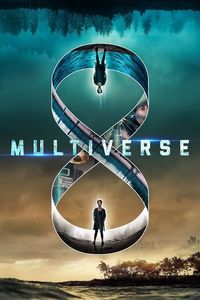
  • Entangled aka Multiverse (2019)

    Entangled aka Multiverse (2019)

    (On Cable TV, February 2020) There are at least two low-budget 2019 films called Entangled—this one is the Canadian Science Fiction thriller featuring four students of “anomalous science” who end up creating a strange quantum entanglement phenomenon that eventually comes to haunt them after an untimely death. Obviously shot in Sudbury (which is quickly emerging as a Canadian Science Fiction film powerhouse—I’m coining Sudburypunk right now), it’s a low-budget, small-cast, limited-scope kind of science fiction film, rather charming in dealing with its own limitations. The film’s colour palette most often seems to be shades of dour blue, which applies to the plot as well: Our amateur mad scientists are not all sane, and when strange events (which we quickly deduct to be parallel universe doppelgangers) start happening, it’s clear that they’re not all going to react rationally. This is probably the weakest part of the story—there was quite enough here in the premise without throwing in a human antagonist as well, but that’s how the script goes. Entangled does a bit better on the execution front—the cinematography reinforces its themes of duplication by making heavy use of mirrors. I’m paying attention to director Gaurav Seth: After the rather good Prisoner X and now Entangled, he seems to be emerging as a significant talent for Canadian genre cinema. Marlee Matlin shows up in a small role as the mother of one character, with her deafness weaved into the story. I’m not entirely happy with the ending that feels both obvious in some ways and willfully obtuse in others, but the result is more interesting than most movies in the Science Fiction genre these days, and I’m not going to be overly critical of a low-budget Canadian feature shot in my area of the continent. It will appeal to fans of more cerebral SF, along the lines of the comparable Radius, Time Freak, I’ll Follow You Down, Volition or James vs his Future Self—many of them also shot in Sudbury. Sudburypunk!

  • Children of a Lesser God (1986)

    Children of a Lesser God (1986)

    (On Cable TV, October 2019) I’m not entirely convinced that romance has anything new to tell us, but sometimes it’s all in the context and that’s where Children of a Lesser God succeeds brilliantly. Romantic dramas about mismatched lovers trying to work out their differences are a dime a dozen, but even thirty-five years later the setting of this film still stands out: taking place at a school for deaf children, it follows a young energetic teacher as he meets his students and develops feelings for the antisocial janitor, an attractive alumnus of the school who refuses to talk out of past trauma. Setting can be a character of its own, and the fascination exerted by Children of a Lesser God quickly develops from learning about an entirely different world set alongside our own. As our guide in this world, John Hurt has the ingrate task of explaining to hearing audiences what’s going on (through his constant audible translation of signed language), even during intensely intimate moments. Opposite him, however, is the formidable Marlee Matlin, who steals the entire film in a ferocious, layered, compelling performance. Far from being merely a love interest, she plays a fully formed character defined by far many other things than her deafness. She deservedly walked away with an Oscar for her role, and it’s easy to see why even today: this is a performance that, for many, still redefines the frame that we use to evaluate good acting. In between the subject matter and Maltin’s performance, it’s easy to see why Children of a Lesser God remains a striking film even today.

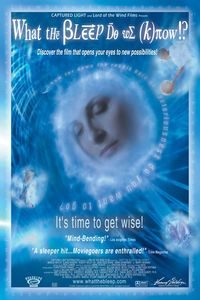
  • What the #$*! Do We (K)now!? (2004)

    What the #$*! Do We (K)now!? (2004)

    (In theaters, January 2005) This is a very frustrating film, one that drove me from one extreme to another in mere seconds. On the surface, it tries to be an metaphysical exploration of the limits of contemporary science, wrapped in a fictional frame story that leads off to interviews with experts. Fine. And, indeed, in some respects the film does an amazing job at presenting aspects of quantum physics in ways to make any science geek cheer in recognition. Time and time again, the film has a line or two that made me want to squeal little satisfied glees of agreement. And as long as it keeps this “isn’t it neat?” attitude, as long as it keeps up the pretence that we’re just joshing around with stuff we’re beginning to understand, there’s nothing wrong here. But then there is the other stuff. The framing story (featuring a lovely Marlee Matlin) is hit-and-miss: The beginning is painful, as it laboriously sets up its own set of visual metaphors and emotional triggers. The mid-point wedding sequence is good fun, as all the set-up pays off, and the party really gets going once the accordion is unleashed. Unfortunately, it soon bogs down under the weight of its growing self-importance, a problem that is shared by the entire film as a whole. You see, What The Bleep Do We Know? soon leaves amused scientific speculation to turns into yet another new-age “what you wish for will become true” crapfest. The interviewee’s identity are kept hidden until the end for a good reason: At least one of them is a crackpot guru with no scientific credentials; many of the rest are also heavily into the woo-woo stuff. (Too bad: I liked Fred Alan Wolf’s kindly-mad-scientist shtick) And that, in turn, explains the various moments in the film where you go “What? That doesn’t make sense!” It gets progressively more painful as the film descends into hard-core “science says wishful thinking is real!” nonsense. I can deal with limited amounts of “what if?” thinking, but this soon turns into “as if!” stuff. Pure frustration, and you know what? Real honest scientific speculation, the kind that doesn’t require feel-good new-age nonsense, is even more wonderful that this stuff.