Marsha Hunt

  • Seven Sweethearts (1942)

    Seven Sweethearts (1942)

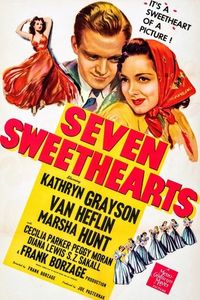
    (On Cable TV, August 2021) Sometimes, you don’t need plot as much as a few likable actors playing to their persona. Ask me in a few weeks about the plot of Seven Sweethearts and I’m liable to blurt something about a father wanting to marry his seven daughters in chronological order, largely dependent on the film’s log-line. But I’ll be far more voluble about what fun it is to see Van Heflin as a young romantic lead going up against S. Z. Sakall as the marrying dad and the rather wonderful ensemble of young women (including leads Kathryn Grayson and Marsha Hunt) that make up the seven titular daughters. It’s all rather cute and fun if you make it past the film’s strong paternalism, with a rather comforting embrace of middle-western values, decent work by actors playing in their wheelhouse (most especially Sakall, clearly enjoying playing a patriarch), some local Dutch-American atmosphere (it all takes place in a small town with a significant Dutch-born population and a big tulip festival) and a happy ending that is never, ever in doubt. You can see why it would play well in an anxious America then plunged into war. A few musical numbers integrated in the action help this reach musical fans, with the romance and character work doing the rest. Seven Sweetheats is not a great or particularly memorable movie by any means, but it’s pleasant enough to make anyone smile.

  • Howling II: Stirba—Werewolf Bitch aka Howling II… Your Sister Is a Werewolf (1985)

    (In French, On Cable TV, August 2021) I’m not going to claim that werewolf thriller The Howling is a wonderful movie (I found it a bit dull), but it’s vastly more ambitious than this lazy attempt at a sequel, which heads almost immediately from Los Angeles to the cheaper shooting realms of eastern Europe for a mixture of folk horror, bland leads, vampire-inspired plot elements and people in hairy makeup passing themselves as werewolves. Fortunately, Christopher Lee is here to keep our interest as a werewolf hunter— but he can’t be in every scene of the film when he’s in a supporting role. There’s quite a bit of sex and nudity here, with no one claiming that it’s there for artistic merit: it’s very much in the exploitation vein all the way to an end-credit sequence in which the same shot of an actress baring her chest is repeated seventeen times in-between reaction shots of other characters taken from elsewhere in the film. If that’s not damning enough, I’m not sure what is. (B-movie queen Sybil Danning reportedly limited filmmakers to one nude shot as per her contract, and that’s what they did with it.)  It does give Howling II a crass and dirty feel — while the East European shooting location does allow the film to punch above its weight in terms of visuals, the script is the same kind of tripe that low-end horror sequels did so often in the 1980s. It’s not, to be fair, actively painful to watch: there’s a ridiculousness to it that makes up some unintended entertainment, the main song is catchy, the actresses are attractive (if you dig a bit, the film will give you a splendid excuse to read all about the extraordinary life of Marsha Hunt, of The Rolling Stones’ “Brown Sugar” fame) and even a performance by Lee in a terrible film is something to be appreciated.

  • The Affairs of Martha (1942)

    The Affairs of Martha (1942)

    (On Cable TV, February 2021) While I’m reasonably happy with The Affairs of Martha, I can’t help but think that this is a film that leaves a lot of material on the table, and I can’t help but wonder how much better it could have been had it been made twenty years later. The premise itself is fun but unfulfilled: What if the elite set of Long Island starting fretting about the announcement of a tell-all book written by an unnamed servant girl of theirs? Much of the film’s comic potential is explored early on, as both the upper-class gets concerned, and the comfortable servant class also finds the development alarming. (“I’ve spent years getting my employer where I want her!” complains one of the veterans of the trade.)  There’s some bite to the opening moments, but it doesn’t really go anywhere — soon enough, the romantic comedy gets underway and nearly forgets about the opening premise. To be fair, the romantic complications that pile up do make for a serviceable film: as an heir to an upper-class family comes back from an expedition with a fiancée in tow, his previous marriage to a servant (the unknown author of the tell-all book!) comes back to make a mess of everyone’s plans. It pretty much ends up like you’d like to, but the class-division aspect takes a much smaller role than announced by the opening minutes. (Especially when the servant doesn’t have anything bad to say about her experience!)  Still, Marsha Hunt is lovely as Martha, Richard Carlson makes for a likable romantic lead, and there’s a lot to like about Virginia Weidler’s performance as a bratty too-smart teenager. (This was a kind of role that Weidler played a lot during her short Hollywood career, and you can look at her turn in The Philadelphia Story as another exemplary instance of that persona.)  The film doesn’t overstay its welcome despite shifting gears early on. The one strangely amusing note here is noticing that the film is an early effort from Jules Dassin, who would become far better known for hard-edged noir thriller in the late 1940s and then (due to the Hollywood Blacklist) be exiled in France, where he’d become famous for legendary crime thrillers. You can find distant echoes of The Affairs of Martha in more modern class-concerned fare such as The Devil Wears Prada or The Nanny Diaries, but I still think that it missed an opportunity to be far more striking.

  • Marsha Hunt’s Sweet Adversity (2015)

    Marsha Hunt’s Sweet Adversity (2015)

    (On Cable TV, December 2020) Hollywood documentaries are often made about the immensely successful, to cap decades of stardom. Others are made about those who died too young. And then there’s the third category, of actors who left the business, not necessarily on their own terms, and found rich rewarding lives away from the cameras. Marsha Hunt certainly fits that third category, as described in Marsha Hunt’s Sweet Adversity: After a substantial fifteen-year career in Hollywood, she moved to television… and got targeted by the Hollywood blacklist of the early 1950s. Her Hollywood career effectively cut short, she first turned to Broadway or travelling troupes and eventually to philanthropy to become a humanitarian activist on behalf of the United Nations, highlighting various causes and gathering support from entertainment-industry friends. (There’s an interesting contrast here with other creatives whose Hollywood stars dimmed and often ended up in miserable circumstances: Hunt was not abusing substances, didn’t have mental health issues and remained a hard worker no matter the circumstances – which explains how she kept working and remained in generally good spirits throughout the rest of her life.) It’s quite an admirable life, and Marsha Hunt’s Sweet Adversity does what it can to convey it. Alas, the material is often better than the filmmaking skill bringing it to the screen: this is a low-budget presentation and the blunt way the material is delivered doesn’t always do justice to its subject. Still, even knowing the story of her post-Hollywood career can be enough. It’s possible to watch Hunt’s classic movies and wonder at her talent and sex appeal, but you really have to watch Sweet Adversity to understand one of the best second acts in Hollywood history, even if it happened away from Hollywood.

  • Pride and Prejudice (1940)

    Pride and Prejudice (1940)

    (On Cable TV, February 2020) One of the appealing characteristics of Jane Austen’s Pride and Prejudice is how it charmed readers and filmmakers throughout generations, meaning that we can compare and contrast adaptions dating back to early Hollywood history. Now, there are Austen devotees that can give you lengthy explanations about the merits and issues of the 1940 version of Pride and Prejudice with far more detail and passion than I can. I’ll do my own best by underlining the cast (the lovely Greer Garson and Laurence Olivier in the lead role, with notables such as Edna May Olvier and Marsha Hunt in supporting roles), the lavish nature of the MGM production and the fact that none other than Brave New World’s Aldous Huxley contributed to the screenplay. It’s not necessarily a problem if the costumes here are all about the 1940s conception of a historical drama than actually being exact to the period—it’s the kind of thing that adds to the charm of a particular take on the material. Most importantly, Austen’s bon mots and comedy of manners have been adapted rather well to the screen, creating not only a hit back then, but also a nice little classic adaptation that still holds its own against more modern takes on the same source material.