Martin Ritt

  • The Spy Who Came in from the Cold (1965)

    The Spy Who Came in from the Cold (1965)

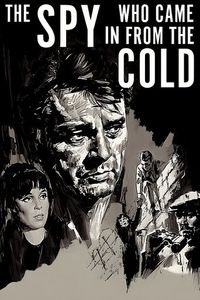
    (Criterion Streaming, August 2021) I used to dislike John Le Carré’s stories when I was younger, but I’m apparently somehow growing up because I have enjoyed his movie adaptations a lot more in the past decade or so, and The Spy Who Came in from the Cold goes join Tinker Tailor Soldier Spy and The Constant Gardener in the big list of great spy movies. Newcomers should know that Le Carré isn’t writing James Bond escapism — his perspective on the spy business (as a former practitioner) is jaded, wary, even exasperated. He often talks contemptuously about the “little grey men” of the secret service as bureaucrats with delusions of heroism in a sordid business that means far less than everyone thinks. This world-weariness is on full display in The Spy Who Came in from the Cold, a film adapted from his breakout novel that now plays as a brutish throwback to the Cold War era. Richard Burton is utterly convincing as a rumpled alcoholic asked to play double agent in “defecting” to the Soviets. That would be a fascinating enough premise, but it turns out that Le Carré has far more devious twists up his sleeves, and as the film quietly picks up momentum, it all builds to a great (if grim) conclusion. Call it spy fiction for adults, maybe: there’s not a single power fantasy in sight, except perhaps for the protagonist’s last remaining delusions. Martin Ritt directs with a matter-of-fact tone well-suited to the film, with sober black-and-white cinematography that’s quite appropriate to the subject matter. It’s for everyone — indeed, you have to remember that The Spy Who Came in from the Cold came out at the height of Bondmania, with four Bond films in four years to launch the series and plenty of imitators looking to cash in on the trend. This offered a welcome counter-argument, and it has aged remarkably well as a period piece. Burton even delivers, three-quarter into the film, a remarkable rant on “seedy squalid bastards” that still acts as a powerful warning against exactly the kind of spy fiction that we still see too often.

  • The Front (1976)

    The Front (1976)

    (On Cable TV, October 2020) Unusually enough, The Front features Woody Allen in a pure acting performance—within a film that he neither directed nor wrote. But you can understand why Allen would accept the project when you take a look at what the film is about—set in the 1950s, it’s about screenwriters put on the blacklist who hire the services of a store clerk (Allen) as a front to present their scripts to entertainment executives. The film’s aims are clear once the credits roll and a good chunk of the film’s topline crew (starting with director Martin Ritt, screenwriter Walter Bernstein and lead actors Zero Mostel, Herschel Bernardi, and Lloyd Gough) have their names accompanied by a note telling us when they were placed on the blacklist—and of course, those who know about Dalton Trumbo’s career will recall how he kept working under various pseudonyms, even winning Academy Awards as someone else. Parts of The Front are quite funny: helped by Allen’s nerdy charm, the film coasts a bit on his ability to portray a sympathetic loser. But as befit the topic, the film has some less amusing turns toward the end, as the illusion dissipates and the film goes for a well-deserved “take that!” at the idiocy of McCarthyism. While not necessarily well known these days, The Front is a welcome act of reclamation by blacklisted Hollywood people, acting as a marker and a bit of wish fulfillment by those who were sidelined by the excessive paranoia of the time.

  • Sounder (1972)

    Sounder (1972)

    (On Cable TV, April 2019) It’s unfair to compare a wholesome family drama like Sounder to the blaxploitation movement of the early 1970s … or is it? At a time when (white) studio producers were consciously trying to appeal to black audiences, the obvious play was to go for gritty urban stories that could empower black audiences and bring in white moviegoers. It wasn’t as obvious to make a wholesome family movie taking place in 1933 rural Louisiana, detailing the struggles of a poor family on a hardscrabble farm trying to keep it together after the father is imprisoned for stealing much-needed food. The mood of this Martin Ritt-directed film is calm, loving, triumphant over quotidian struggles. It’s a film that openly preaches for the value of education and kinship as a way to climb out of poverty, uniting against misfortune, racism and adverse circumstances. Even modern audiences will find much to appreciate in its honest appraisal about the impact of incarceration on families: you could show Sounder alongside other more modern films without feeling out of place. While nominated for a Best Picture Academy Award, Sounder is now most likely remembered as a footnote, except when discussing the history of black-themed movies (thank you TCM for showing it), which seems regrettable considering how inspiring the film can be. It also features career-best performances from Cicely Tyson and Paul Winfield. It’s also quite optimistic in its own way: Unusually for a drama that plays so much emphasis on the family dog (whose name is the film’s title), it doesn’t even die at the end!

  • Norma Rae (1979)

    Norma Rae (1979)

    (On Cable TV, March 2019) While I’m not an active labour militant, I am glad to be a unionized, and thankful for the work the union does on my behalf. Unions are an essential counterbalance to the power of management, and all workers would be better off if they were part of a union. Perhaps more importantly: everyone would be better off if everyone was part of a union. Those aren’t particularly controversial statements where I come from, but one of the greatest cons ever perpetrated on the (North-) American population has been to convince people that unions are not in their best interest. As Norma Rae shows, this is not new—its story (adapted from real events) takes place in a small North Carolina town where workers at a local textile factory gradually realize the unhealthy working conditions affecting them. With the help of a union organizer, our heroine gets to upset things, advance the cause of a union and find self-fulfillment along the way. In the tradition of many gritty 1970s movies, this is a blue-collar story through and through, with Sally Field doing great character work as a brighter-than-average factory worker—it’s easy to see how the role led her to her first Academy Award. For such a small-town low-stake film, Norma Rae is substantially more interesting than expected. There are a handful of strong scenes (most notably the work stoppage that represents a significant turn in the plot) and a considerable amount of verisimilitude in the way director Martin Ritt portrays its down-to-Earth, unglamorous, even seedy setting. It also portrays its unionization message in a clearly understandable way, bolstered by believable characters and dramatic situations. At a time where unionization has reached an all-time low, Norma Rae’s message still resonates today … unfortunately.