Matthew Robbins

  • Dragonslayer (1981)

    (On DVD, November 2021) The state of fantasy film has advanced a lot since the mini-boom of the early 1980s — notably in special effects, but also in sheer pacing, accessibility and entertainment. A look at Dragonslayer, which should work far better than it does, it not without its lessons. The premise does have some interest to it — a familiar but not badly-intentioned story of a dragonslayer, with just enough refinements (including a king not happy at all that the dragon has been conquered) to keep it from being too stale. The film is notable for early practical special effects work by ILM, including a large-scale dragon and some surprisingly good stop-motion animation. There’s clearly a not-so-childish intention behind the film’s themes and execution, including a gritty execution and some jaundiced commentary on religious appropriation. Still, I had a truly difficult time getting swept along in writer-director Matthew Robbins’s creation — the pacing is deathly slow, the fog-shrouded landscapes overly trite, the screenwriting laborious and meandering. It does get better toward the end, especially as the special effects budget finally gets spent. Otherwise, Dragonslayer is a lot like other fantasy films of the period — perhaps ambitious, but stuck in this weirdly ponderous style and definitely held back by stiff special effects that couldn’t match the requirements of the story being told.
  • *batteries not included (1987)

    *batteries not included (1987)

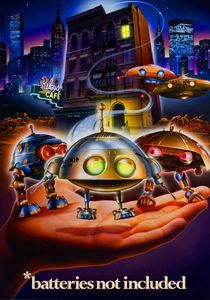
    (Second Viewing, On TV, March 2019) I must have seen *batteries not included as a teenager in the early 1990s, and remembered a strange mix between special effects work and unabashed sentimentality. As it turns out, that’s not too far away from an impression left by a second middle-aged look at the film, as the film blends then-top-notch special effects work with a script that wears its heart on its sleeve at multiple levels. The premise focuses on an old building in the middle of an area cleared for high-rise development. As you’d expect, the villains are real estate developers doing their best to force the tenants to move out. It just so happens that alien creatures then enter the picture, nesting on top of the building and helping with minor repairs and good actions throughout the building. The rest goes on from there, with no one really being surprised at how it ends. Director Matthew Robbins keeps a good balance between special effects showcases (some of them still quite effective) and more humanistic moments. The film is built on a nice unity of place, to the point where it feels off-putting when the action eventually leaves the apartment block. It’s sentimental for sure, but it’s difficult to dislike a film so optimistic—although the “baby alien” creature is pushing things. For cinephiles, what’s perhaps most remarkable about *batteries not included is the number of known names from different eras assembled for the occasion: It’s one of the last recognizable roles for veteran actor Hume Cronyn, a decent performance from his wife Jessica Tandy, a rather young Elizabeth Pena, and a screenwriting debut for Brad Bird. Predictable but not bad, *batteries not included still works as a film for the entire family.