Mel Gibson

  • Machete Kills (2013)

    Machete Kills (2013)

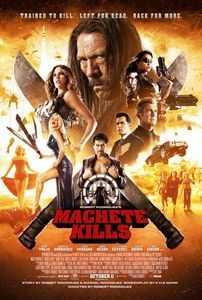
    (On Cable TV, August 2014) I’m a long-time fan of Robert Rodriguez’s films (all the way back to Desperado on VHS), but it sure looks as if he’s spent the last decade repeating himself with a long series of sequels and spin-offs.  Machete Kills is the third film to be spun off from 2007’s Grindhouse, and it suggests that the joke has been played out.  Not that the film itself is unpleasant to watch: As you may expect from its neo-grindhouse inspiration, it’s suitably over-the-top, allowing Rodriguez and his ensemble cast to have a lot of fun by sending up an assortment of action movie clichés.  Danny Trejo is compelling as usual as the titular Machete, but it’s a toss-up as to whether he’s having as much fun as Mel Gibson (as a Bond-grade villain), Charlie Sheen (as a lecherous President) or Sofia Vergara (using her shrill persona to good effect, for once).  Even Lady Gaga gets a role as a shape-shifting assassin.  The action gets silly quickly and never lets basic disbelief being an obstacle.  It’s all good fun, except that Rodriguez’s low-budget aesthetics (tight framing, cheap special effects, lazy blocking, editing that allows actors to share a scene without ever having been in the same room together) are less satisfying than one would expect… especially once they’re repeated too often.  Rodriguez can command bigger budgets than he used to at the beginning of his career –he should use that power for a few money shots.  Still, despite the over-the-top action, shameless exploitation (often going straight to comic parody) and self-aware ridiculousness, there’s a sense that Machete Kills is a bit too big for its aw-shucks attitude.  By focusing on the comedy, it even loses a bit of the edge that the first Machete had, and the focus on violence while downplaying the nudity is a step in the wrong direction.  It’s too long for its own good, and in stretching out some of its duller stretches, invites tiresomeness.  It probably doesn’t help that this is Rodriguez’s umpteenth return to the same source: For all of the chuckles and I-can’t-believe-I’m-seeing-this outrageousness, by the time the end credits roll, there’s no need for a third Machete outing.  Let’s leave well-enough alone and let’s hope that Rodriguez does something a bit fresher for his next effort.

  • Edge of Darkness (2010)

    Edge of Darkness (2010)

    (In theatres, January 2010) It’s been a long time since Mel Gibson has simply acted in a film, and his choice of vehicle for his come-back really isn’t a stretch: As a Boston cop who seeks to avenge his murdered daughter, Gibson relies on tics developed for Payback and the Lethal Weapon series, although in a far darker context.  What seems like a botched criminal revenge killing eventually develops into a conspiracy involving politicians, state secrets, eco-terrorists and professional assassins.  It doesn’t end well for anyone.  While all of the above sounds pleasantly crunchy, the result feels curiously uninvolving.  The story (adapted, updated and condensed from a mid-eighties BBC series) advances in jolts, with the political angle feeling particularly disconnected and superfluous.  Gibson himself does better as the vengeful father, his grim (and increasingly creased) face lending a bit of gravitas to the shootouts that pepper the film.  Director Martin Campbell brings a few good shocks and suspense sequences to compensate for mawkish flashbacks to the daughter-as-a-girl and an over-the-top final sequence that marks the fourth big movie in three weeks to make heavy use of pseudo-Christian mythology.  Edge of Darkness doesn’t embarrass itself, but neither does it achieve narrative velocity.  It’s a thriller for post-teenage moviegoers, but even with its grim atmosphere, it’s not even up to the equally-adapted-from-the-BBC State of Play in terms of effectiveness.

  • Lethal Weapon (1987)

    Lethal Weapon (1987)

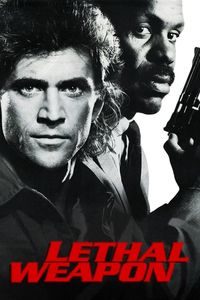
    (On TV, July 1998) A routine “buddy” cop movie that raises itself above average with the inclusion of a few action sequences (the money shot being a car doing a vertical 180o in front of a bus) and the marvelous mismatched characters personified by Danny Glover and Mel Gibson. Exemplifies a certain archetype of 80s buddy-cop action pictures: I wonder how much of the film’s then-freshness is invisible today thanks to countless imitators?

  • Lethal Weapon 4 (1998)

    Lethal Weapon 4 (1998)

    (In theaters, July 1998) Once you’ve accepted that Lethal Weapon 4 is going to be an incoherent action comedy, the movie is a blast. Sporting no less than six big-name stars (Gibson, Glover, Russo, Rock, Pesci and Li) and numerous explosions, Lethal Weapon 4 is still a pretty good follow-up to the franchise. It’s certainly one of the first 1998 releases that can be enjoyed by a wide audience without too many problems. Again, the standout sequence of the film is a fabulous car chase that resulted in applause in my theatre. Rene Russo is criminally underused, the coincidental aspects of the plot are troublesome, the emotional content of the movie is manipulative, some of the comedy falls flat and most of the drama is quickly glossed over, but Lethal Weapon 4 delivers like few blockbusters this year.

  • Lethal Weapon 2 (1989)

    Lethal Weapon 2 (1989)

    (On TV, July 1998) This sequel loses something of the initial interaction between the two lead characters, but gains fantastic villains and even better action sequences while retaining a certain dramatic edge that is nowhere to be found in latter films of the series. Series regulars may regard this one as a high point of the series, lame ending aside.