Melanie Griffith

  • Pacific Heights (1990)

    Pacific Heights (1990)

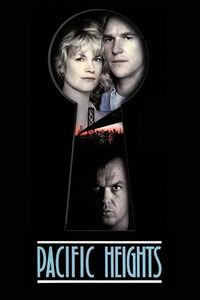
    (On TV, August 2021) As much as Pacific Heights tries to stack the deck in making us sympathize with its young couple of protagonists (they’re in love, they’re in debt, they’re expecting a baby!), I’m not sure that a thriller in which we’re meant to side with the landlords is going to find much of an audience in a twenty-first century defined by unaffordable housing. Ah well — 1990 was at the end of the ultra-capitalistic 1980s and renting was the ultimate achievement for middle-class bourgeois. Not that Pacific Heights particularly cares about the plight of the common man or even simple plausibility: not when the antagonist is a consummate conman who’s able to manipulate the laws of California to his advantage. Step one is getting the apartment; step two is doing whatever he wants, knowing that he can’t be evicted; and step three is ruining his landlord’s lives so that they either go to prison or bankrupt. (Since there are two of them, why not in prison and bankrupt?)  It’s particularly far-fetched, so it’s a good thing that the film has one lawyer character to explain the labyrinthine way in which our protagonists are trapped. It does feel like an unusually conservative film in-between glorifying yuppies, criticizing renters’ rights and justifying extreme violence from the landlords. It doesn’t help that the script is occasionally slapdash — the male lead (played by Matthew Modine) often explodes in violent confrontation in ways that could have been interesting to explore in their own right. I’m really not fond of Melanie Griffith most of the time, so having her become the protagonist of the film didn’t do it any favours. But there’s one bright spot, and that’s Michael Keaton playing the brilliant yet utterly deranged tenant who becomes the film’s deliciously cartoonish villain — Keaton plays against type here and does it really well. It’s not quite enough to make Pacific Heights a good movie, but it does take the edge of what could have been a much worse film.

  • Cherry 2000 (1987)

    Cherry 2000 (1987)

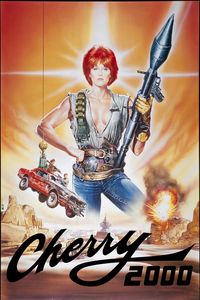
    (Second Viewing, on Cable TV, June 2020) Heyyy… I remember watching Cherry 2000 off basic TV as a teenager, and in retrospect it’s kind of amazing that a movie about a man going on a post-apocalyptic quest to repair his sex bot was playing on network TV. But, of course, this was French Canadian TV, and it’s not as if PG-13 Cherry 2000 is all that explicit in the first place. Decades later, it has settled into a quirky Science Fiction adventure, with Melanie Griffith in a strong role as a tough action heroine who inevitably becomes the love interest of the protagonist (a bland David Andrews) once he gives up on the whole refurbished-sex-bot thing. Despite ambitious worldbuilding, Cherry 2000 is clearly limited by its budget and mid-1980s special effects technology, as well as a script that wants to be subversive and satirical but is held back by its own lack of self-confidence. It’s a bit too scattered to be effective—according to the film’s production history, it was completed in 1985 but held back from release until 1988, having clearly flummoxed its marketing team. But, in retrospect, it does have a bit of oddball charm. While Cherry 2000 isn’t any kind of classic (cult or otherwise), it is kind of amusing, and still carries the genre-bending spirit of the 1980s with it.

  • RKO 281 (1999)

    RKO 281 (1999)

    (In French, On Cable TV, May 2020) It makes perfect sense that one of the most famous movies of all time would spawn its own making-of TV movie. No, not a documentary—a full scripted drama with enough good actors to make this a prestige TV event. Yes, RKO 281 is a slick dramatization not only of the making of Citizen Kane, but the subsequent thunderstorm of disapproval that came from media mogul William Randolph Hearst, who was convinced the film was an attack on him and his girlfriend Marion Davies. As someone with a fair amount of knowledge about the film and its era, I was very happy with the result, even if I knew where the story was going. Some very impressive means have been spent to come up with convincing period details, and the cast is almost pitch-perfect for their roles—Liev Schreiber as Orson Welles? John Malkovich as Herman J. Mankiewicz? James Cromwell as William Randolph Hearst? Melanie Griffith as Marion Davies? RKO 281 is one wonder after another. Sixty years after the events depicted, the film pulls no punches: Hearst is the villain, and Hedda Hopper is the henchwoman. It all culminated, as film buffs know, in the dumbfounding decision to give that year’s Best Picture Academy Award to How Green Was My Valley—although this, curiously, is not in the film considering that RKO 281 ends soon after Citizen Kane’s premiere. (Maybe RKO 281 knew that biting the hand that hands over the Oscars was not a good idea, even for a 1999 TV movie.) It’s certainly not perfect (there are anachronisms and simplifications and not enough attention paid to the artistry of Kane) but it’s a decent dramatization, even if everyone will know not to take it as a documentary. Some special editions of Citizen Kane on physical media include this film as a bonus, and it’s a good one.

  • Something Wild (1986)

    Something Wild (1986)

    (In French, On Cable TV, February 2020) Much of Something Wild feels like a film on autopilot, as long as you account for one mid-movie swerve into slightly different territory. It doesn’t take a long time for the premise to be established: here’s a straight-arrow corporate guy who gets snagged in the schemes of a flighty bohemian-type girl and—somehow—goes along with her on a road trip away from Manhattan back to her small town. Stuff happens, lessons are learned, characters revealed, cars crashed and chuckles obtained but that only takes us to the middle of the movie, as the last half gets significantly darker as the female lead’s dangerous ex-boyfriend shows up to make trouble for everyone. Jeff Daniels and Melanie Griffith are the lead couple, while Ray Liotta makes an early bid at his tough-guy screen persona with his role as the ex-boyfriend. The casting seems appropriate; Griffith, in particular, gets to play a few roles all by herself and her chameleonic character. Still, much of the fun of Something Wild is in seeing what else it has in store for the pair’s difficult trip and how they will deal with the unbelievable coincidences that keep complicating their lives. I’m not sure about the darker shift in tone toward the end, but it does feel as if it lives up to its “anything can happen” credo. Not a bad choice for fans of the lead actors or director Jonathan Demme, but there have been quite a few similar movies since then.

  • Roar (1981)

    Roar (1981)

    (In French, On Cable TV, October 2019) Oh boy, what a movie. The story of the making of Roar is amazing in itself, but even if you see the movie absolutely cold you’ll be gobsmacked at what you will be seeing: a family of actors in their own rural home, interacting with a menagerie of wild cats running all around them. If you’ve grown up (like, well, everybody) with a healthy respect and primal fear of lions, tigers and panthers, that’s amazing enough. It’s hard not to be impressed by the way the actors and the animal share physical space with seemingly no barrier or protection: Far from the usual treatment of actors sharing the screen with dangerous animals, our protagonists make full physical contact with the beasts. It’s so captivating that it does take a while to realize that the story here hangs on only by the flimsiest of threads: It’s about a family joining their father in a big cat-infested house in Africa, and learning to like the animals. (Animal psychology is arguably more important in Roar than human psychology.) The scene-by-scene plotting is disjointed at best, with very little narrative cohesion from one shot to another. The editing is choppy. It feels improvised. These impressions are not accidental when you start reading about the amazing behind-the-scenes story of Roar and how it came to be. The quick version goes like this: While shooting a film in Africa, wife-and-husband Tippi Hedren and Noel Marshall came to like big cats and decided to illegally host as many of them as they could in their remote California residence. After altering the terrain to look like Africa and bringing together as many at 71 lions, 26 tigers, 10 cougars, 9 panthers and a host of other dangerous animals (including four Canadian geese potentially being the worst of them), they started shooting a movie with the noble goal of bolstering preservation efforts for big cats in Africa. Things, however, did not go as planned: The shooting took five years, not helped along by the animals’ lack of acting cooperation. There was a catastrophic flood, ruining sets, film, equipment and the producer/director/star’s own home. The finished film went unseen in North America. They went bankrupt. Animals died, either after escaping and being shot by authorities, or through illness. Roar’s five years of shooting extended to eleven years from pre-production to the final cut. Then there’s the fact that 70 people were injured on-set (some seriously, such as daughter Melanie Griffith and then-cinematographer Jan de Bont), because (as anyone knows) humans and big cats aren’t meant to live together. Imagine the crew turnover under these conditions. Hilariously enough, the film begins by the standard “No animals were harmed during the shooting of this movie”—when the film was re-released in 2005, the tagline added, “70 Cast and crewmembers were.”  The resulting footage is frankly amazing—By the time the characters share their beds with lions and tigers, it’s hard not to be scared and envious. (While nothing bad happens in the film, it was broadcast on a horror channel and my daughter flat-out refused to watch it, showing better self-preservation instincts than any character in the film.) But it does raise the question of whether this has been worth it—it’s easy to laugh in amazement at the kind of madness that led to the existence of the film, but only because nobody died along the way. Still, it exists, and its 2005 re-release did much to remind people of the fact: in the annals of moviemaking, you’d be hard-pressed to find a more amazing making-of than the story of how Roar came to be.

  • Nobody’s Fool (1994)

    Nobody’s Fool (1994)

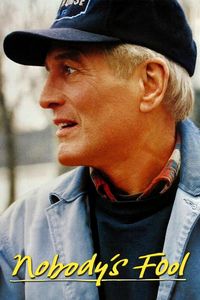
    (On Cable TV, June 2019) For an actor that was once so vital to American cinema, it’s surprising to realize after the fact that Paul Newman essentially retired in the nineties, with a total of five films during that decade: At the exception of Road to Perdition, his twenty-first century career was low-key—voice acting, TV movies, smaller roles, this kind of thing. So, it’s a bit of a surprise to discover Nobody’s Fool as one of his parting lead roles, a small-town character-driven drama focused entirely on his character. Newman’s filmography is not the only one being enhanced by Nobody’s Fool—he plays opposite a cross-generational ensemble cast that includes a prime-era Bruce Willis, one of Jessica Tandy’s last roles, as well as turns for Melanie Griffith (who hilariously flashes her breasts to Newman’s character) and Philip Seymour Hoffman (as a policeman, no less). Willis, in particular, is almost a revelation for those who have grown used to his increasingly detached screen persona—here he is playing a now-unfamiliar character—loose, funny and engaged. Still, the show belongs to Newman: In a revealing contrast to his earlier, sullen roles, the bad boy of Hud and The Prize and Cool Hand Luke has mellowed into an elderly actor playing an elderly man who has found contentment in a simple life. It does complement the small-town charm of the film, albeit one tempered by a depressing snowy atmosphere and the very down-to-earth portrait of flawed characters. There’s more nudity than you’d think from a “small-town intimate drama.”  Still, Nobody’s Fool remains a bit more interesting than expected—and not just as a lesser-known title on multiple filmographies.

  • Working Girl (1988)

    Working Girl (1988)

    (On Cable TV, January 2019) Now there’s a strong contender for the title of the most 1980s movie ever. Working Girl came at a time when Hollywood seemingly couldn’t get enough of Manhattan’s Wall Street ambience, in between Wall Street and The Secret of my Success and Baby Boom and many others released in barely a three-year span. Unlike many of those, however, Work Girl clearly has (from its title onward) a clear idea that it wants to talk about class issues in the United States, especially when the Manhattan office environment can be used to put the very poor right alongside the very rich. Director Mike Nichols approaches the topic with two ideal actresses at each pole of the story: Melanie Griffith as the heroic low-class girl whose smarts exceed those around her, and Sigourney Weaver as her high-class, low-morals opposite. The opponents having been defined, the rest is up for grabs: the job, the prestige, even the boy-toy (Harrison Ford, good but not ideal—the role is funnier than he is) will be given to the winner. Good performances abound, with some surprising names (Joan Cusack! Alec Baldwin? Oliver Platt!! Kevin Spacey as a lecherous pervert?!) along the way. Still, this is Griffith and Weaver’s show. Only one of them shows up in lingerie, though. Now, Working Girl is not a perfect film—it does use a few shortcuts on the way to a sappy romantic conclusion, and it bothered me more than it should that the characters would assign so much importance to the idea as having value—in the real world, execution is far more important, but it doesn’t dramatize so well. Still, that doesn’t take much away from Working Girl as class conflict playing out in late-1980s Manhattan. It’s not a complicated film, but it is very well crafted. (One more thing: Weaver’s character’s name had me thinking of evil Katharine Hepburn, which led me to think about how the two women looked like each other, which had me thinking about how they could have switched many roles, which had me thinking about Katharine Hepburn as Ripley in Aliens. Hollywood, if you’re listening, I know you have the CGI and lack of morals to make this happen.)

  • The Bonfire Of The Vanities (1990)

    The Bonfire Of The Vanities (1990)

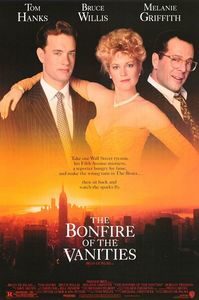
    (On DVD, October 2008) This movie was critically lambasted upon release, but if it’s not quite a success, it’s not the disaster that some reviewers have reported. As an adaptation of Tom Wolfe’s novel, it manages to hit most of the high points of the novel, and if Wolfe’s prose can’t be fully adapted to the screen, it finds an appropriate counterpart in Brian de Palma’s swooping direction and ambitious cinematography. The long continuous opening shot is a small marvel of the form, while other sporadic flourishes keep things hopping along. Things aren’t as slick regarding the script, which does an intriguing job re-casting Wolfe’s story into a satiric comedy mold, but falters in the film’s second half with a number of limp scenes that don’t advance the story as efficiently as they should. It’s too bad that the manic quality of the original is only half-finished here. The result isn’t terrible, but it certainly could have been better. The first-generation DVD, regrettably, doesn’t include any supplementary material about the film, which is a shame given that an entire book has been written about the film’s troubled production.

    (Second viewing, On Cable TV, August 2021) After enjoying TCM’s podcast adaptation/update of Julie Solomon’s The Devil’s Candy, which offers four hours of material on the making of The Bonfire of the Vanities, the mandatory next step was to watch the film itself. (Actually, I watched it between the sixth and seventh episode – the best possible timing considering that the seventh episode opens on the first public showing of the film.)  Once again, a rewatch had me protesting that the result wasn’t that bad, even enjoyable. Oh, it’s clear that as a film, The Bonfire of Vanities falls considerably short of its potential. The dark cynical humour is mishandled and neutered by a final speech that shouldn’t be in the film. It’s miscast from top to bottom – Tom Hanks is not bad in the last third of the film when he’s free to play up his comic persona, but he’s really not the right choice for playing a high-powered adulterous stockbroker. Melanie Griffith has never been much of a draw for me, so her casting as an irresistible femme fatale is wasted. Morgan Freeman’s not bad, even when saddled with the film’s most awkward dialogue. Surprisingly, I found Bruce Willis to be the most watchable, but only when he fully plays into the quasi-noir role of the crumpled journalist working hard for his bylines. (This is not, however, the character in the book.)  Visually, the film is far better than its script – The first ten minutes overpromise a film that’s not to be found later on, as a magnificent overhead shot of New York City leads to an astonishing steady-cam shot and then to the memorable image of Tom Hanks dragging his dog off to a sodden walk (and a misguided phone call that triggers everything that follows). Narratively, you have enough to keep viewers invested, but there is often a clash between the original intentions of author Tom Wolfe and the neutered execution that Brian de Palma ends up delivering. Part of it is clearly due to an attempt at mainstream filmmaking – I don’t think that major studios were ready back in 1990 to bet the bank on a highly cynical work, at least not as much as today. You can see the compromises all the way through, even as the atmosphere of a New York City divided along racial and class lines is still quite pertinent as long as you ignore the Bronx caricatures. It’s frequently (but intermittently) funny, at least enough to keep the film from being dull. I strongly suspect that The Bonfire of Vanities’ reputation partially comes from overinflated expectations considering the success of the original book, partially because entertainment pundits were (and are) always looking for a fall-from grace story from Hollywood, and partially because the gap between that the film aimed for and what it achieved is so visible. As someone who routinely watches near-unwatchable cinematic tripe made with only a fraction of The Bonfire of Vanities’ assembled talents, the circa-1990 hyperbolic pans of the film are embarrassing for those taking the potshots: The Bonfire of the Vanities is misguided, disappointing, even a case study in how even the best intentions can go wrong in such a complicated production as a Hollywood film, but there’s more than enough here to make viewers happy – even its problems can be entertaining once you get into them.