Melvyn Douglas

  • Fast Company (1938)

    (On Cable TV, October 2021) Any resemblance between the love-bickering, funny-detecting married couple at the heart of Fast Company and Nick and Norah Charles of The Thin Man series is strictly intentional: history has it that theatrical exhibitors asked MGM to deliver a series much like it in-between the long production delays between instalments. MGM obliged, and Fast Company is the first of three attempts (all featuring a different leading cast) to replicate the success of Nick and Norah. Taking on the rather interesting world of rare books, our protagonists are booksellers that moonlight as investigators for insurance companies. Things do get more urgent when murder enters the equation, and the film manages to fit an impressive amount of criminal plot, charming repartee, good character moments and evocative details along the way. Melvyn Douglas and Florence Rice are rather good in the leads, but they will inevitably have the bad luck to be compared to the incomparable William Powell and Myrna Loy. Still, as a short quick piece of entertainment, Fast Company holds its own—it’s methadone compared to the good stuff of The Thin Man series, but it does the job if you’re in the mood for something similar. Exactly as MGM first intended.
  • Theodora Goes Wild (1936)

    Theodora Goes Wild (1936)

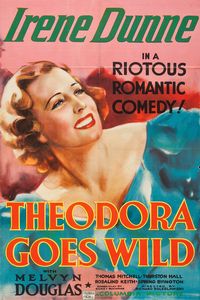
    (On Cable TV, April 2021) A slight but amusing comedy, Theodora Goes Wild introduces Irene Dunne to comedy, a field in which she’d encounter considerable success in the following years. The plot, rich in lies, half-trues and misunderstandings, has to do with a small-town Sunday School teacher who moonlights as the writer of a salacious novel that has all the town’s busybodies clutching their pearls. (There’s probably some commentary about the Hays Code in there.) The fun escalates once someone from Manhattan discovers her double identity and follows her back home to make her life difficult — especially when she has no other choice but to introduce the stranger as her gardener. The expected romance ensues, even when the action moves back to Manhattan for much of the third act. It’s all a bit silly, sometimes quite arbitrary, and Melvyn Douglas isn’t always the best as the male lead… but Dunne is quite good in an Oscar-nominated performance. If you’re looking for a better-than-average 1930s comedy with some good set-pieces and a solid lead performance, Theodora Goes Wild is a really good choice.

  • I Never Sang for My Father (1970)

    I Never Sang for My Father (1970)

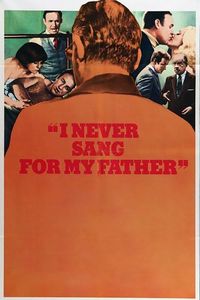
    (On Cable TV, April 2021) There’s an unescapable clash of generations at the heart of I Never Sang for My Father that can only come from a 1970 production, as the first baby-boomers were hitting 25 and New Hollywood was changing the business forever. An intriguing pairing with The Graduate, it’s a film about a young, well-educated protagonist having to deal with his conservative father and housewife mother — echoes of the 1950s that clearly don’t understand him. Gene Hackman plays the protagonist, visibly too old for the role (age 40, playing 25…) but still echoing the generational divide so apparent circa 1970. It’s all vividly illustrated by a simple but well-developed drama in which the character is torn between what he wants to do (that is: move across the country to be with his girlfriend) and what one would expect him to do (stay with his widowed father even in declining health). The two men clash, argue, clearly don’t understand each other and the ending is not exactly comforting. But as far as dramas go, I Never Sang for My Father does have more punch than usual. The younger Hackman is good but Melvyn Douglas is arguably better as the abrasive father who’s not interested in getting closer to his son — both of them earned their Academy-Award nominations here. No character here is virtuous or admirable (never mind the close-minded, abusive father—the protagonist juggles two girlfriends and the film doesn’t seem all that bothered by it) and the conclusion is similarly bittersweet. I Never Sang for My Father is not a big or uplifting film, but it works well enough and draws viewers in small doses before they’re hooked for the rest.

  • Mr. Blandings Builds His Dream House (1948)

    Mr. Blandings Builds His Dream House (1948)

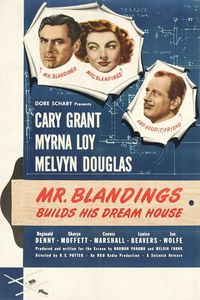
    (On Cable TV, August 2020) Some experiences transcend time and space, and so the premise described by Mr. Blandings Builds His Dream House carries through the decades all the way to now. While I haven’t had the experience of contracting the building of a new house, I have enough experience with major renovations to sympathize with the lead character as he engineers his family’s move from a cramped Manhattan apartment to a Connecticut country estate… which has to be torn down and built anew. Cary Grant is perfect for the demands of the role: he can go from patrician to bewildered in the same scene, not to mention a climactic scene of righteous indignation at the accumulated costs of his new house. Numerous comic sketches pepper the rather simple narrative – obviously, this is a film meant to put one comic set-piece after another, and gradually crank the pressure on the protagonist until he cracks. Grant does get a few capable actors to play with: Myrna Loy makes for a very reasonable wife (except for her flower sink, whatever that is), while Melvyn Douglas brings the snark into the movie as a sarcastic friend/lawyer trying to keep the protagonist out of trouble, only to fall into the same madness from time to time. The picture of dealing with contractors is still hilariously accurate, although a jealousy subplot seems to fit badly. While the film is a comic success, modern audiences may find less to laugh about in a few scenes: There’s a tone-deaf breakfast table discussion in which the children talk about their progressive ideals, for instance… while a black maid works behind them. Later on, that same black maid provides a creative spark that the lead character desperately needs to keep his new house – and while the film acknowledges her contribution by giving her a whole ten-dollar raise, it does leave a less-than-ideal impression. Oh well – this is a film from the late 1940s, after all. Mr. Blandings Builds His Dream House is about as funny as its titles suggest – it got quite a few honest laughs from me, and not all of the film’s success can be attributed to Grant as the headliner.

  • Ninotchka (1939)

    Ninotchka (1939)

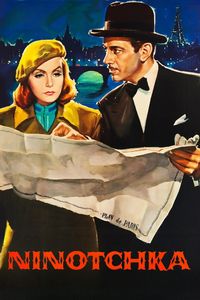
    (On Cable TV, February 2020) As unfair as it can be to judge a film by its remake, I do like Ninotchka quite a bit, but not as much as its musical remake Silk Stockings. Of course, there’s the star factor to consider: While Ninotchka has an impressive pairing with Melvyn Douglas and Greta Garbo, Silk Stockings has Fred Astaire and Cyd Charisse—a most unfair comparison. Silk Stockings has finger-snapping tunes, while Ninotchka is a straight-up comedy. It’s really too bad for Ninotchka that Silk Stockings happens to be one of the most successful musical remakes in a subgenre littered with inferior results. Still—Ninotchka, what about it? It’s a story about three bumbling Soviet men coming to Paris to get back a piece of artwork, but being seduced by the hedonistic French lifestyle… which leads the Soviet government to send a hard-as-nail operative to clean up the mess. A perfect plan, except when she, too, falls under the charm of a Frenchman. The lead pair in nigh perfect: Melvyn Douglas approaches William Powell’s levels of pure suave charm, while Greta Garbo is a legend for a good reason. Ninotchka is one of the few comedies she’s even made (the tagline for the film was the fondly remembered “Garbo Laughs!”) and the film cleverly uses her persona as a façade against which Douglas’s charming powers crash time and time again. The bumbling Soviet emissaries are a lot of fun in the way they succumb to the pressures of Paris, but the highlight here is the interplay between Douglas and Garbo. The pro-Western jabs and Soviet rigidity are somewhat prescient of the Cold War, and do help the film feel more modern than its 1939 production date. Director Ernst Lubitsch turns in another success here, although perhaps a bit less impressive than some of his other features. Occluding unfair comparisons with its remake, Ninotchka remains a decent-enough romantic comedy, with sly one-liners and some good flirting dialogue.

  • That Uncertain Feeling (1941)

    That Uncertain Feeling (1941)

    (On Cable TV, March 2019) I don’t think today’s audiences can quite approach Ernst Lubitsch comedies with the same thrill as they did upon release: Social attitudes are not what they were, and the impish sense of the perverse that powers his comedies has often been outpaced by progressivism. But Lubitsch wasn’t just there to shock for comic value: the execution of his films was based on a solid sense of sophistication that, frankly, has rarely been equalled since. That Uncertain Feeling, for instance, takes on a comedy of remarriage as its topic, casually bandying around a divorce as if it was no big deal for a woman to leave her husband for an eccentric new man. It’s all sophisticated like many comedies of the time were, set within the upper-class Manhattan set with more romantic comic worries than money problems. Built on witty dialogue, much of the humour comes from characters acting unusually calmly to stressful situations … although That Uncertain Feeling’s biggest laughs come from having them revert to type and punch someone who aggravates them. The character work isn’t bad either—while Merle Oberon is splendid as the wayward wife and Melvyn Douglas does some great seething, Burgess Meredith is a highlight as a pianist who becomes the object of the female lead’s attention, causing chaos with gnomic utterances, misplaced dislikes, odd anxieties and a complete lack of care. It ends as we may expect, with a remarriage—both because the pretender is hopeless, but more importantly because (and here’s the heartfelt awww underpinning the comedy) our two leads never stopped loving one another. That Uncertain Feeling leaves a clear impression even in modern reviewers: it has aged quite well (perhaps helped along by a freer attitude toward divorce) and while it may not be Lubitsch’s best, it’s sufficiently clever and witty to remain interesting … and funny.