Michael Apted

  • Agatha (1979)

    (On Cable TV, October 2022) As a number of commentators have noted, the mystery of Agatha Christie’s eleven-day disappearance isn’t much of a mystery. After being told of her philandering husband’s intention to divorce her, she (to use a technical term) freaked out, crashed her car as a possible suicide attempt, found refuge at a hotel designed for relaxation, lived as someone else for a few days, mulled over her marriage and, when she was inevitably discovered, was so embarrassed by the whole thing that she pretexted a convenient bout of amnesia. While unusual, this sequence of events is not that extraordinary for a woman with her means and social standing. What ludicrous thriller Agatha does, however, is not merely tell that story—it imagines Christie (Vanessa Redgrave, quite good) plotting revenge to kill her husband’s lover, investigating the hotel’s electrical equipment and hydrotherapy tools to concoct a perfect murder. Fortunately, there’s an American (Dustin Hoffman?!?) to tempt her with an affair of her own and prevent her from going from writer to murderess. The historical re-creation is convincing and Redgrave makes for a dignified Christie, but I’m tempted to side with the Christie estate when they claim that the film was character assassination. I’m really not sure about what Hoffman is doing there, either for him as an actor or his character in general. In rushing to make Christie a would-be murderess, director Michael Apted seems unable to capture a more subtle story of betrayal and defiance—I’m almost certain that a modern take, possibly from a female writer and director, would have been far more interesting without necessarily cranking the dial all the way up to genre thriller. I mean: there’s enough of a story there to tell without inventing things out of pure pulp speculation.
  • Unlocked (2017)

    (In French, On TV, September 2022) If you have seen Unlocked and forgot about it, don’t be too hard on yourself—in many, many, manyyy ways, it’s a variation on an incredibly familiar kind of thriller: a middling, murky London-set espionage caper featuring a heroine betrayed by friends and institutions. (See also: Milla Jovovich in Survivor, etc.)  Here, it’s Noomi Rapace (working steadily since her Millennium breakthrough roles, but somehow never becoming the A-lister she was often presented to be) as a disgraced agent who accidentally discovers a dangerous secret, and ends up hunted by friends and foes. It’s serviceable without being actually any good—while this was director Michael Apted’s last movie before his death in 2021, it’s not much of a closing statement. Apted’s name probably explains why such known names as Michael Douglas, John Malkovich, Toni Collette and Orlando Bloom fill out the cast—but his handling of B-grade thriller material is merely competent. Unlocked’s biggest problem remains the script, which regurgitates a parade line of clichés without much gusto—there’s a sense that whatever energy the film has is provided by the actors chewing into their roles. Thank goodness for John Malkovich hamming things up in his line delivery; otherwise the entire film would have been a much duller affair. The other highlights (Rapace shooting her way out of a hotel room where she’s supposed to be killed; Colette handling a machine gun) are slight, few and should have been in a much better film. Given all this, Unlocked amounts to a disappointing, and yet very familiar film—a B-grade thriller the likes of which you can watch while doing something else and not miss a single plot beat.

  • Thunderheart (1992)

    Thunderheart (1992)

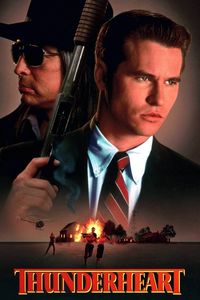
    (In French, On Cable TV, January 2020) On the one hand, there’s something admirable in seeing Thunderheart tackle the deplorable state of native reserves in the United States by setting a murder mystery within its borders. Our way into this setting is done through the dispatch of an FBI agent of mixed ethnicity (Val Kilmer, who is also of mixed ethnicity) but no cultural affiliation to native causes. As he gradually investigates the murder, he also gains an appreciation for his own origins. Standard Hollywood character development, but handled well, especially within the context of an unvarnished depiction of reserve living in the early 1990s—not that things have changed very much since then. Director Michael Apted makes effective use of helicopter-mounted cameras to give a good sense of space, action and the neighbouring landscapes—an essential when setting a film in the Badlands. While Kilmer ably headlines, the highlight here is once again Graham Greene as a local agent. Still, this could have been a better film: Thunderheart remains very much the story of a non-native protagonist exploring “the other,” and not a story told from within the native community. As revelatory as it could be in the early 1990s, it does feel limited today at a time when movies increasingly reflect diverse voices from their own perspectives. I liked it, but I can see how we’ve gone a bit beyond that.